Home
Department Of Physics text logo
  • Research
    • Our research
    • Our research groups
    • Our research in action
    • Research funding support
    • Summer internships for undergraduates
  • Study
    • Undergraduates
    • Postgraduates
  • Engage
    • For young people
    • For teachers
    • For the public
    • For alumni
    • For business
  • Support
Menu
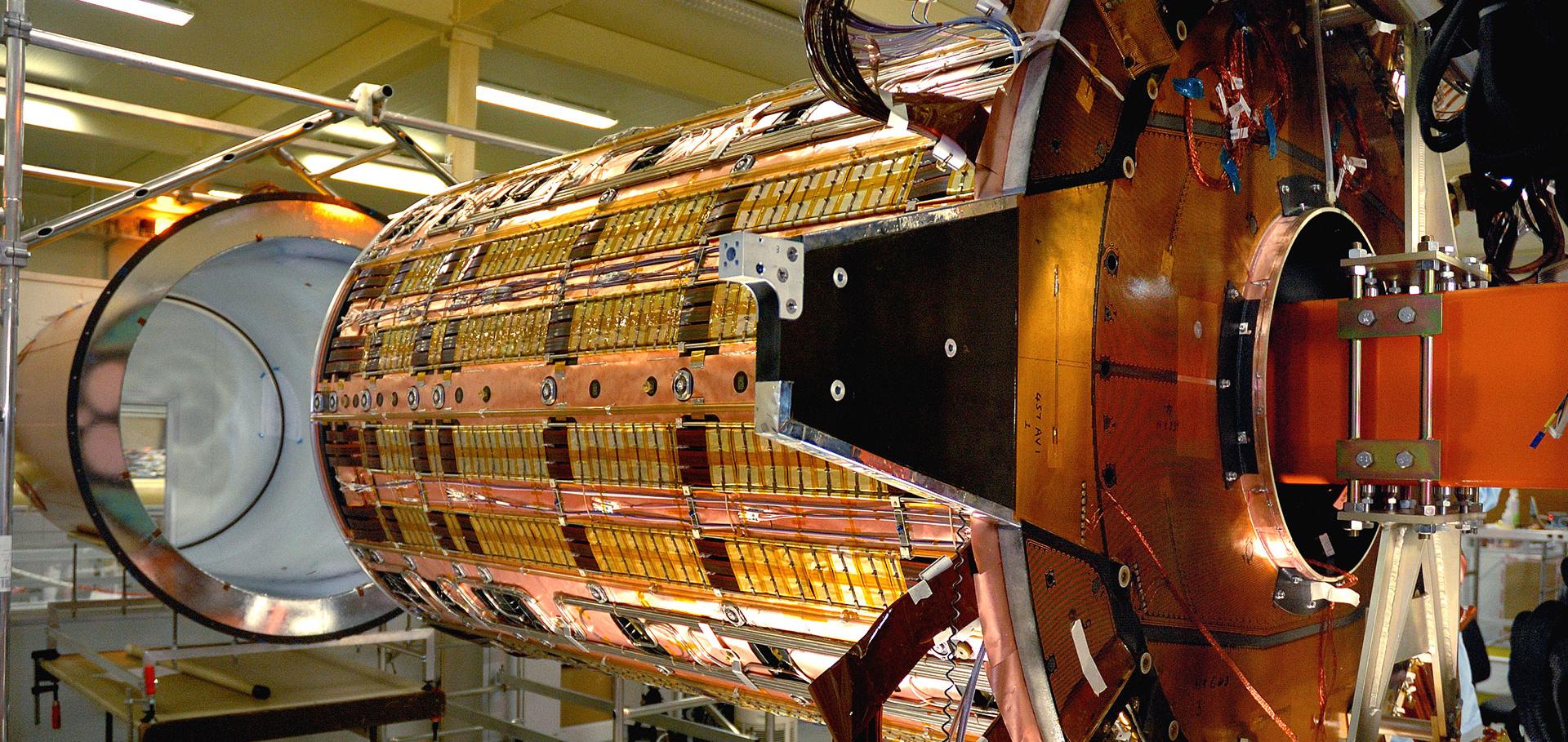
Insertion of STC into TRT at the Department of Physics, Oxford
Credit: CERN

Professor Daniela Bortoletto

Professor and Head of Particle Physics

Research theme

  • Instrumentation
  • Fundamental particles and interactions

Sub department

  • Particle Physics

Research groups

  • AION/Magis
  • ATLAS
  • Future Colliders
  • Mu3e
  • OPMD
daniela.bortoletto@physics.ox.ac.uk
Telephone: 01865 (2)73635
Denys Wilkinson Building, room 608c1
  • About
  • Students
  • Research
  • Teaching
  • Publications

Erratum to: Observation of four-top-quark production in the multilepton final state with the ATLAS detector

European Physical Journal C Springer Nature 84:2 (2024) 156
More details from the publisher
More details

Search for pair production of squarks or gluinos decaying via sleptons or weak bosons in final states with two same-sign or three leptons with the ATLAS detector

Journal of High Energy Physics Springer 2024:2 (2024) 107

Authors:

G Aad, B Abbott, K Abeling, NJ Abicht, SH Abidi, A Aboulhorma, H Abramowicz, H Abreu, Y Abulaiti, AC Abusleme Hoffman, BS Acharya, C Adam Bourdarios, L Adamczyk, L Adamek, SV Addepalli, MJ Addison, J Adelman, A Adiguzel, T Adye, AA Affolder, Y Afik, MN Agaras, J Agarwala, A Aggarwal

Abstract:

A search for pair production of squarks or gluinos decaying via sleptons or weak bosons is reported. The search targets a final state with exactly two leptons with same-sign electric charge or at least three leptons without any charge requirement. The analysed data set corresponds to an integrated luminosity of 139 fb−1 of proton-proton collisions collected at a centre-of-mass energy of 13 TeV with the ATLAS detector at the LHC. Multiple signal regions are defined, targeting several SUSY simplified models yielding the desired final states. A single control region is used to constrain the normalisation of the WZ + jets background. No significant excess of events over the Standard Model expectation is observed. The results are interpreted in the context of several supersymmetric models featuring R-parity conservation or R-parity violation, yielding exclusion limits surpassing those from previous searches. In models considering gluino (squark) pair production, gluino (squark) masses up to 2.2 (1.7) TeV are excluded at 95% confidence level.
More details from the publisher
Details from ORA
More details

Search for top-philic heavy resonances in pp collisions at s=13 TeV with the ATLAS detector

European Physical Journal C Springer Nature 84:2 (2024) 157
More details from the publisher
More details

A statistical combination of ATLAS Run 2 searches for charginos and neutralinos at the LHC

ArXiv 2402.08347 (2024)
Details from ArXiV

Combination of measurements of the top quark mass from data collected by the ATLAS and CMS experiments at $\sqrt{s}$ = 7 and 8 TeV

ArXiv 2402.08713 (2024)

Authors:

CMS Collaboration, ATLAS Collaboration
Details from ArXiV

Pagination

  • First page First
  • Previous page Prev
  • …
  • Page 114
  • Page 115
  • Page 116
  • Page 117
  • Current page 118
  • Page 119
  • Page 120
  • Page 121
  • Page 122
  • …
  • Next page Next
  • Last page Last

Footer Menu

  • Contact us
  • Giving to the Dept of Physics
  • Work with us
  • Media

User account menu

  • Log in

Follow us

FIND US

Clarendon Laboratory,

Parks Road,

Oxford,

OX1 3PU

CONTACT US

Tel: +44(0)1865272200

University of Oxfrod logo Department Of Physics text logo
IOP Juno Champion logo Athena Swan Silver Award logo

© University of Oxford - Department of Physics

Cookies | Privacy policy | Accessibility statement

Built by: Versantus

  • Home
  • Research
  • Study
  • Engage
  • Our people
  • News & Comment
  • Events
  • Our facilities & services
  • About us
  • Giving to Physics
  • Current students
  • Staff intranet