Home
Department Of Physics text logo
  • Research
    • Our research
    • Our research groups
    • Our research in action
    • Research funding support
    • Summer internships for undergraduates
  • Study
    • Undergraduates
    • Postgraduates
  • Engage
    • For young people
    • For teachers
    • For the public
    • For alumni
    • For business
  • Support
Menu
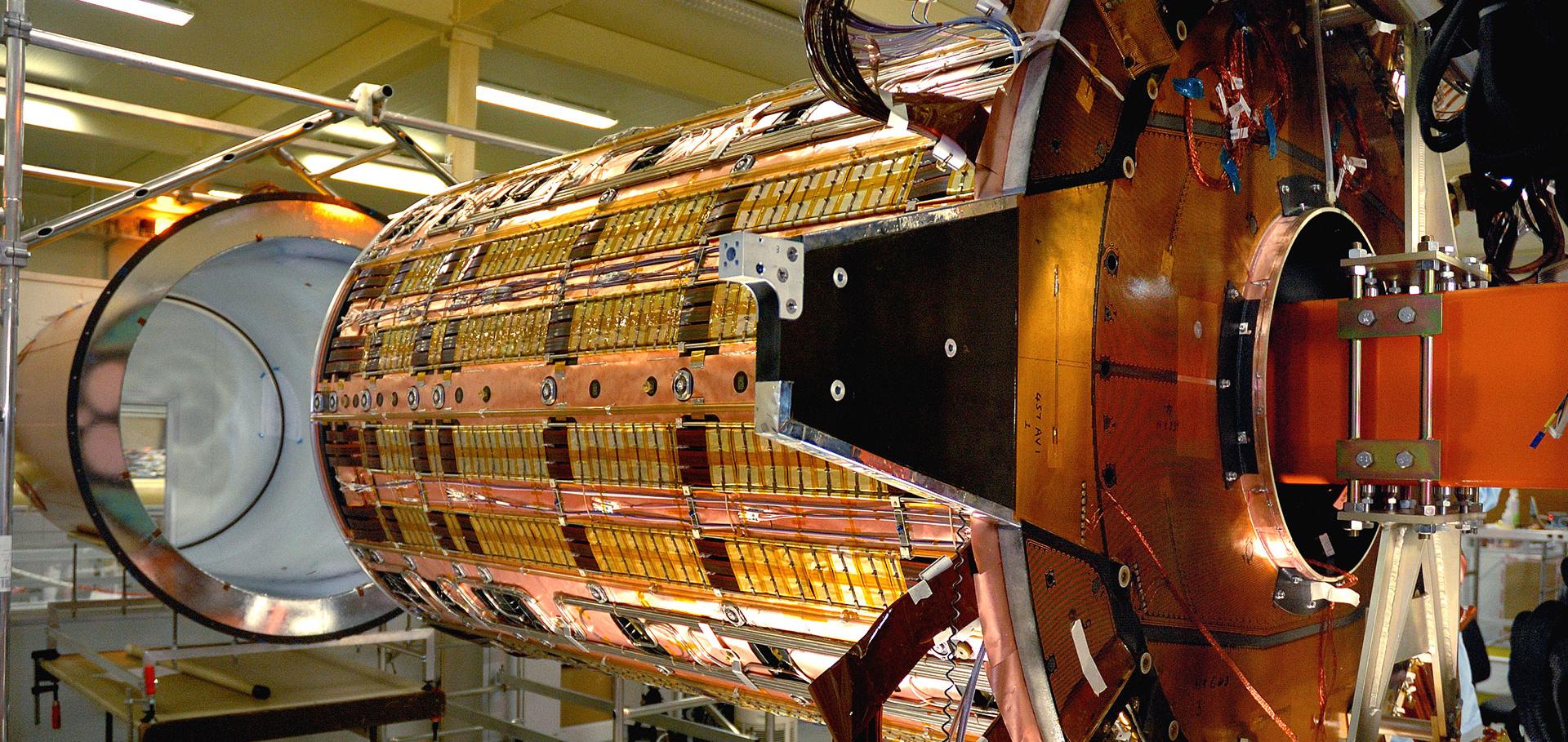
Insertion of STC into TRT at the Department of Physics, Oxford
Credit: CERN

Professor Daniela Bortoletto

Professor and Head of Particle Physics

Research theme

  • Instrumentation
  • Fundamental particles and interactions

Sub department

  • Particle Physics

Research groups

  • AION/Magis
  • ATLAS
  • Future Colliders
  • Mu3e
  • OPMD
daniela.bortoletto@physics.ox.ac.uk
Telephone: 01865 (2)73635
Denys Wilkinson Building, room 608c1
  • About
  • Students
  • Research
  • Teaching
  • Publications

Combination of inclusive top-quark pair production cross-section measurements using ATLAS and CMS data at $\sqrt{s}= 7$ and 8 TeV

ArXiv 2205.1383 (2022)

Authors:

ATLAS, CMS Collaborations
Details from ArXiV

Low Gain Avalanche Detector development for the LHC’s High-Luminosity Upgrade at Teledyne e2v

Nuclear Instruments and Methods in Physics Research Section A: Accelerators, Spectrometers, Detectors and Associated Equipment Elsevier 1037 (2022) 166876

Authors:

Philip Patrick Allport, Daniela Bortoletto, Martin Gazi, Laura Gonella, Daniel Hynds, Douglas Jordan, Ioannis Kopsalis, Steve McMahon, Jonathan Mulvey, Richard Plackett, Konstantin Stefanov, Enrico Giulio Villani

Abstract:

The need for ultra-fast timing is a result of the expected pile-up at the High-Luminosity LHC General-Purpose Detectors. Track timing resolution of the order of tens of picoseconds is required to sufficiently resolve individual vertices. In collaboration with Teledyne e2v, 22 six-inch wafers with Low Gain Avalanche Detectors, featuring a 50 μm thick high-resistivity epitaxial layer and different gain layer implants, have been completed successfully. Using transient current technique, the charge gain of a 1 × 1 mm 2 LGAD device from one of the wafers was found to be higher than 10, with jitter reaching 10 ps when biased at 240 V. Tests with other wafers are under way.
More details from the publisher
Details from ORA
More details

Determination of the parton distribution functions of the proton using diverse ATLAS data from pp collisions at root √s =7, 8 and 13 TeV

European Physical Journal C Springer Nature 82:5 (2022) 438

Authors:

G Aad, B Abbott, Dc Abbott, A Abed Abud, K Abeling, Dk Abhayasinghe, Sh Abidi, A Aboulhorma, H Abramowicz, H Abreu, Y Abulaiti, Ac Abusleme Hoffman, Bs Acharya, B Achkar, L Adam, C Adam Bourdarios, L Adamczyk, L Adamek, Sv Addepalli, J Adelman, A Adiguzel, S Adorni, T Adye, Aa Affolder, Y Afik, C Agapopoulou, Mn Agaras, J Agarwala, A Aggarwal, C Agheorghiesei, Ja Aguilar-Saavedra, A Ahmad, F Ahmadov, Ws Ahmed, X Ai, G Aielli, I Aizenberg, M Akbiyik, Tpa Akesson, Av Akimov, K Al Khoury, Gl Alberghi, J Albert, P Albicocco, Mj Alconada Verzini, S Alderweireldt, M Aleksa, In Aleksandrov, C Alexa, T Alexopoulos

Abstract:

This paper presents an analysis at next-to-next-to-leading order in the theory of quantum chromodynamics for the determination of a new set of proton parton distribution functions using diverse measurements in pp collisions at √s =7, 8 and 13 TeV, performed by the ATLAS experiment at the Large Hadron Collider, together with deep inelastic scattering data from ep collisions at the HERA collider. The ATLAS data sets considered are differential cross-section measurements of inclusive W± and Z/ γ∗ boson production, W± and Z boson production in association with jets, tt¯ production, inclusive jet production and direct photon production. In the analysis, particular attention is paid to the correlation of systematic uncertainties within and between the various ATLAS data sets and to the impact of model, theoretical and parameterisation uncertainties. The resulting set of parton distribution functions is called ATLASpdf21.
More details from the publisher
Details from ORA
More details

Search for heavy, long-lived, charged particles with large ionisation energy loss in $pp$ collisions at $\sqrt{s} = 13~\text{TeV}$ using the ATLAS experiment and the full Run 2 dataset

ArXiv 2205.06013 (2022)
Details from ArXiV

Constraints on Higgs boson production with large transverse momentum using H→bb¯ decays in the ATLAS detector

Physical Review D American Physical Society (APS) 105:9 (2022) 92003

Authors:

G Aad, B Abbott, Dc Abbott, A Abed Abud, K Abeling, Dk Abhayasinghe, Sh Abidi, A Aboulhorma, H Abramowicz, H Abreu, Y Abulaiti, Ac Abusleme Hoffman, Bs Acharya, B Achkar, L Adam, C Adam Bourdarios, L Adamczyk, L Adamek, Sv Addepalli, J Adelman, A Adiguzel, S Adorni, T Adye, Aa Affolder, C Agapopoulou
More details from the publisher
Details from ORA
More details

Pagination

  • First page First
  • Previous page Prev
  • …
  • Page 191
  • Page 192
  • Page 193
  • Page 194
  • Current page 195
  • Page 196
  • Page 197
  • Page 198
  • Page 199
  • …
  • Next page Next
  • Last page Last

Footer Menu

  • Contact us
  • Giving to the Dept of Physics
  • Work with us
  • Media

User account menu

  • Log in

Follow us

FIND US

Clarendon Laboratory,

Parks Road,

Oxford,

OX1 3PU

CONTACT US

Tel: +44(0)1865272200

University of Oxfrod logo Department Of Physics text logo
IOP Juno Champion logo Athena Swan Silver Award logo

© University of Oxford - Department of Physics

Cookies | Privacy policy | Accessibility statement

Built by: Versantus

  • Home
  • Research
  • Study
  • Engage
  • Our people
  • News & Comment
  • Events
  • Our facilities & services
  • About us
  • Giving to Physics
  • Current students
  • Staff intranet