Home
Department Of Physics text logo
  • Research
    • Our research
    • Our research groups
    • Our research in action
    • Research funding support
    • Summer internships for undergraduates
  • Study
    • Undergraduates
    • Postgraduates
  • Engage
    • For young people
    • For teachers
    • For the public
    • For alumni
    • For business
  • Support
Menu
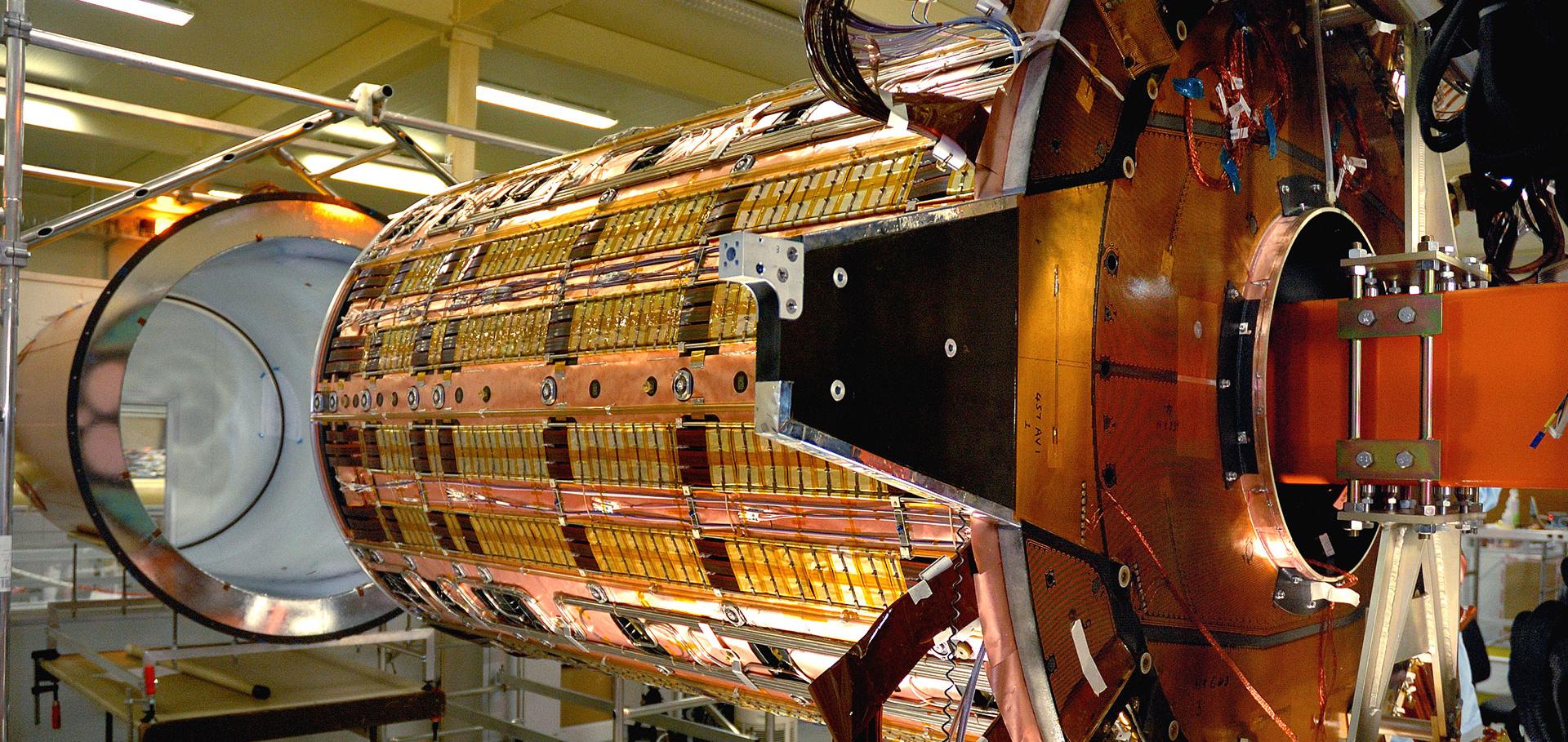
Insertion of STC into TRT at the Department of Physics, Oxford
Credit: CERN

Professor Daniela Bortoletto

Professor and Head of Particle Physics

Research theme

  • Instrumentation
  • Fundamental particles and interactions

Sub department

  • Particle Physics

Research groups

  • AION/Magis
  • ATLAS
  • Future Colliders
  • Mu3e
  • OPMD
daniela.bortoletto@physics.ox.ac.uk
Telephone: 01865 (2)73635
Denys Wilkinson Building, room 608c1
  • About
  • Students
  • Research
  • Teaching
  • Publications

Measurement of B(t->Wb)/B(t->Wq) at the Collider Detector at Fermilab

ArXiv hep-ex/0505091 (2005)

Authors:

CDF Collaboration, D Acosta
Details from ArXiV

Evidence for the exclusive decay Bc+- to J/psi pi+- and measurement of the mass of the Bc meson

ArXiv hep-ex/0505076 (2005)

Authors:

CDF Collaboration, A Abulencia
Details from ArXiV

Study of Jet Shapes in Inclusive Jet Production in ppbar Collisions at sqrt{s} = 1.96 TeV

ArXiv hep-ex/0505013 (2005)

Authors:

CDF Collaboration, D Acosta
Details from ArXiV

Measurement of charged-particle multiplicities in gluon and quark jets in pp̄ collisions at √s = 1:8 TeV

Physical Review Letters 94:17 (2005)

Authors:

D Acosta, T Affolder, MG Albrow, D Ambrose, D Amidei, K Anikeev, J Antos, G Apollinari, T Arisawa, A Artikov, W Ashmanskas, F Azfar, P Azzi-Bacchetta, N Bacchetta, H Bachacou, W Badgett, A Barbaro-Galtieri, VE Barnes, BA Barnett, S Baroiant, M Barone, G Bauer, F Bedeschi, S Behari, S Belforte, WH Bell, G Bellettini, J Bellinger, D Benjamin, A Beretvas, A Bhatti, M Binkley, D Bisello, M Bishai, RE Blair, C Blocker, K Bloom, B Blumenfeld, A Bocci, A Bodek, G Bolla, A Bolshov, D Bortoletto, J Boudreau, C Bromberg, E Brubaker, J Budagov, HS Budd, K Burkett, G Busetto, KL Byrum, S Cabrera, M Campbell, W Carithers, D Carlsmith, A Castro, D Cauz, A Cerri, L Cerrito, J Chapman, C Chen, YC Chen, M Chertok, G Chiarelli, G Chlachidze, F Chlebana, ML Chu, JY Chung, WH Chung, YS Chung, CI Ciobanu, AG Clark, M Coca, A Connolly, M Convery, J Conway, M Cordelli, J Cranshaw, R Culbertson, D Dagenhart, S D'Auria, P de Barbaro, S de Cecco, S Dell'Agnello, M Dell'Orso, S Demers, L Demortier, M Deninno, D de Pedis, PF Derwent, C Dionisi, JR Dittmann, A Dominguez, S Donati, M D'Onofrio, T Dorigo, N Eddy, R Erbacher, D Errede, S Errede

Abstract:

We report the first largely model independent measurement of charged particle multiplicities in quark and gluon jets, Nq and Ng, produced at the Fermilab Tevatron in pp collisions with a center-of-mass energy of 1.8 TeV and recorded by the Collider Detector at Fermilab. The measurements are made for jets with average energies of 41 and 53 GeV by counting charged particle tracks in cones with opening angles of θc = 0:28, 0.36, and 0.47 rad around the jet axis. The corresponding jet hardness Q = Ejetθc varies in the range from 12 to 25 GeV. At Q = 19:2 GeV, the ratio of multiplicities r = Ng=Nq is found to be 1:64 ± 0:17, where statistical and systematic uncertainties are added in quadrature. The results are in agreement with resummed perturbative QCD calculations.
More details from the publisher
More details
More details

Measurements of bottom-antibottom azimuthal production correlations in proton-antiproton collisions at s=1.8TeV

Physical Review D Particles Fields Gravitation and Cosmology 71:9 (2005) 1-39

Authors:

D Acosta, T Affolder, MG Albrow, D Ambrose, D Amidei, K Anikeev, J Antos, G Apollinari, T Arisawa, A Artikov, W Ashmanskas, F Azfar, P Azzi-Bacchetta, N Bacchetta, H Bachacou, W Badgett, A Barbaro-Galtieri, VE Barnes, BA Barnett, S Baroiant, M Barone, G Bauer, F Bedeschi, S Behari, S Belforte, WH Bell, G Bellettini, J Bellinger, D Benjamin, A Beretvas, A Bhatti, M Binkley, D Bisello, M Bishai, RE Blair, C Blocker, K Bloom, B Blumenfeld, A Bocci, A Bodek, G Bolla, A Bolshov, D Bortoletto, J Boudreau, C Bromberg, E Brubaker, J Budagov, HS Budd, K Burkett, G Busetto, KL Byrum, S Cabrera, M Campbell, W Carithers, D Carlsmith, A Castro, D Cauz, A Cerri, L Cerrito, J Chapman, C Chen, YC Chen, M Chertok, G Chiarelli, G Chlachidze, F Chlebana, ML Chu, JY Chung, WH Chung, YS Chung, CI Ciobanu, AG Clark, M Coca, A Connolly, M Convery, J Conway, M Cordelli, J Cranshaw, R Culbertson, D Dagenhart, S D'Auria, P De Barbaro, S De Cecco, S Dell'Agnello, M Dell'Orso, S Demers, L Demortier, M Deninno, D De Pedis, PF Derwent, C Dionisi, JR Dittmann, A Dominguez, S Donati, M D'Onofrio, T Dorigo, N Eddy, R Erbacher, D Errede, S Errede

Abstract:

We have measured the azimuthal angular correlation of bb̄ production, using 86.5pb-1 of data collected by Collider Detector at Fermilab (CDF) in pp̄ collisions at s=1.8TeV during 1994-1995. In high-energy pp̄ collisions, such as at the Tevatron, bb̄ production can be schematically categorized into three mechanisms. The leading-order (LO) process is "flavor creation," where both b and b̄ quarks substantially participate in the hard scattering and result in a distinct back-to-back signal in final state. The "flavor excitation" and the "gluon splitting" processes, which appear at next-leading-order (NLO), are known to make a comparable contribution to total bb̄ cross section, while providing very different opening angle distributions from the LO process. An azimuthal opening angle between bottom and antibottom, Δ, has been used for the correlation measurement to probe the interaction creating bb̄ pairs. The Δ distribution has been obtained from two different methods. One method measures the Δ between bottom hadrons using events with two reconstructed secondary vertex tags. The other method uses bb̄→(J/ ψX)(X′) events, where the charged lepton () is an electron (e) or a muon (μ), to measure Δ between bottom quarks. The bb̄ purity is determined as a function of Δ by fitting the decay length of the J/ψ and the impact parameter of the. Both methods quantify the contribution from higher-order production mechanisms by the fraction of the bb̄ pairs produced in the same azimuthal hemisphere, ftoward. The measured ftoward values are consistent with both parton shower Monte Carlo and NLO QCD predictions. © 2005 The American Physical Society.
More details from the publisher
More details

Pagination

  • First page First
  • Previous page Prev
  • …
  • Page 822
  • Page 823
  • Page 824
  • Page 825
  • Current page 826
  • Page 827
  • Page 828
  • Page 829
  • Page 830
  • …
  • Next page Next
  • Last page Last

Footer Menu

  • Contact us
  • Giving to the Dept of Physics
  • Work with us
  • Media

User account menu

  • Log in

Follow us

FIND US

Clarendon Laboratory,

Parks Road,

Oxford,

OX1 3PU

CONTACT US

Tel: +44(0)1865272200

University of Oxfrod logo Department Of Physics text logo
IOP Juno Champion logo Athena Swan Silver Award logo

© University of Oxford - Department of Physics

Cookies | Privacy policy | Accessibility statement

Built by: Versantus

  • Home
  • Research
  • Study
  • Engage
  • Our people
  • News & Comment
  • Events
  • Our facilities & services
  • About us
  • Giving to Physics
  • Current students
  • Staff intranet