Home
Department Of Physics text logo
  • Research
    • Our research
    • Our research groups
    • Our research in action
    • Research funding support
    • Summer internships for undergraduates
  • Study
    • Undergraduates
    • Postgraduates
  • Engage
    • For young people
    • For teachers
    • For the public
    • For alumni
    • For business
  • Support
Menu
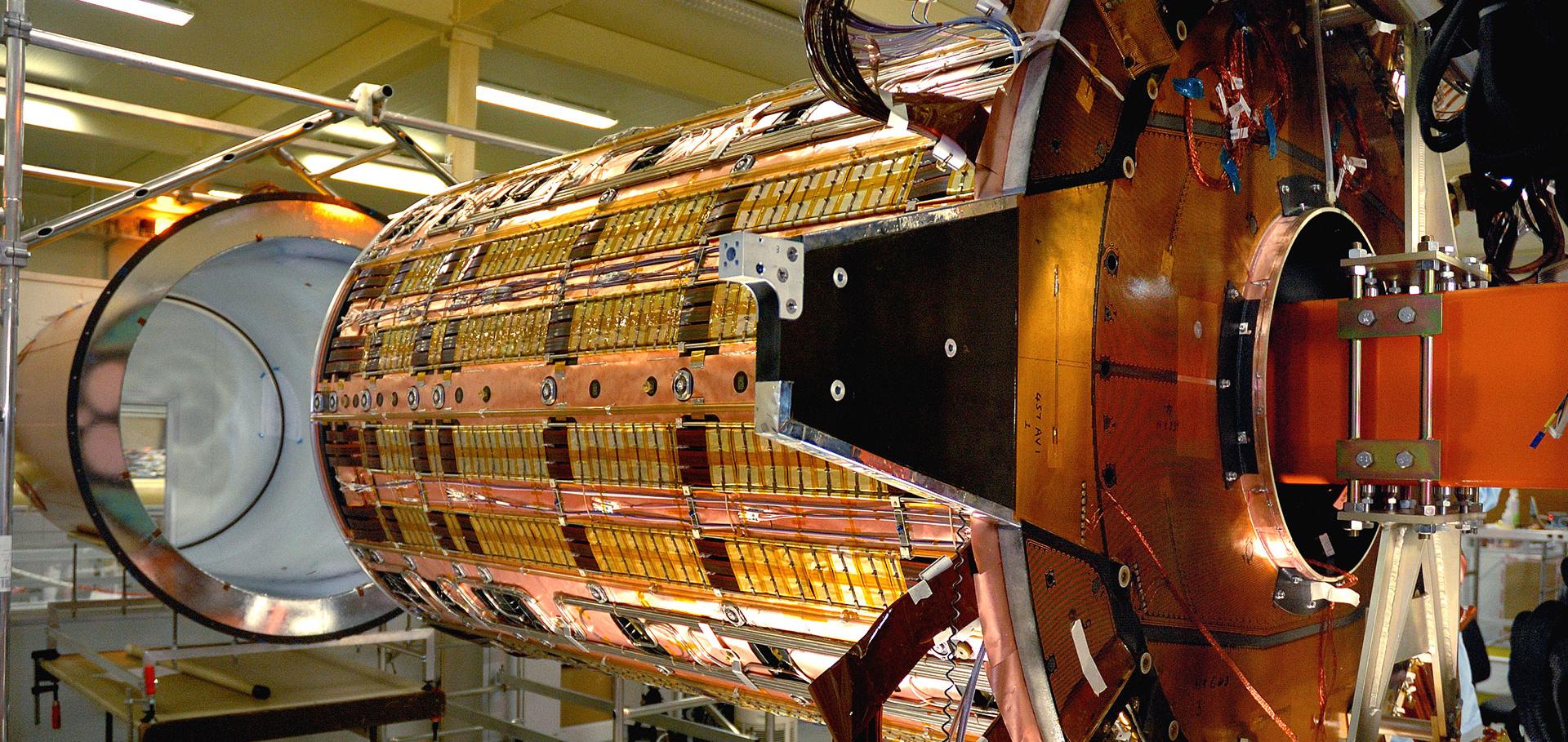
Insertion of STC into TRT at the Department of Physics, Oxford
Credit: CERN

Professor Daniela Bortoletto

Professor and Head of Particle Physics

Research theme

  • Instrumentation
  • Fundamental particles and interactions

Sub department

  • Particle Physics

Research groups

  • AION/Magis
  • ATLAS
  • Future Colliders
  • Mu3e
  • OPMD
daniela.bortoletto@physics.ox.ac.uk
Telephone: 01865 (2)73635
Denys Wilkinson Building, room 608c1
  • About
  • Students
  • Research
  • Teaching
  • Publications

B Physics at Hadron Colliders

ArXiv hep-ex/0212022 (2002)

Abstract:

Hadron colliders have played, and will continue to play, a crucial role in the understanding of CP violation. Their impact is expected to be especially important in the study of CP asymmetries in rare decays and the $B_s$ meson. The experimental challenge and reach of current and future experiments is discussed.
Details from ArXiV

Comparison of the isolated direct photon cross sections in pp̄ collisions at √s = 1.8 TeV and √s = 0.63 TeV

Physical Review D 65:11 (2002)

Authors:

D Acosta, T Affolder, H Akimoto, MG Albrow, D Ambrose, D Amidei, K Anikeev, J Antos, G Apollinari, T Arisawa, A Artikov, T Asakawa, W Ashmanskas, F Azfar, P Azzi-Bacchetta, N Bacchetta, H Bachacou, W Badgett, S Bailey, P De Barbaro, A Barbaro-Galtieri, VE Barnes, BA Barnett, S Baroiant, M Barone, G Bauer, F Bedeschi, S Belforte, WH Bell, G Bellettini, J Bellinger, D Benjamin, J Bensinger, A Beretvas, JP Berge, J Berryhill, A Bhatti, M Binkley, D Bisello, M Bishai, RE Blair, C Blocker, K Bloom, B Blumenfeld, SR Blusk, A Bocci, A Bodek, G Bolla, Y Bonushkin, D Bortoletto, J Boudreau, A Brandl, S Van Den Brink, C Bromberg, M Brozovic, E Brubaker, N Bruner, J Budagov, HS Budd, K Burkett, G Busetto, A Byon-Wagner, KL Byrum, S Cabrera, P Calafiura, M Campbell, W Carithers, J Carlson, D Carlsmith, W Caskey, A Castro, D Cauz, A Cerri, AW Chan, PS Chang, PT Chang, J Chapman, C Chen, YC Chen, MT Cheng, M Chertok, G Chiarelli, I Chirikov-Zorin, G Chlachidze, F Chlebana, L Christofek, ML Chu, JY Chung, WH Chung, YS Chung, CI Ciobanu, AG Clark, M Coca, AP Colijn, A Connolly, M Convery, J Conway, M Cordelli, J Cranshaw

Abstract:

We have measured the cross sections d2σ/d P Tdη) for production of isolated direct photons in pp̄ collisions at two different center-of-mass energies, 1.8 TeV and 0.63 TeV, using the Collider Detector at Fermilab. The normalization of both data sets agrees with the predictions of quantum chromodynamics for a photon transverse momentum (PT) of 25 GeV/c, but the shapes versus photon PT do not. These shape differences lead to a significant disagreement in the ratio of cross sections in the scaling variable xT(≡ 2PT/√s). This disagreement in the xT ratio is difficult to explain with conventional theoretical uncertainties such as scale dependence and parton distribution parametrizations. © 2002 The American Physical Society.
More details from the publisher
More details

Search for Long-lived Charged Massive Particles in anti-p p Collisions at s**1/2 = 1.8 TeV

ArXiv hep-ex/0211064 (2002)
Details from ArXiV

Search for a W' Boson Decaying to a Top and Bottom Quark Pair in 1.8 TeV p-pbar Collisions

ArXiv hep-ex/0209030 (2002)
Details from ArXiV

Branching ratio measurements of exclusive B+ decays to charmonium with the collider detector at fermilab

Physical Review D Particles Fields Gravitation and Cosmology 66:5 (2002) 520051-520057

Authors:

D Acosta, T Affolder, H Akimoto, MG Albrow, D Ambrose, D Amidei, K Anikeev, J Antos, G Apollinari, T Arisawa, A Artikov, T Asakawa, W Ashmanskas, F Azfar, P Azzi-Bacchetta, N Bacchetta, H Bachacou, W Badgett, S Bailey, P de Barbaro, A Barbaro-Galtieri, VE Barnes, BA Barnett, S Baroiant, M Barone, G Bauer, F Bedeschi, S Behari, S Belforte, WH Bell, G Bellettini, J Bellinger, D Benjamin, J Bensinger, A Beretvas, J Berryhill, A Bhatti, M Binkley, D Bisello, M Bishai, RE Blair, C Blocker, K Bloom, B Blumenfeld, SR Blusk, A Bocci, A Bodek, G Bolla, Y Bonushkin, D Bortoletto, J Boudreau, A Brandl, C Bromberg, M Brozovic, E Brubaker, N Bruner, J Budagov, HS Budd, K Burkett, G Busetto, KL Byrum, S Cabrera, P Calafiura, M Campbell, W Carithers, J Carlson, D Carlsmith, W Caskey, A Castro, D Cauz, A Cerri, AW Chan, PS Chang, PT Chang, J Chapman, C Chen, YC Chen, MT Cheng, M Chertok, G Chiarelli, I Chirikov-Zorin, G Chlachidze, F Chlebana, L Christofek, ML Chu, JY Chung, WH Chung, YS Chung, CI Ciobanu, AG Clark, M Coca, AP Colijn, A Connolly, M Convery, J Conway, M Cordelli, J Cranshaw, R Culbertson, D Dagenhart, S D'Auria

Abstract:

We report on measurements of the branching ratios of the decays B+→Xcl0(1P)K+ and B+ →J/ψK+π+π-, where Xcl0(1P)→J/ψγ and J/ψ→μ+μ- in pp collisions at √s= 1.8 TeV. Using a data sample from an integrated luminosity of 110 pb-1 collected by the Collider Detector at Fermilab we measure the branching ratios to be BR(B+→Xcl0(1P) K+)=15.5±5.4(stat)±1.5(syst)±1.3(br)× 10-4 and BR(B+ →J/ψK+π+π-)=6.9 ±1.8(stat)±1.1(syst)±0.4(br)×10-4 where (br) is due to the finite precision on BR(B-→J/ψK+), BR(Xcl0(1P)→J/ψγ)is used to normalize the signal yield, and (syst) encompasses all other systematic uncertainties.
More details from the publisher
More details

Pagination

  • First page First
  • Previous page Prev
  • …
  • Page 850
  • Page 851
  • Page 852
  • Page 853
  • Current page 854
  • Page 855
  • Page 856
  • Page 857
  • Page 858
  • …
  • Next page Next
  • Last page Last

Footer Menu

  • Contact us
  • Giving to the Dept of Physics
  • Work with us
  • Media

User account menu

  • Log in

Follow us

FIND US

Clarendon Laboratory,

Parks Road,

Oxford,

OX1 3PU

CONTACT US

Tel: +44(0)1865272200

University of Oxfrod logo Department Of Physics text logo
IOP Juno Champion logo Athena Swan Silver Award logo

© University of Oxford - Department of Physics

Cookies | Privacy policy | Accessibility statement

Built by: Versantus

  • Home
  • Research
  • Study
  • Engage
  • Our people
  • News & Comment
  • Events
  • Our facilities & services
  • About us
  • Giving to Physics
  • Current students
  • Staff intranet