Home
Department Of Physics text logo
  • Research
    • Our research
    • Our research groups
    • Our research in action
    • Research funding support
    • Summer internships for undergraduates
  • Study
    • Undergraduates
    • Postgraduates
  • Engage
    • For alumni
    • For business
    • For schools
    • For the public
  • Support
Menu
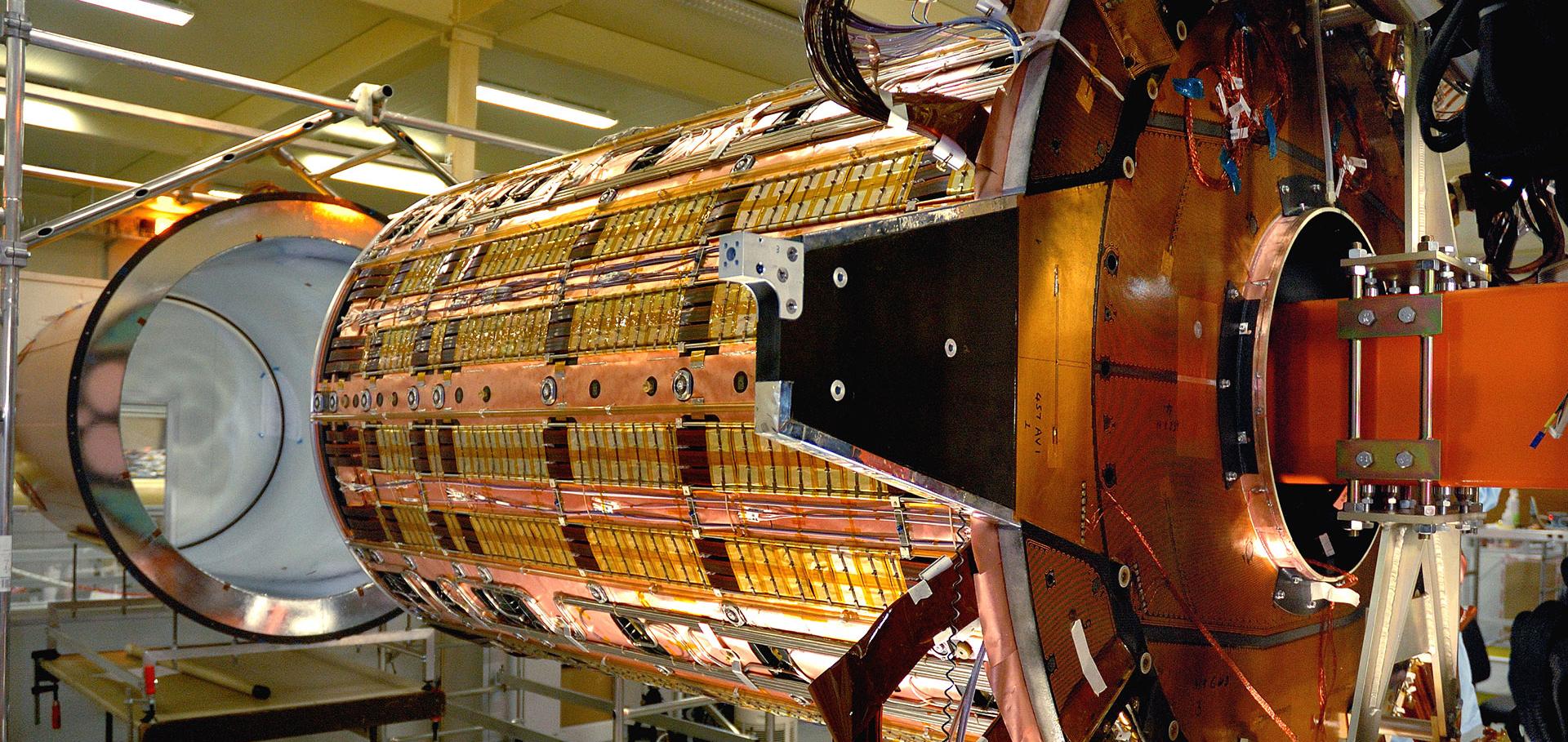
Insertion of STC into TRT at the Department of Physics, Oxford
Credit: CERN

Professor Daniela Bortoletto

Professor and Head of Particle Physics

Research theme

  • Instrumentation
  • Fundamental particles and interactions

Sub department

  • Particle Physics

Research groups

  • AION/Magis
  • ATLAS
  • Future Colliders
  • Mu3e
  • OPMD
daniela.bortoletto@physics.ox.ac.uk
Telephone: 01865 (2)73635
Denys Wilkinson Building, room 608c1
  • About
  • Students
  • Research
  • Teaching
  • Publications

AION: An Atom Interferometer Observatory and Network

Authors:

L Badurina, E Bentine, D Blas, K Bongs, D Bortoletto, T Bowcock, K Bridges, W Bowden, O Buchmueller, C Burrage, J Coleman, G Elertas, J Ellis, C Foot, V Gibson, Mg Haehnelt, T Harte, S Hedges, R Hobson, M Holynski, T Jones, M Langlois, S Lellouch, M Lewicki, R Maiolino, P Majewski, S Malik, J March-Russell, C McCabe, D Newbold, B Sauer, U Schneider, I Shipsey, Y Singh, Ma Uchida, T Valenzuela, M van der Grinten, V Vaskonen, J Vossebeld, D Weatherill, I Wilmut

Abstract:

We outline the experimental concept and key scientific capabilities of AION (Atom Interferometer Observatory and Network), a proposed UK-based experimental programme using cold strontium atoms to search for ultra-light dark matter, to explore gravitational waves in the mid-frequency range between the peak sensitivities of the LISA and LIGO/Virgo/ KAGRA/INDIGO/Einstein Telescope/Cosmic Explorer experiments, and to probe other frontiers in fundamental physics. AION would complement other planned searches for dark matter, as well as probe mergers involving intermediate mass black holes and explore early universe cosmology. AION would share many technical features with the MAGIS experimental programme in the US, and synergies would flow from operating AION in a network with this experiment, as well as with other atom interferometer experiments such as MIGA, ZAIGA and ELGAR. Operating AION in a network with other gravitational wave detectors such as LIGO, Virgo and LISA would also offer many synergies.
More details from the publisher
More details
Details from ArXiV

Combined CDF and D0 Upper Limits on Standard Model Higgs Boson Production with up to 8.2 fb$^-1$ of Data

Authors:

T Aaltonen, others
Details from ArXiV

ILC Vertex Tracker R&D

Office of Scientific and Technical Information (OSTI)

Authors:

Marco Battaglia, Jean-Marie Bussat, Devis Contarato, Peter Denes, Lindsay Glesener, Leo Greiner, Benjamin Hooberman, Derek Shuman, Lauren Tompkins, Chinh Vu, Dario Bisello, Piero Giubilato, Devis Pantano, Marco Costa, Alessandro La Rosa, Gino Bolla, Daniela Bortoletto, Isaac Children
More details from the publisher

Sensor Compendium

Office of Scientific and Technical Information (OSTI)

Authors:

M Artuso, et al.
More details from the publisher

Technical design of the phase I Mu3e experiment

Authors:

K Arndt, H Augustin, P Baesso, N Berger, F Berg, C Betancourt, D Bortoletto, A Bravar, K Briggl, D vom Bruch, A Buonaura, F Cadoux, C Chavez Barajas, H Chen, K Clark, P Cooke, S Corrodi, A Damyanova, Y Demets, S Dittmeier, P Eckert, F Ehrler, D Fahrni, L Gerritzen, J Goldstein, D Gottschalk, C Grab, R Gredig, A Groves, J Hammerich, U Hartenstein, U Hartmann, H Hayward, A Herkert, G Hesketh, S Hetzel, M Hildebrandt, Z Hodge, A Hofer, Qh Huang, S Hughes, L Huth, Dm Immig, T Jones, M Jones, H-C Kästli, M Köppel, P-R Kettle, M Kiehn, S Kilani

Abstract:

The Mu3e experiment aims to find or exclude the lepton flavour violating decay $\mu \rightarrow eee$ at branching fractions above $10^{-16}$. A first phase of the experiment using an existing beamline at the Paul Scherrer Institute (PSI) is designed to reach a single event sensitivity of $2\cdot 10^{-15}$. We present an overview of all aspects of the technical design and expected performance of the phase~I Mu3e detector. The high rate of up to $10^{8}$ muon decays per second and the low momenta of the decay electrons and positrons pose a unique set of challenges, which we tackle using an ultra thin tracking detector based on high-voltage monolithic active pixel sensors combined with scintillating fibres and tiles for precise timing measurements.
More details from the publisher
More details
Details from ArXiV

Pagination

  • First page First
  • Previous page Prev
  • …
  • Page 899
  • Page 900
  • Page 901
  • Page 902
  • Page 903
  • Page 904
  • Page 905
  • Current page 906
  • Page 907
  • Next page Next
  • Last page Last

Footer Menu

  • Contact us
  • Giving to the Dept of Physics
  • Work with us
  • Media

User account menu

  • Log in

Follow us

FIND US

Clarendon Laboratory,

Parks Road,

Oxford,

OX1 3PU

CONTACT US

Tel: +44(0)1865272200

University of Oxfrod logo Department Of Physics text logo
IOP Juno Champion logo Athena Swan Silver Award logo

© University of Oxford - Department of Physics

Cookies | Privacy policy | Accessibility statement

Built by: Versantus

  • Home
  • Research
  • Study
  • Engage
  • Our people
  • News & Comment
  • Events
  • Our facilities & services
  • About us
  • Giving to Physics
  • Current students
  • Staff intranet