Home
Department Of Physics text logo
  • Research
    • Our research
    • Our research groups
    • Our research in action
    • Research funding support
    • Summer internships for undergraduates
  • Study
    • Undergraduates
    • Postgraduates
  • Engage
    • For young people
    • For teachers
    • For the public
    • For alumni
    • For business
  • Support
Menu
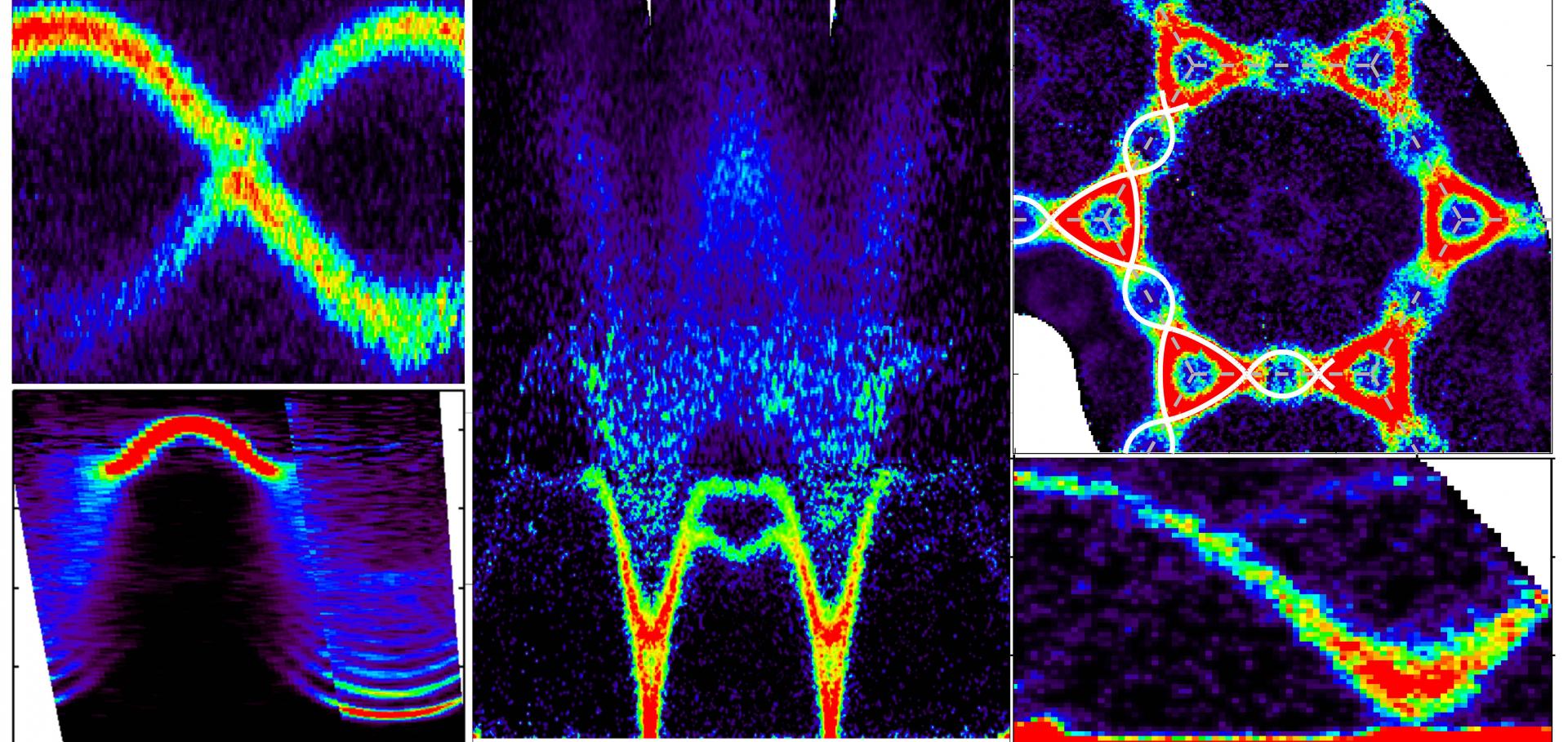
inelastic neutron scattering spectra of quantum magnets

Prof Radu Coldea

Professor of Physics

Research theme

  • Quantum materials

Sub department

  • Condensed Matter Physics

Research groups

  • Quantum magnetism and quantum phase transitions
Radu.Coldea@physics.ox.ac.uk
Telephone: 01865 (2)72335
Clarendon Laboratory, room 162,051,014,111.1 (office)
  • About
  • Publications

Direct Measurement of the Spin Hamiltonian and Observation of Condensation of Magnons in the 2D Frustrated Quantum Magnet Cs2CuCl4

(2001)

Authors:

R Coldea, DA Tennant, K Habicht, P Smeibidl, C Wolters, Z Tylczynski
More details from the publisher

Correlations and fluctuations in the 2D Heisenberg antiferromagnet

Journal of Magnetism and Magnetic Materials 236:1-2 (2001) 4-5

Authors:

HM Ronnow, DF McMorrow, A Harrison, ID Youngson, R Coldea, TG Perring, G Aeppli, O Syljuåsen

Abstract:

The correlations and fluctuations in Cu(DCOO)2·4D2O, which is a good physical realization of the 2D S = 1/2 Heisenberg antiferromagnet on a square lattice, have been measured by neutron scattering measurements. The quantum fluctuations cause a non-uniform renormalization of the spin-wave dispersion with a zone boundary dispersion of 7%, while the spin wave amplitude is reduced to 51±4% of its classical value. The temperature dependence of the correlation length, the spin-wave damping and the spin-wave softening agrees with theoretical predictions over a large temperature range. © 2001 Elsevier Science B.V. All rights reserved.
More details from the publisher
More details

Spin dynamics of the 2D spin 1/2 quantum antiferromagnet copper deuteroformate tetradeuterate (CFTD).

Phys Rev Lett 87:3 (2001) 037202

Authors:

HM Rønnow, DF McMorrow, R Coldea, A Harrison, ID Youngson, TG Perring, G Aeppli, O Syljuåsen, K Lefmann, C Rischel

Abstract:

The magnetic excitation spectrum in the two-dimensional (2D) S = 1/2 Heisenberg antiferromagnet copper deuteroformate tetradeuterate has been measured for temperatures up to T approximately J/2, where J = 6.31+/-0.02 meV is the 2D exchange coupling. For T<
More details from the publisher
More details

Multiparticle states in the S = 1 chain system CsNiCl3.

Phys Rev Lett 87:1 (2001) 017201

Authors:

M Kenzelmann, RA Cowley, WJ Buyers, R Coldea, JS Gardner, M Enderle, DF McMorrow, SM Bennington

Abstract:

A continuum of magnetic states has been observed by neutron scattering from the spin-1 chain compound CsNiCl3 in its disordered gapped one-dimensional phase. Results using both triple-axis and time-of-flight spectrometers show that around the antiferromagnetic point Qc = pi, the continuum lies higher in energy than the Haldane gapped excitations. At 6 K the integrated intensity of the continuum is about 12(2)% of the total spectral weight. This result is considerably larger than the 1%-3% weight predicted by the nonlinear sigma model for the three-particle continuum.
More details from the publisher
More details
Details from ArXiV

Spin dynamics of the model 2D quantum antiferromagnet CFTD

Phys.Rev.Lett. (2001)

Authors:

HM Ronnow, DF McMorrow, R Coldea, A Harrison, ID Youngson, TG Perring, G Aeppli, O Syljyasen, K Lefmann, C Rischel

Abstract:

The magnetic excitation spectrum in the two-dimensional (2D) S=1/2 Heisenberg antiferromagnet copper deuteroformate tetradeuterate (CFTD) has been measured for temperatures up to T\sim J/2, where J=6.31+-0.02 meV is the 2D exchange coupling. For T\ll J, a dispersion of the zone boundary energy is observed, which is attributed to a wavevector dependent quantum renormalization. At higher temperatures, spin-wave-like excitations persist, but are found to broaden and soften. By combining our data with numerical calculations, and with existing theoretical work, a consistent description of the behaviour of the model system is found over the whole temperature interval investigated.
Details from ArXiV
More details

Pagination

  • First page First
  • Previous page Prev
  • …
  • Page 34
  • Page 35
  • Page 36
  • Page 37
  • Current page 38
  • Page 39
  • Page 40
  • Page 41
  • Page 42
  • …
  • Next page Next
  • Last page Last

Footer Menu

  • Contact us
  • Giving to the Dept of Physics
  • Work with us
  • Media

User account menu

  • Log in

Follow us

FIND US

Clarendon Laboratory,

Parks Road,

Oxford,

OX1 3PU

CONTACT US

Tel: +44(0)1865272200

University of Oxfrod logo Department Of Physics text logo
IOP Juno Champion logo Athena Swan Silver Award logo

© University of Oxford - Department of Physics

Cookies | Privacy policy | Accessibility statement

Built by: Versantus

  • Home
  • Research
  • Study
  • Engage
  • Our people
  • News & Comment
  • Events
  • Our facilities & services
  • About us
  • Giving to Physics
  • Current students
  • Staff intranet