Home
Department Of Physics text logo
  • Research
    • Our research
    • Our research groups
    • Our research in action
    • Research funding support
    • Summer internships for undergraduates
  • Study
    • Undergraduates
    • Postgraduates
  • Engage
    • For young people
    • For teachers
    • For the public
    • For alumni
    • For business
  • Support
Menu
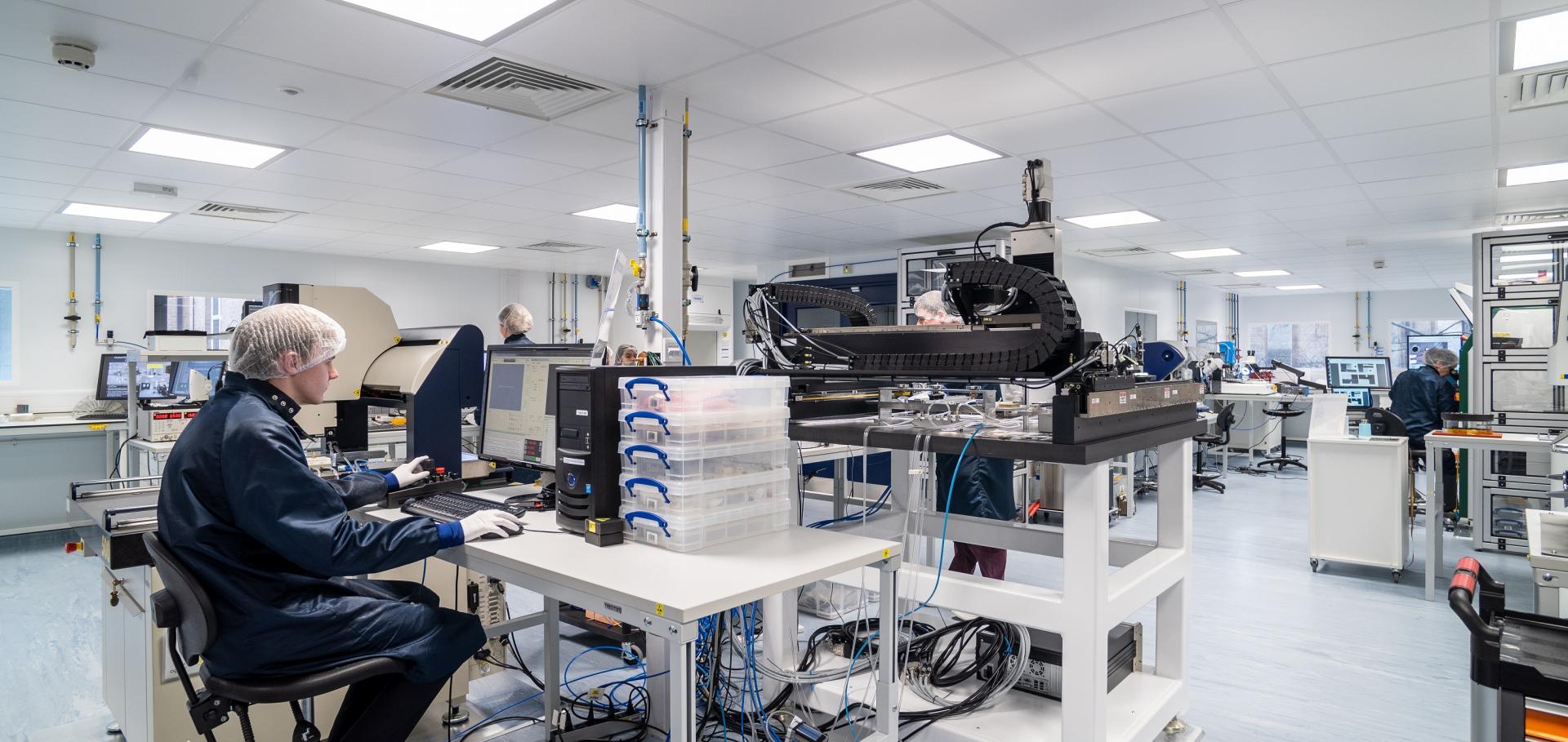
The OPMD Laboratory

Staff workign in the OPMD laboratory building detectors for Particle Phsycis experiments

Dr Richard Plackett

Silicon Detector Development Scientist

Research theme

  • Instrumentation
  • Fundamental particles and interactions

Sub department

  • Particle Physics

Research groups

  • ATLAS
  • Mu3e
  • Rubin-LSST
  • OPMD
richard.plackett@physics.ox.ac.uk
Telephone: 01865 (2)82744
Robert Hooke Building, room F21
  • About
  • Publications

Reconstruction bias in Timepix4 subpixel centroiding for electron imaging

Journal of Instrumentation 21:10 (2026)

Authors:

N Dimova, R Plackett, D Bortoletto

Abstract:

Subpixel centroiding is widely used to improve the spatial resolution of hybrid pixel detectors for electron imaging by estimating the true interaction position within an entry pixel. Existing centroiding strategies are typically optimised using localisation accuracy. However, observations show that improved localisation does not necessarily translate into improved modulation transfer function (MTF) or reliable virtual-pixel rebinning. This work proposes a unified interpretation of these observations based on the ambiguity of the centroid reconstruction problem. We show that observable-based centroid estimators solve an intrinsically non-unique inverse problem using deterministic reconstruction rules, which can introduce entry-phase-dependent reconstruction bias that governs the spatial distribution of reconstructed subpixel coordinates. This framework explains why localisation accuracy alone is insufficient to predict imaging performance and identifies approximate intra-pixel translational symmetry as a prerequisite for faithful virtual-pixel imaging. The proposed interpretation is evaluated using simulated 200 keV and 300 keV electron data together with measured 200 keV data acquired with a Timepix4 detector. Comparisons of charge-weighted, timing-based, and morphology-dependent centroiding strategies demonstrate that estimators with similar localisation performance can exhibit markedly different MTFs and rebinned flat-field behaviour. The results suggest that future centroid optimisation should consider subpixel phase bias and rebinnability alongside localisation accuracy.
More details from the publisher

Investigation of the in-pixel response of the Mupix11 monolithic pixel sensor using a microfocus X-ray beam at Diamond Light Source

ArXiv 2604.24367 (2026)

Authors:

AS Rotelli, H Augustin, D Bortoletto, A Brooks, M Grimes, AJA Knight, MS Köppel, AE McDougall, R Plackett, DMS Sultan, L Vigani, S Wood
Details from ArXiV

Detective Quantum Efficiency of the Timepix4 Hybrid Pixel Detector and its Application to Parallel-Beam Diffraction

ArXiv 2603.06857 (2026)

Authors:

Zhiyuan Ding, Nina Dimova, Jonathan S Barnard, Giulio Crevatin, Liam O'Ryan, Richard Plackett, Daniela Bortoletto, Angus I Kirkland, Marcus Gallagher-Jones
Details from ArXiV

Measurement of the resolution of the Timepix4 detector for 100 keV and 200 keV electrons for transmission electron microscopy

Nuclear Instruments and Methods in Physics Research Section A Accelerators Spectrometers Detectors and Associated Equipment Elsevier 1075 (2025) 170335-170335

Authors:

N Dimova, R Plackett, D Weatherill, D Wood, L O’Ryan, G Crevatin, JS Barnard, M Gallagher-Jones, D Hynds, R Goldsbrough, I Shipsey, D Bortoletto, A Kirkland
More details from the publisher
More details

Bounds on heavy axions with an X-ray free electron laser

Physical Review Letters American Physical Society 134:5 (2025) 55001

Authors:

Jack WD Halliday, Giacomo Marocco, Konstantin A Beyer, Charles Heaton, Motoaki Nakatsutsumi, Thomas R Preston, Charles Arrowsmith, Carsten Baehtz, Sebastian Goede, Oliver Humphries, Alejandro Laso Garcia, Richard Plackett, Pontus Svensson, Georgios Vacalis, Justin Wark, Daniel Wood, Ulf Zastrau, Robert Bingham, Ian Shipsey, Subir Sarkar, Gianluca Gregori

Abstract:

We present new exclusion bounds obtained at the European X-Ray Free Electron Laser facility (EuXFEL) on axionlike particles in the mass range $10^{-3}\,\mathrm{eV} \lesssim m_a \lesssim 10^{4}\,\mathrm{eV}$. Our experiment exploits the Primakoff effect via which photons can, in the presence of a strong external electric field, decay into axions, which then convert back into photons after passing through an opaque wall. While similar searches have been performed previously at a third-generation synchrotron [Yamaji et al., Phys.\ Lett.\ B 782, 523 (2018)], our work demonstrates improved sensitivity, exploiting the higher brightness of x-rays at EuXFEL.
More details from the publisher
Details from ORA
More details
More details

Pagination

  • Current page 1
  • Page 2
  • Page 3
  • Next page Next
  • Last page Last

Footer Menu

  • Contact us
  • Giving to the Dept of Physics
  • Work with us
  • Media

User account menu

  • Log in

Follow us

FIND US

Clarendon Laboratory,

Parks Road,

Oxford,

OX1 3PU

CONTACT US

Tel: +44(0)1865272200

University of Oxfrod logo Department Of Physics text logo
IOP Juno Champion logo Athena Swan Silver Award logo

© University of Oxford - Department of Physics

Cookies | Privacy policy | Accessibility statement

Built by: Versantus

  • Home
  • Research
  • Study
  • Engage
  • Our people
  • News & Comment
  • Events
  • Our facilities & services
  • About us
  • Giving to Physics
  • Current students
  • Staff intranet