Home
Department Of Physics text logo
  • Research
    • Our research
    • Our research groups
    • Our research in action
    • Research funding support
    • Summer internships for undergraduates
  • Study
    • Undergraduates
    • Postgraduates
  • Engage
    • For young people
    • For teachers
    • For the public
    • For alumni
    • For business
  • Support
Menu
Atomic and Laser Physics
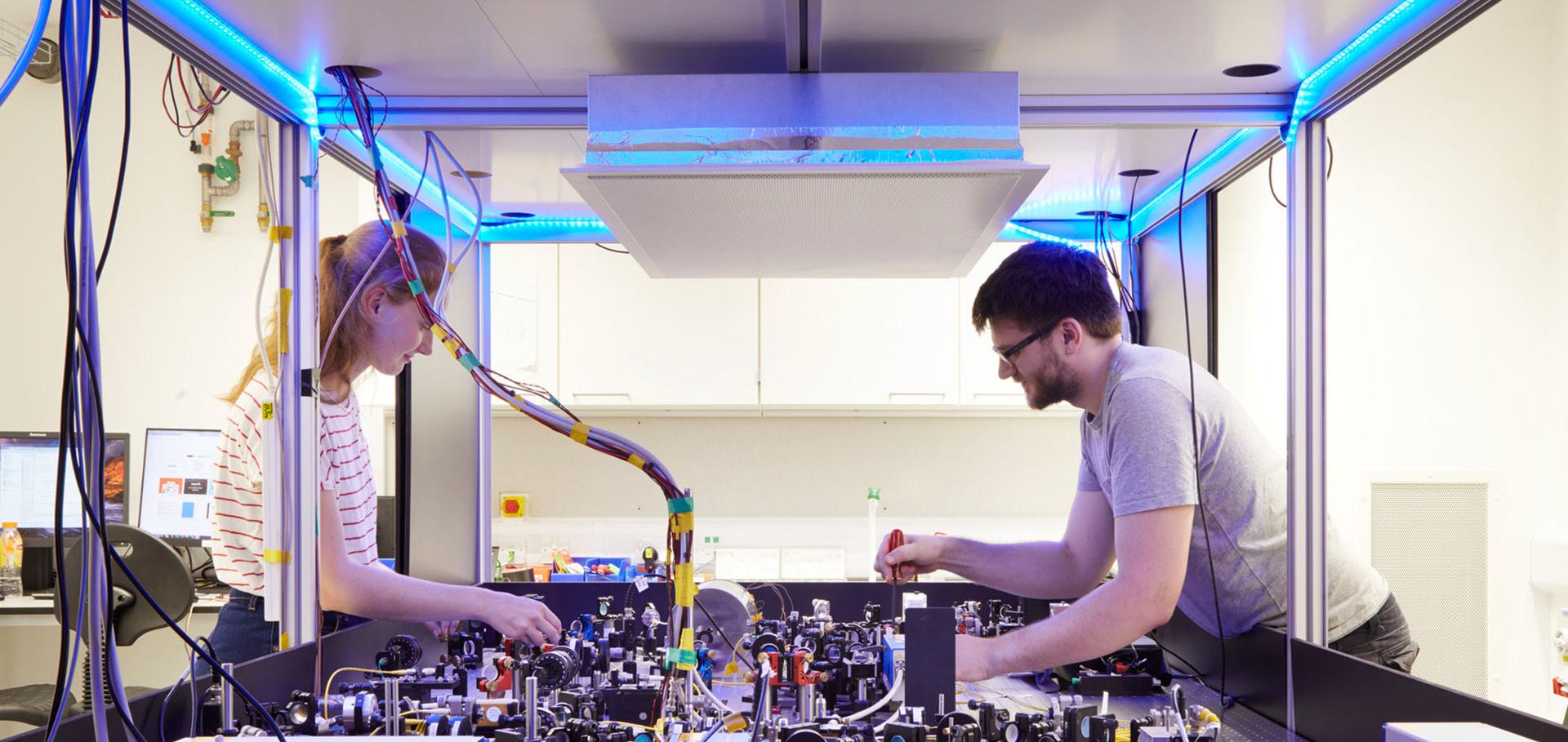
Credit: Jack Hobhouse

Sebastian Saner

Visitor

Research theme

  • Quantum information and computation

Sub department

  • Atomic and Laser Physics

Research groups

  • Ion trap quantum computing
sebastian.saner@physics.ox.ac.uk
Clarendon Laboratory
  • About
  • Publications

Towards quantum computing Feynman diagrams in hybrid qubit-oscillator devices

Quantum 10 (2026) 01-23

Authors:

S Varona, S Saner, O Băzăvan, G Araneda, G Aarts, A Bermudez

Abstract:

We show that recent experiments in hybrid qubit-oscillator devices that measure the phase-space characteristic function of the oscillator via the qubit can be seen through the lens of functional calculus and path integrals, drawing a clear analogy with the generating functional of a quantum field theory. This connection suggests an expansion of the characteristic function in terms of Feynman diagrams, exposing the role of the real-time bosonic propagator, and identifying the external source functions with certain time-dependent couplings that can be controlled experimentally. By applying maximum-likelihood techniques, we show that the “measurement” of these Feynman diagrams can be reformulated as a problem of multi-parameter point estimation that takes as input a set of Ramsey-type measurements of the qubit. By numerical simulations that consider leading imperfections in trapped-ion devices, we identify the optimal regimes in which Feynman diagrams could be reconstructed from measured data with low systematic and statistical errors. We discuss how these ideas can be generalized to finite temperatures via the Schwinger-Keldysh formalism, contributing to a bottom-up approach to probe quantum simulators of lattice field theories by systematically increasing the qubit-oscillator number.
More details from the publisher

Real-Time Observation of Aharonov-Bohm Interference in a $\mathbb{Z}_2$ Lattice Gauge Theory on a Hybrid Qubit-Oscillator Quantum Computer

(2025)

Authors:

S Saner, O Băzăvan, DJ Webb, G Araneda, CJ Ballance, R Srinivas, DM Lucas, A Bermúdez
More details from the publisher
Details from ArXiV

Multipartite Mixed-Species Entanglement over a Quantum Network

(2025)

Authors:

D Main, P Drmota, EM Ainley, A Agrawal, D Webb, S Saner, O Bazavan, BC Nichol, R Srinivas, DP Nadlinger, G Araneda, DM Lucas
More details from the publisher
Details from ArXiV

Towards quantum computing Feynman diagrams in hybrid qubit-oscillator devices

(2024)

Authors:

S Varona, S Saner, O Băzăvan, G Araneda, G Aarts, A Bermudez
More details from the publisher
Details from ArXiV

Generating arbitrary superpositions of nonclassical quantum harmonic oscillator states

(2024)

Authors:

S Saner, O Băzăvan, DJ Webb, G Araneda, DM Lucas, CJ Ballance, R Srinivas
More details from the publisher
Details from ArXiV

Pagination

  • First page First
  • Previous page Prev
  • Page 1
  • Current page 2
  • Page 3
  • Page 4
  • Page 5
  • Next page Next
  • Last page Last

Footer Menu

  • Contact us
  • Giving to the Dept of Physics
  • Work with us
  • Media

User account menu

  • Log in

Follow us

FIND US

Clarendon Laboratory,

Parks Road,

Oxford,

OX1 3PU

CONTACT US

Tel: +44(0)1865272200

University of Oxfrod logo Department Of Physics text logo
IOP Juno Champion logo Athena Swan Silver Award logo

© University of Oxford - Department of Physics

Cookies | Privacy policy | Accessibility statement

Built by: Versantus

  • Home
  • Research
  • Study
  • Engage
  • Our people
  • News & Comment
  • Events
  • Our facilities & services
  • About us
  • Giving to Physics
  • Current students
  • Staff intranet