

Global Chemical Transport on Hot Jupiters: Insights from the 2D VULCAN Photochemical Model
The Astrophysical Journal American Astronomical Society 963:1 (2024) 41-41
Abstract:
The atmospheric dynamics of tidally-locked hot Jupiters is characterized by strong equatorial winds. Understanding the interaction between global circulation and chemistry is crucial in atmospheric studies and interpreting observations. Two-dimensional (2D) photochemical transport models shed light on how the atmospheric composition depends on circulation. In this paper, we introduce the 2D photochemical (horizontal and vertical) transport model, VULCAN 2D, which improves on the pseudo-2D approaches by allowing for non-uniform zonal winds. We extensively validate our VULCAN 2D with analytical solutions and benchmark comparisons. Applications to HD 189733 b and HD 209458 b reveal a transition in mixing regimes: horizontal transport predominates below $\sim$0.1 mbar while vertical mixing is more important at higher altitudes above 0.1 mbar. Motivated by the previously inferred carbon-rich atmosphere, we find that HD 209458 b with super-solar carbon-to-oxygen ratio (C/O) exhibits pronounced C$_2$H$_4$ absorption on the morning limb but not on the evening limb, owing to horizontal transport from the nightside. We discuss when a pseudo-2D approach is a valid assumption and its inherent limitations. Finally, we demonstrate the effect of horizontal transport in transmission observations and its impact on the morning-evening limb asymmetry with synthetic spectra, highlighting the need to consider global transport when interpreting exoplanet atmospheres.Comment: 19 pages, 20 figures, published in ApResponse of winter climate and extreme weather to projected Arctic sea-ice loss in very large-ensemble climate model simulations
npj Climate and Atmospheric Science Springer Nature 7:1 (2024) 20
Abstract:
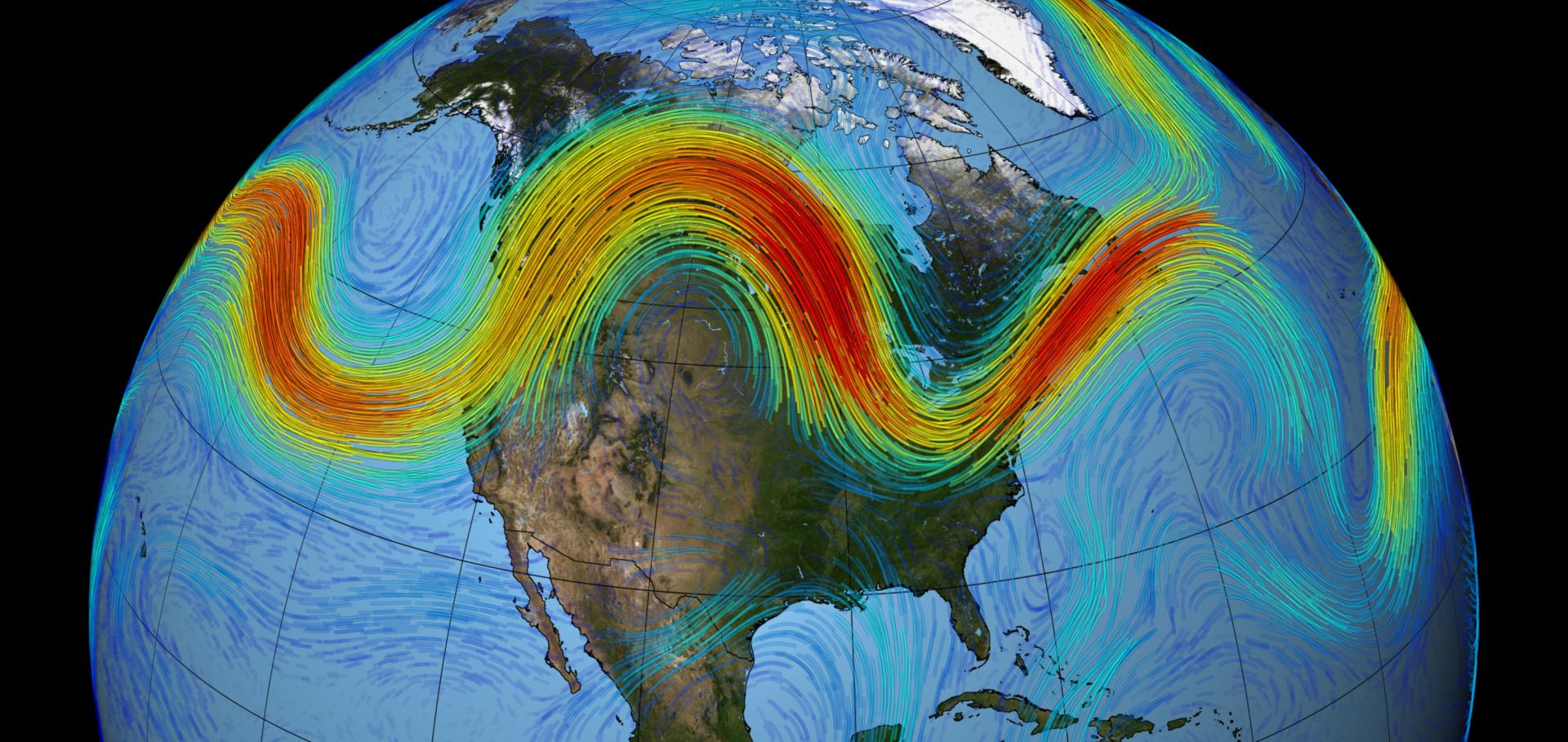
Very large (~2000 members) initial-condition ensemble simulations have been performed to advance understanding of mean climate and extreme weather responses to projected Arctic sea-ice loss under 2 °C global warming above preindustrial levels. These simulations better sample internal atmospheric variability and extremes for each model compared to those from the Polar Amplification Model Intercomparison Project (PAMIP). The mean climate response is mostly consistent with that from the PAMIP multi-model ensemble, including tropospheric warming, reduced midlatitude westerlies and storm track activity, an equatorward shift of the eddy-driven jet and increased mid-to-high latitude blocking. Two resolutions of the same model exhibit significant differences in the stratospheric circulation response; however, these differences only weakly modulate the tropospheric response. The response of temperature and precipitation extremes largely follows the seasonal-mean response. Sub-sampling confirms that large ensembles (e.g. ≥400) are needed to robustly estimate the seasonal-mean large-scale circulation response, and very large ensembles (e.g. ≥1000) for regional climate and extremes.Modelling the day–night temperature variations of ultra-hot Jupiters: confronting non-grey general circulation models and observations
Monthly Notices of the Royal Astronomical Society Oxford University Press (OUP) 528:1 (2024) 1016-1036
Characterizing volcanic ash density and its implications on settling dynamics
Journal of Geophysical Research: Atmospheres American Geophysical Union 129:2 (2024) e2023JD039903
Abstract:
Volcanic ash clouds are carefully monitored as they present a significant hazard to humans and aircraft. The primary tool for forecasting the transport of ash from a volcano is dispersion modelling. These models make a number of assumptions about the size, sphericity and density of the ash particles. Few studies have measured the density of ash particles or explored the impact that the assumption of ash density might have on the settling dynamics of ash particles. In this paper, the raw apparent density of 23 samples taken from 15 volcanoes are measured with gas pycnometry, and a negative linear relationship is found between the density and the silica content. For the basaltic ash samples, densities were measured for different particle sizes, showing that the density is approximately constant for particles smaller than 100 µm, beyond which it decreases with size. While this supports the current dispersion model used by the London Volcanic Ash Advisory Centre (VAAC), where the density is held at a constant (2.3 g cm-3), inputting the measured densities into a numerical simulation of settling velocity reveals a primary effect from the silica content changing this constant. The VAAC density overestimates ash removal times by up to 18 %. These density variations, including those varying with size beyond 100 µm, also impact short-range particle-size distribution (PSD) measurements and satellite retrievals of ash.Modeling Noncondensing Compositional Convection for Applications to Super-Earth and Sub-Neptune Atmospheres
The Astrophysical Journal American Astronomical Society 961:1 (2024) 35-35