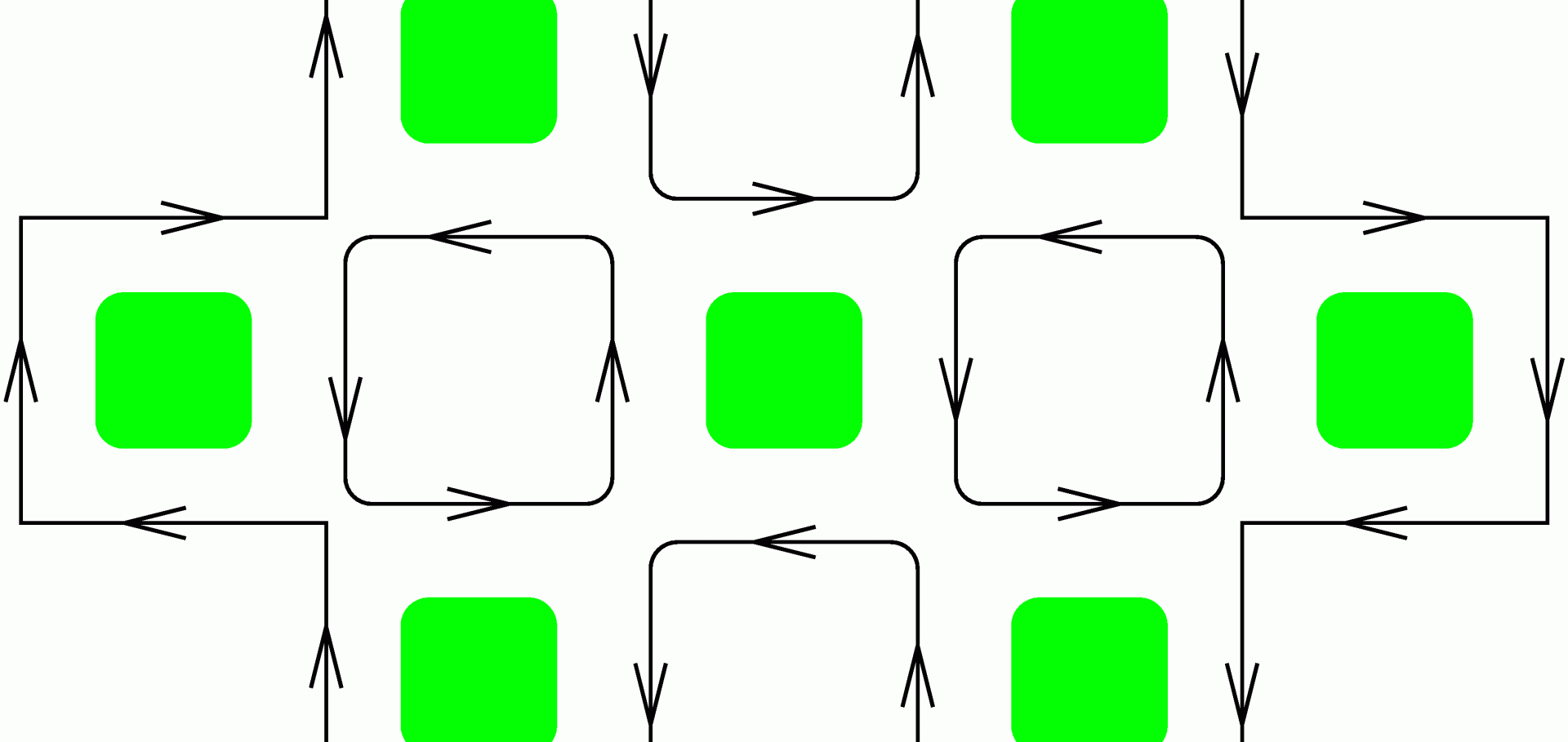
Noncontact racK and pinion powered by the lateral Casimir force.

Phys Rev Lett 98:14 (2007) 140801

Authors:

Arash Ashourvan, MirFaez Miri, Ramin Golestanian

Abstract:

The lateral Casimir force is employed to propose a design for a potentially wear-proof rack and pinion with no contact, which can be miniaturized to the nanoscale. The robustness of the design is studied by exploring the relation between the pinion velocity and the rack velocity in the different domains of the parameter space. The effects of friction and added external load are also examined. It is shown that the device can hold up extremely high velocities, unlike what the general perception of the Casimir force as a weak interaction might suggest.

Effective Forces Induced by a Fluctuating Interface: Exact Results

Physical Review Letters 98 (2007) 170602 4pp

Authors:

DB Abraham, A.M. Maciolek, F.H.L. Essler

Rectification of the lateral Casimir force in a vibrating noncontact rack and pinion.

Phys Rev E Stat Nonlin Soft Matter Phys 75:4 Pt 1 (2007) 040103

Authors:

Arash Ashourvan, Mirfaez Miri, Ramin Golestanian

Abstract:

The nonlinear dynamics of a cylindrical pinion that is kept at a distance from a vibrating rack is studied, and it is shown that the lateral Casimir force between the two corrugated surfaces can be rectified. The effects of friction and external load are taken into account, and it is shown that the pinion can do work against loads of up to a critical value, which is set by the amplitude of the lateral Casimir force. We present a phase diagram for the rectified motion that could help its experimental investigations, as the system exhibits a chaotic behavior in a large part of the parameter space.

Effective forces induced by fluctuating interface: exact results

(2007)

Authors:

DB Abraham, FHL Essler, A Maciolek, ;

Double criticality of the Sherrington-Kirkpatrick model at T=0.

Phys Rev Lett 98:12 (2007) 127201

Authors:

R Oppermann, MJ Schmidt, D Sherrington

Abstract:

Numerical results up to the 42nd order of replica-symmetry breaking (RSB) are used to predict the singular structure of the Sherrington-Kirkpatrick spin glass at T=0. We confirm predominant single parameter scaling and derive corrections for the T=0 order function q(a), related to a Langevin equation with pseudotime 1/a. a=0 and a=infinity are shown to be two critical points for infinity-RSB, associated with two discrete spectra of Parisi block size ratios, attached to a continuous spectrum. Finite-RSB-size scaling, associated exponents, and T=0-energy are obtained with unprecedented accuracy.