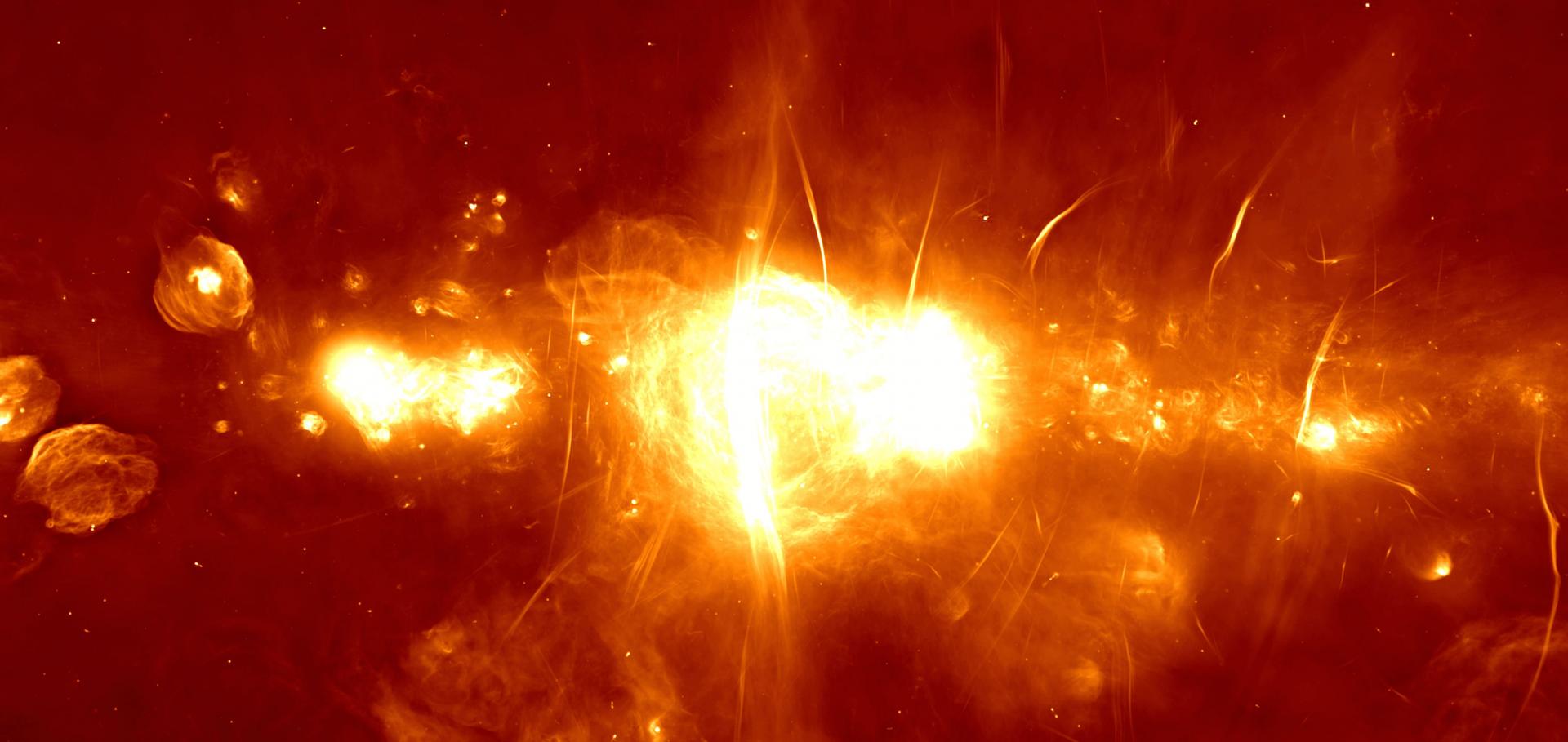
MIGHTEE: multi-wavelength counterparts in the COSMOS field

Monthly Notices of the Royal Astronomical Society Oxford University Press 527:2 (2023) 3231-3245

Authors:

Imogen H Whittam, Matthew Prescott, Catherine L Hale, Matthew J Jarvis, Ian Heywood, Rebecca A Bowler, Peter W Hatfield, Rohan J Varadaraj

Abstract:

In this paper, we combine the Early Science radio continuum data from the MeerKAT International GHz Tiered Extragalactic Exploration (MIGHTEE) Survey, with optical and near-infrared data and release the cross-matched catalogues. The radio data used in this work covers 0.86 deg2 of the COSMOS field, reaches a thermal noise of 1.7 μJy beam−1 and contains 6102 radio components. We visually inspect and cross-match the radio sample with optical and near-infrared data from the Hyper Suprime-Cam (HSC) and UltraVISTA surveys. This allows the properties of active galactic nuclei and star-forming populations of galaxies to be probed out to z ≈ 5. Additionally, we use the likelihood ratio method to automatically cross-match the radio and optical catalogues and compare this to the visually cross-matched catalogue. We find that 94 per cent of our radio source catalogue can be matched with this method, with a reliability of 95 per cent. We proceed to show that visual classification will still remain an essential process for the cross-matching of complex and extended radio sources. In the near future, the MIGHTEE survey will be expanded in area to cover a total of ∼20 deg2; thus the combination of automated and visual identification will be critical. We compare the redshift distribution of SFG and AGN to the SKADS and T-RECS simulations and find more AGN than predicted at z ∼ 1.

MIGHTEE: multi-wavelength counterparts in the COSMOS field

(2023)

Authors:

IH Whittam, M Prescott, CL Hale, MJ Jarvis, I Heywood, Fangxia An, M Glowacki, N Maddox, L Marchetti, LK Morabito, NJ Adams, RAA Bowler, PW Hatfield, RG Varadaraj, J Collier, B Frank, AR Taylor, MG Santos, M Vaccari, J Afonso, Y Ao, J Delhaize, K Knowles, S Kolwa, SM Randriamampandry, Z Randriamanakoto, O Smirnov, DJB Smith, SV White

Exploring the Impact of Ejecta Velocity Profile on Kilonova Evolution: Diversity of the Kilonova Lightcurves

(2023)

Authors:

Donggeun Tak, Z Lucas Uhm, James H Gillanders

Unprecedented Early Flux Excess in the Hybrid 02es-like Type Ia Supernova 2022ywc Indicates Interaction with Circumstellar Material

The Astrophysical Journal Letters American Astronomical Society 956:2 (2023) L34-L34

Authors:

Shubham Srivastav, T Moore, M Nicholl, MR Magee, SJ Smartt, MD Fulton, SA Sim, JM Pollin, L Galbany, C Inserra, A Kozyreva, Takashi J Moriya, FP Callan, X Sheng, KW Smith, JS Sommer, JP Anderson, M Deckers, M Gromadzki, TE Müller-Bravo, G Pignata, A Rest, DR Young

Abstract:

We present optical photometric and spectroscopic observations of the 02es-like type Ia supernova (SN) 2022ywc. The transient occurred in the outskirts of an elliptical host galaxy and showed a striking double-peaked light curve with an early excess feature detected in the ATLAS orange and cyan bands. The early excess is remarkably luminous with an absolute magnitude ∼ − 19, comparable in luminosity to the subsequent radioactively driven second peak. The spectra resemble the hybrid 02es-like SN 2016jhr, which is considered to be a helium shell detonation candidate. We investigate different physical mechanisms that could power such a prominent early excess and rule out massive helium shell detonation, surface 56Ni distribution, and ejecta–companion interaction. We conclude that SN ejecta interacting with circumstellar material (CSM) is the most viable scenario. Semianalytical modeling with MOSFiT indicates that SN ejecta interacting with ∼0.05 M ⊙ of CSM at a distance of ∼1014 cm can explain the extraordinary light curve. A double-degenerate scenario may explain the origin of the CSM, by tidally stripped material from either the secondary white dwarf or disk-originated matter launched along polar axes following the disruption and accretion of the secondary white dwarf. A nonspherical CSM configuration could suggest that a small fraction of 02es-like events viewed along a favorable line of sight may be expected to display a very conspicuous early excess like SN 2022ywc

Cosmology from LOFAR Two-metre Sky Survey data release 2: angular clustering of radio sources

Monthly Notices of the Royal Astronomical Society Oxford University Press 527:3 (2023) 6540-6568

Authors:

Cl Hale, Dj Schwarz, Pn Best, Sj Nakoneczny, David Alonso, D Bacon, L Böhme, N Bhardwaj, M Bilicki, S Camera, Cs Heneka, M Pashapour-Ahmadabadi, P Tiwari, J Zheng, Kj Duncan, Mj Jarvis, R Kondapally, M Magliocchetti, Hja Rottgering, Tw Shimwell

Abstract:

Covering ∼ 5600 deg2 to rms sensitivities of ∼70−100 μJy beam−1, the LOFAR Two-metre Sky Survey Data Release 2 (LoTSS-DR2) provides the largest low-frequency (∼150 MHz) radio catalogue to date, making it an excellent tool for large-area radio cosmology studies. In this work, we use LoTSS-DR2 sources to investigate the angular two-point correlation function of galaxies within the survey. We discuss systematics in the data and an improved methodology for generating random catalogues, compared to that used for LoTSS-DR1, before presenting the angular clustering for ∼900 000 sources ≥1.5 mJy and a peak signal-to-noise ≥ 7.5 across ∼80 per cent of the observed area. Using the clustering, we infer the bias assuming two evolutionary models. When fitting angular scales of 0.5 ≤ θ < 5◦, using a linear bias model, we find LoTSS-DR2 sources are biased tracers of the underlying matter, with a bias of bC = 2.14+0.22 −0.20 (assuming constant bias) and bE(z = 0) = 1.79+0.15 −0.14 (for an evolving model, inversely proportional to the growth factor), corresponding to bE = 2.81+0.24 −0.22 at the median redshift of our sample, assuming the LoTSS Deep Fields redshift distribution is representative of our data. This reduces to bC = 2.02+0.17 −0.16 and bE(z = 0) = 1.67+0.12 −0.12 when allowing preferential redshift distributions from the Deep Fields to model our data. Whilst the clustering amplitude is slightly lower than LoTSS-DR1 (≥2 mJy), our study benefits from larger samples and improved redshift estimates.