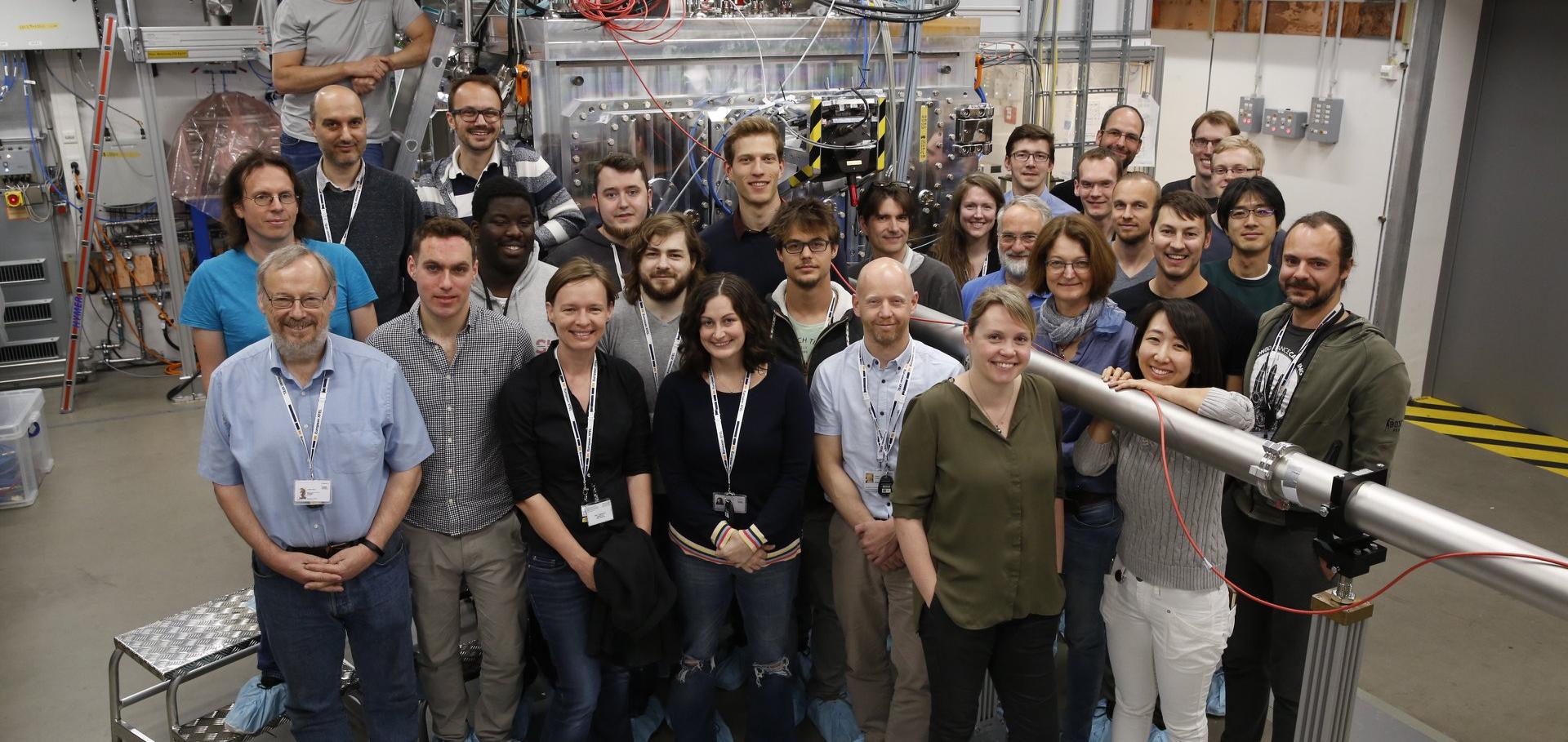
Fundamental Physics Opportunities with Multi-PetaWatt- and Multi-MegaJoule-class Facilities

(2024)

Abstract:

In my talk, I will present some recent highlights from my research group in the Clarendon Laboratory, obtained working in partnership with many outstanding international collaborators. These fall under the three broad themes. The first is novel laser-plasma interactions, which include those resulting from twisted light, ionisation injection for laser- and beam-driven wakefield accelerators, along with frequency domain holographic and compressive sensing diagnostic developments relevant to future colliders. The second theme is that of extreme field physics using multi-petawatt laser facilities. These include first principles ionisation processes, absorption processes and ultra-bright attosecond X-rays from high harmonic generation, photon-photon scattering in the non-linear QED regime and, most recently, gravitational wave generation using petaWatt- and/or megaJoule-class facilities. We are now extending these studies to those of gravity-wave detection, with promising preliminary results. The third theme is that of inertial fusion studies. All of these studies indicate that an international, dual-use, 20-MJ ICF/IFE facility, with the first 2-MJ at high repetition rate supplying single-shot high energy amplifiers, will open many new exciting avenues for both fundamental physics and high energy density science in the decades ahead.

Phase transitions of Fe$_2$O$_3$ under laser shock compression

(2024)

Authors:

A Amouretti, C Crépisson, S Azadi, D Cabaret, T Campbell, DA Chin, B Colin, GR Collins, L Crandall, G Fiquet, A Forte, T Gawne, F Guyot, P Heighway, H Lee, D McGonegle, B Nagler, J Pintor, D Polsin, G Rousse, Y Shi, E Smith, JS Wark, SM Vinko, M Harmand

Quantifying ionization in hot dense plasmas

Physical Review E American Physical Society 109 (2024) L023201

Authors:

Thomas Gawne, Sam Vinko, Justin Wark

Abstract:

Ionization is a problematic quantity in that it does not have a well-defined thermodynamic definition, yet it is a key parameter within plasma modelling. One still therefore aims to find a consistent and unambiguous definition for the ionization state. Within this context we present finite-temperature density functional theory calculations of the ionization state of carbon in CH plasmas using two potential definitions: one based on counting the number of continuum electrons, and another based on the optical conductivity. Differences of up to 10% are observed between the two methods. However, including “Pauli forbidden” transitions in the conductivity reproduces the counting definition, suggesting such transitions are important to evaluate the ionization state.

Multi-GeV wakefield acceleration in a plasma-modulated plasma accelerator

Physical Review E American Physical Society 109:2 (2024) 25206

Authors:

Johannes J van de Wetering, Simon M Hooker, Roman Walczak

Abstract:

We investigate the accelerator stage of a plasma-modulated plasma accelerator (P-MoPA) [Jakobsson et al., Phys. Rev. Lett. 127, 184801 (2021)] using both the paraxial wave equation and particle-in-cell (PIC) simulations. We show that adjusting the laser and plasma parameters of the modulator stage of a P-MoPA allows the temporal profile of pulses within the pulse train to be controlled, which in turn allows the wake amplitude in the accelerator stage to be as much as 72% larger than that generated by a plasma beat-wave accelerator with the same total drive laser energy. Our analysis shows that Rosenbluth-Liu detuning is unimportant in a P-MoPA if the number of pulses in the train is less than ∼30, and that this detuning is also partially counteracted by increased red-shifting, and hence increased pulse spacing, towards the back of the train. An analysis of transverse mode oscillations of the driving pulse train is found to be in good agreement with 2D (Cartesian) PIC simulations. PIC simulations demonstrating energy gains of ∼1.5GeV (∼2.5GeV) for drive pulse energies of 2.4J (5.0J) are presented. Our results suggest that P-MoPAs driven by few-joule, picosecond pulses, such as those provided by high-repetition-rate thin-disk lasers, could accelerate electron bunches to multi-GeV energies at pulse repetition rates in the kilohertz range.

Achievement of target gain larger than unity in an inertial fusion experiment

Physical Review Letters American Physical Society 132:6 (2024) 065102

Authors:

H Abu-Shawareb, R Acree, P Adams, J Adams, B Addis, R Aden, P Adrian, Bb Afeyan, M Aggleton, L Aghaian, A Aguirre, D Aikens, J Akre, F Albert, M Albrecht, Bj Albright, J Albritton, J Alcala, C Alday, Da Alessi, N Alexander, J Alfonso, N Alfonso, E Alger, Sj Ali, Za Ali, A Allen, We Alley, P Amala, Pa Amendt, P Amick, S Ammula, C Amorin, Dj Ampleford, Rw Anderson, T Anklam, N Antipa, B Appelbe, C Aracne-Ruddle, E Araya, Tn Archuleta, M Arend, P Arnold, T Arnold, A Arsenlis, J Asay, Lj Atherton, D Atkinson, R Atkinson, Jm Auerbach

Abstract:

On December 5, 2022, an indirect drive fusion implosion on the National Ignition Facility (NIF) achieved a target gain G_{target} of 1.5. This is the first laboratory demonstration of exceeding "scientific breakeven" (or G_{target}>1) where 2.05 MJ of 351 nm laser light produced 3.1 MJ of total fusion yield, a result which significantly exceeds the Lawson criterion for fusion ignition as reported in a previous NIF implosion [H. Abu-Shawareb et al. (Indirect Drive ICF Collaboration), Phys. Rev. Lett. 129, 075001 (2022)PRLTAO0031-900710.1103/PhysRevLett.129.075001]. This achievement is the culmination of more than five decades of research and gives proof that laboratory fusion, based on fundamental physics principles, is possible. This Letter reports on the target, laser, design, and experimental advancements that led to this result.