

HARMONI: a single-field wide-band integral-field spectrograph for the European ELT
Proceedings of SPIE--the International Society for Optical Engineering SPIE, the international society for optics and photonics 7735 (2010) 77352i-77352i-11
MI-6: Michigan interferometry with six telescopes
Proceedings of SPIE--the International Society for Optical Engineering SPIE, the international society for optics and photonics 7734 (2010) 77340g-77340g-12
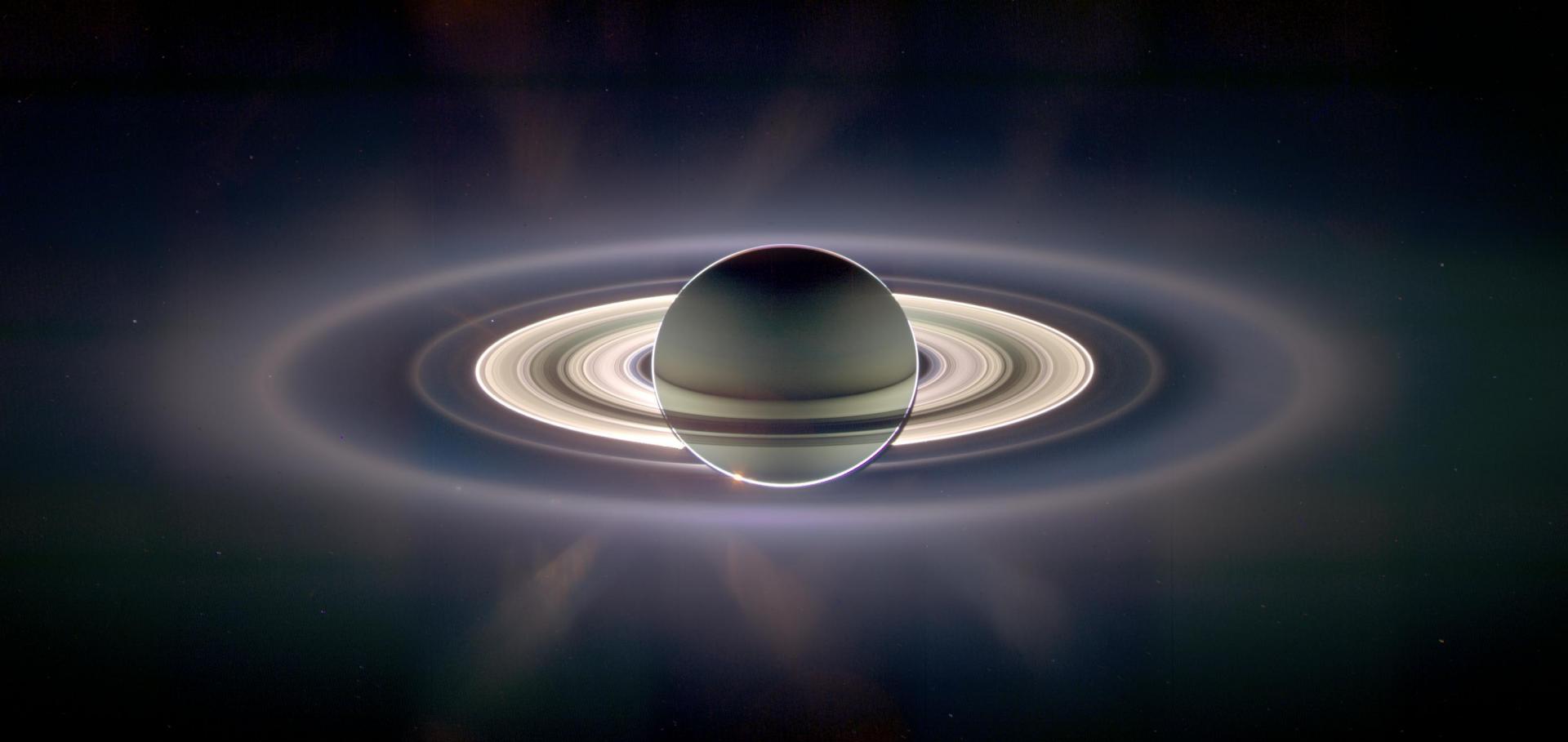
Seasonal change on Saturn from Cassini/CIRS observations, 2004-2009
Icarus 208:1 (2010) 337-352
Abstract:
Five years of thermal infrared spectra from the Cassini Composite Infrared Spectrometer (CIRS) are analyzed to determine the response of Saturn's atmosphere to seasonal changes in insolation. Hemispheric mapping sequences at 15.0cm-1 spectral resolution are used to retrieve the variation in the zonal mean temperatures in the stratosphere (0.5-5.0mbar) and upper troposphere (75-800mbar) between October 2004 (shortly after the summer solstice in the southern hemisphere) and July 2009 (shortly before the autumnal equinox).Saturn's northern mid-latitudes show signs of dramatic warming in the stratosphere (by 6-10. K) as they emerge from ring-shadow into springtime conditions, whereas southern mid-latitudes show evidence for cooling (4-6. K). The 40-K asymmetry in stratospheric temperatures between northern and southern hemispheres (at 1. mbar) slowly decreased during the timespan of the observations. Tropospheric temperatures also show temporal variations but with a smaller range, consistent with the increasing radiative time constant of the atmospheric response with increasing pressure. The tropospheric response to the insolation changes shows the largest magnitude at the locations of the broad retrograde jets. Saturn's warm south-polar stratospheric hood has cooled over the course of the mission, but remains present.Stratospheric temperatures are compared to a radiative climate model which accounts for the spatial distribution of the stratospheric coolants. The model successfully predicts the magnitude and morphology of the observed changes at most latitudes. However, the model fails at locations where strong dynamical perturbations dominate the temporal changes in the thermal field, such as the hot polar vortices and the equatorial semi-annual oscillation (Orton, G., and 27 colleagues [2008]. Nature 453, 196-198). Furthermore, observed temperatures in Saturn's ring-shadowed regions are larger than predicted by all radiative-climate models to date due to the incomplete characterization of the dynamical response to the shadow. Finally, far-infrared CIRS spectra are used to demonstrate variability of the para-hydrogen distribution over the 5-year span of the dataset, which may be related to observed changes in Saturn's tropospheric haze in the spring hemisphere. © 2010 Elsevier Inc.Thermal structure and composition of Jupiter's Great Red Spot from high-resolution thermal imaging
Icarus 208:1 (2010) 306-328
Abstract:
Thermal-IR imaging from space-borne and ground-based observatories was used to investigate the temperature, composition and aerosol structure of Jupiter's Great Red Spot (GRS) and its temporal variability between 1995 and 2008. An elliptical warm core, extending over 8° of longitude and 3° of latitude, was observed within the cold anticyclonic vortex at 21°S. The warm airmass is co-located with the deepest red coloration of the GRS interior. The maximum contrast between the core and the coldest regions of the GRS was 3.0-3.5. K in the north-south direction at 400. mbar atmospheric pressure, although the warmer temperatures are present throughout the 150-500. mbar range. The resulting thermal gradients cause counter-rotating flow in the GRS center to decay with altitude into the lower stratosphere. The elliptical warm airmass was too small to be observed in IRTF imaging prior to 2006, but was present throughout the 2006-2008 period in VLT, Subaru and Gemini imaging.Spatially-resolved maps of mid-IR tropospheric aerosol opacity revealed a well-defined lane of depleted aerosols around the GRS periphery, and a correlation with visibly-dark jovian clouds and bright 4.8-μm emission. Ammonia showed a similar but broader ring of depletion encircling the GRS. This narrow lane of subsidence keeps red aerosols physically separate from white aerosols external to the GRS. The visibility of the 4.8-μm bright periphery varies with the mid-IR aerosol opacity of the upper troposphere. Compositional maps of ammonia, phosphine and para-HAbundances of Jupiter's trace hydrocarbons from Voyager and Cassini
Planetary and Space Science Elsevier 58:13 (2010) 1667-1680