Reflation: Redox-Driven Atmospheric Inflation as Tracer of Super-Earth Geochemistry

The Astrophysical Journal Letters American Astronomical Society 1007:1 (2026) L8-L8

Authors:

Lorenzo Cesario, Tim Lichtenberg, Mara Attia, Harrison Nicholls, Imre Kisvárdai, Quentin Changeat

Abstract:

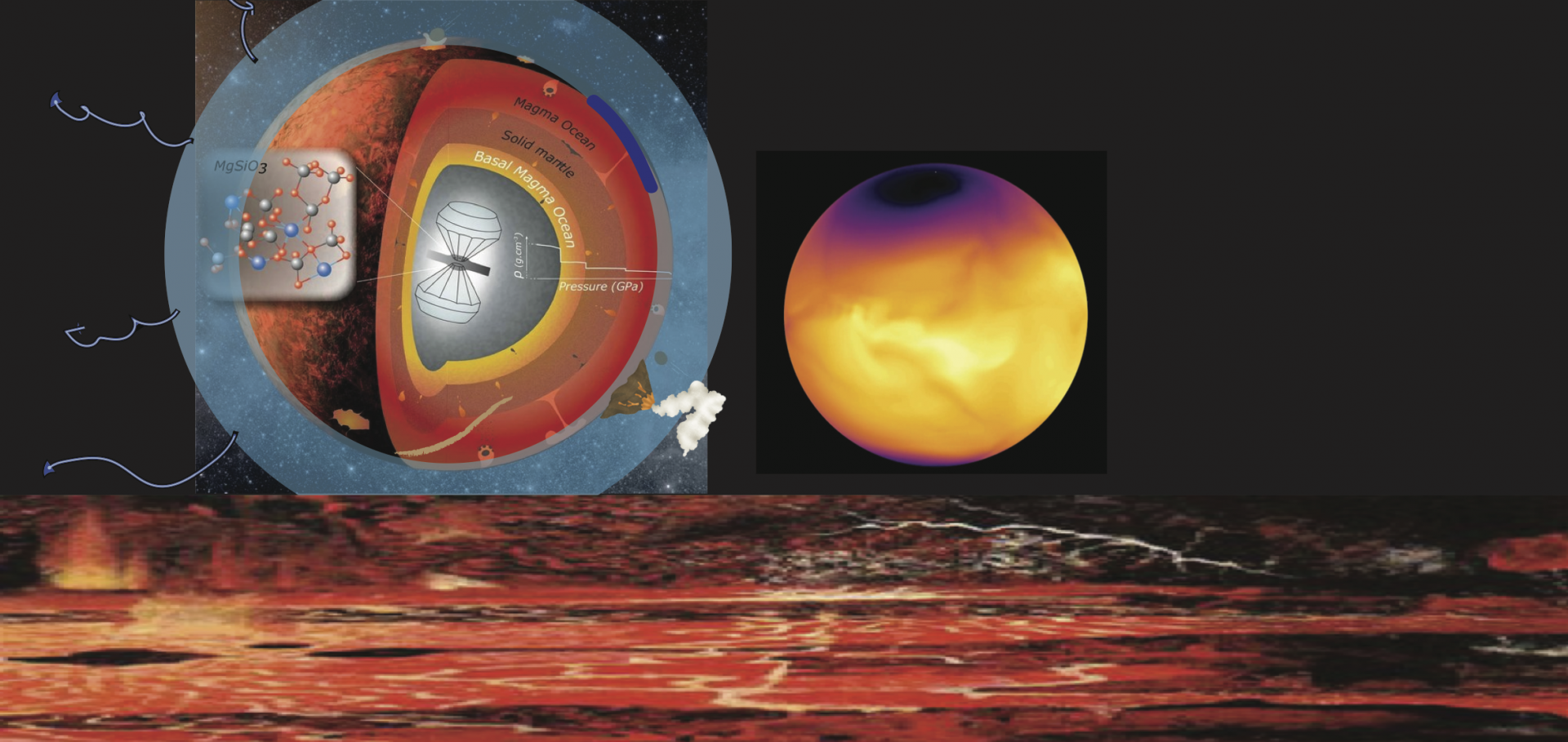
Abstract We demonstrate that the redox-sensitivity of mantle outgassing can trigger transient episodes of atmospheric reinflation in highly irradiated and geochemically reduced super-Earths, a mechanism we term “reflation.” Mantle redox governs the outgassing and speciation of CHONS volatiles, setting the background secondary atmospheric composition during extended photoevaporation at highly irradiated conditions. Using simulations of the coupled atmosphere–interior evolution of irradiated super-Earths, we illustrate that reduced mantles close to the iron–wüstite buffer initially produce CO-dominated atmospheres. Hydrodynamic escape continuously removes volatiles while outgassing from the melt replenishes the atmosphere with H 2 , converted from H 2 O dissolved in the underlying magma ocean. This leads to a late-stage transition from C- to H-dominated gas that transiently reinflates super-Earth atmospheres and decreases their bulk densities by up to ∼60% between several hundreds of megayears to a gigayear after their formation, prior to complete atmospheric erosion by photoevaporation. In contrast, oxidized mantles, closer to Earth-like geochemistry, strongly buffer their atmospheric composition while exposed to hydrodynamic escape, producing monotonic radius deflation. Reflation events are triggered by geochemically reduced mantles, intermediate escape efficiencies, high irradiation, and initial water inventories ≳ 5 Earth oceans. This redox-dependent evolutionary divergence hinges on the sensitive feedback between interior and atmospheric evolution serving as a potential tracer of historical geochemical state. Population-level reflation signatures of close-in super-Earths may thus serve as tracers of interior geochemistry and formation conditions.

Reflation: redox-driven atmospheric inflation as a tracer of super-Earth geochemistry

(2026)

Authors:

Lorenzo Cesario, Tim Lichtenberg, Mara Attia, Harrison Nicholls, Imre Kisvárdai, Quentin Changeat

Abstract:

Recent JWST observations have begun to constrain the atmospheres of highly irradiated super-Earth exoplanets. The dayside emission spectrum of the ultra-short-period super-Earth TOI-561 b is inconsistent with a bare-rock surface and instead favours a thick volatile envelope sustained over the system's roughly 10 Gyr lifetime (Teske et al. 2025). A volatile, likely CO/CO2-bearing secondary atmosphere has also been inferred for 55 Cancri e (Hu et al. 2024), with comparable indications now reported for additional ultra-short-period rocky planets (August et al. 2025; Monaghan et al. 2025; Park Coy et al. 2026). These detections challenge the canonical expectation that ultra-short-period rocky planets are stripped to bare rock by stellar irradiation, and motivate a coupled treatment of magma-ocean evolution and atmospheric loss to interpret them (Lichtenberg & Miguel 2025; Lichtenberg et al. 2025).We address this question with the open-source PROTEUS framework (Lichtenberg et al. 2021, Nicholls et al. 2024), which self-consistently advances the energy balance of a cooling rocky interior, the redox-controlled outgassing of CHONS volatiles between the magma ocean and the overlying atmosphere (Nicholls et al. 2024), the radiative-convective structure of the resulting secondary atmosphere (Nicholls et al. 2025), and energy-limited hydrodynamic escape driven by the host star's evolving XUV output. Starting from a fully molten state, we follow super-Earth analogues on ultra-short-period orbits through several Gyr while tracking the surface pressure, atmospheric composition, mean molecular weight, and observable bulk density as the interior and atmosphere co-evolve.We identify a new evolutionary climate pathway that we term reflation. In geochemically reduced super-Earths, with mantle oxygen fugacity near the iron-wuestite buffer, the initial outgassed atmosphere is dominated by CO while hydrogen remains stored as H2O dissolved in the underlying magma ocean. As hydrodynamic escape strips the CO-rich envelope, the dropping surface pressure releases this hydrogen reservoir, and equilibrium chemistry under reducing conditions converts much of it to H2. The transient transformation from a carbon-dominated to a hydrogen-dominated atmosphere lowers the mean molecular weight, expands the scale height, and reduces the planet's bulk density by up to roughly 60 percent over several hundred Myr to a few Gyr, before final atmospheric erosion. Oxidised, Earth-like mantles instead outgas heavy CO2- and SO2-rich envelopes that buffer the mean molecular weight throughout, producing monotonic deflation and substantially longer atmospheric survival.Mapping the parameter space of mantle oxygen fugacity, initial volatile inventory, escape efficiency, and orbital distance, we find that reflation events concentrate at oxygen fugacities within about two log units of the iron-wuestite buffer, intermediate escape efficiencies, semi-major axes inside roughly 0.05 au, and initial hydrogen inventories above five Earth-ocean equivalents. Reflation thus provides a direct, redox-sensitive link between deep interior geochemistry and a transient observable under-density on irradiated super-Earths, complementing emerging interpretations of individual systems such as L 98-59 d (Nicholls et al. 2026).We discuss the prospects for detecting reflated super-Earths in ongoing JWST programmes, including dedicated follow-up of TOI-561 b and other ultra-short-period super-Earths, and through population-level surveys with PLATO and Ariel, where joint constraints on age, radius, mass, and atmospheric composition may disentangle reflation from competing scenarios and open a direct observational window onto the mantle redox state of rocky exoplanets. References:August, P. C., Buchhave, L. A., Diamond-Lowe, H., et al. 2025, A&A, 695, A171.Cesario, L., Lichtenberg, T., Attia, M., Nicholls, H., Kisvardai, I., & Changeat, Q. 2026, submitted.Hu, R., Bello-Arufe, A., Zhang, M., et al. 2024, Nature, 630, 609.Lichtenberg, T., Bower, D. J., Hammond, M., et al. 2021, J. Geophys. Res. Planets, 126, e2020JE006711.Lichtenberg, T., & Miguel, Y. 2025, in Treatise on Geochemistry, vol. 7, Elsevier, 51-112.Lichtenberg, T., Shorttle, O., Teske, J. K., & Kempton, E. M.-R. 2025, Science, 390, eads3660.Monaghan, C., Roy, P.-A., Benneke, B., et al. 2025, AJ, 169, 239.Nicholls, H., Lichtenberg, T., Bower, D. J., & Pierrehumbert, R. T. 2024, J. Geophys. Res. Planets, 129, e2024JE008576.Nicholls, H., Pierrehumbert, R. T., Lichtenberg, T., Soucasse, L., & Smeets, S. 2025, MNRAS, 536, 2957.Nicholls, H., Lichtenberg, T., Chatterjee, R. D., Guimond, C. M., Postolec, E., & Pierrehumbert, R. T. 2026, Nature Astronomy.Park Coy, B., Xue, Q., Weiner Mansfield, M., et al. 2026, arXiv:2604.11911.Teske, J. K., Wallack, N. L., Piette, A. A. A., Dang, L., Lichtenberg, T., et al. 2025, ApJL, 995, L39.

Geophysical and atmospheric implications of fO2-dependent melting on rocky exoplanets

(2026)

Authors:

Mariana Sastre, Tim Lichtenberg, Laurent Soucasse, Dan Bower, Harrison Nicholls, Inga Kamp

Abstract:

The geochemical evolution of long-lived magma oceans is strongly regulated by volatile exchange between the molten mantle and the atmosphere. For planets inside the runaway-greenhouse limit, this coupled evolution can persist for billions of years, governing bulk density, surface conditions, and long-term geodynamics. However, most existing studies assume Earth-like (oxidized) conditions and neglect the influence of redox state on melt thermodynamics and volatile release. We quantify how experimentally derived, oxygen-fugacity-dependent melting curves implemented within the coupled interior-atmosphere framework PROTEUS propagate into the thermal structure, melt fraction, and rheological evolution of rocky exoplanet interiors, applying this to the short-period super-Earth GJ 1132 b. We find strongly non-linear thermal responses to variations in melting curves. In volatile-poor systems, reduced meltingcurves ( f O2 ≤ IW) promote earlier deep-mantle crystallisation relative to oxidised (IW + 2.0) and Earth-like (IW+4.0) cases (range IW−4.0 to IW+4.0), favouring late-stage surface magma oceans sustained by greenhouse warming, while oxidized melting curves maintain higher melt fractions and a vertically extended magma ocean. Reduced mantles produce massive H2-CO-rich atmospheres; oxidized mantles favour thinner H2O-CO2 envelopes. In volatile-rich systems, the interior reaches radiative equilibrium at high melt fractions, sustaining a steady-state global magma ocean in which melting curve variations do not significantly influence solidification timing. This indicates a hierarchical control: volatile inventory and surface oxygen fugacity act as the primary regulators of thermal state, while oxygen-fugacity-dependent melting relations provide a secondary modulation. These contrasting regimes produce distinct atmospheric compositions and formation timescales, offering testable spectral predictions for close-in rocky exoplanets evaluable with forthcoming JWST observations.

Three-dimensional Ocean Dynamics and Detectability of Tidally Locked Lava Worlds

Astrophysical Journal 1005:1 (2026)

Authors:

Y Lai, W Kang, J Yang, X Tan

Abstract:

Tidally locked lava planets are hot, rocky worlds on close-in orbits with a permanent molten dayside. With JWST, their surfaces and atmospheres are beginning to be revealed. This work investigates three-dimensional (3D) magma ocean dynamics, derives scaling laws for the resulting ocean heat transport, and predicts its detectability. For the first time, the ocean circulation driven by the intense momentum and mass exchanges with the supersonic atmosphere is considered in addition to that by thermal forcing. The wind forcing turns out to overwhelmingly dominate the other two mechanisms, driving ocean currents reaching ∼100 m s−1 and greatly expanding the latitudinal extent of the Matsuno–Gill response. Despite these extreme flow speeds, scaling analysis and 3D simulations consistently demonstrate that magma ocean circulation alone does not produce an observable hot-spot offset. This inefficiency arises because basin geometry and circulation structure fundamentally constrain zonal heat redistribution, suppressing large-scale longitudinal transport even under vigorous flow.

The Days Drag On on WASP-121 b: Interpreting Its NIRISS Spectroscopic Phase Curve with General Circulation Models

Astrophysical Journal 1004:1 (2026)

Authors:

RC Frazier, E Rauscher, J Splinter, TD Kennedy, X Tan, V Parmentier, I Malsky, LP Coulombe, R Allart, NB Cowan, D Lafrenière, R MacDonald, S Pelletier, L Dang, R Doyon, D Johnstone, L Kaltenegger, MR Meyer, C Piaulet-Ghorayeb, M Radica, JD Turner

Abstract:

Ultra-hot Jupiters (UHJs) present extreme atmospheric phenomena not found in the solar system. These planets’ daysides experience strong temperature inversions, molecular species (including H2) dissociate, and magnetism effects disrupt atmospheric circulation. On their nightsides, H2 can recombine and clouds may form. Spectroscopic phase curves allow us to measure these spatially inhomogeneous conditions, which can then be interpreted with three-dimensional (3D) models. In this work, we compare the JWST Near Infrared Imager and Slitless Spectrograph (or NIRISS) spectroscopic phase curve of the UHJ WASP-121 b to state-of-the-art 3D models with varying modeling assumptions, including the aforementioned physical phenomena. We demonstrate the importance of accurately accounting for the planet’s radius when comparing data and models, as it changes the implied overall planetary emission. We find that the 3D models predict planetary emission that is ∼12% higher than observed, contributing to the continued tension between measured and predicted hot Jupiter albedos. We identify multiple lines of evidence confirming a strong source of drag operating in this planet’s atmosphere. In addition, the nightside emission spectrum is devoid of strong absorption features, which may be best explained by nightside clouds. One feature of the dataset that is not reproduced by the 3D models is a trend toward increasingly eastward phase offsets at wavelengths shorter than ∼1.4 μm. This result is inconsistent with reflection from dayside clouds, nor can it be explained by removing atmospheric opacity sources. Our analysis highlights the complexities involved in generating 3D models and interpreting observations of UHJs in the JWST era.