

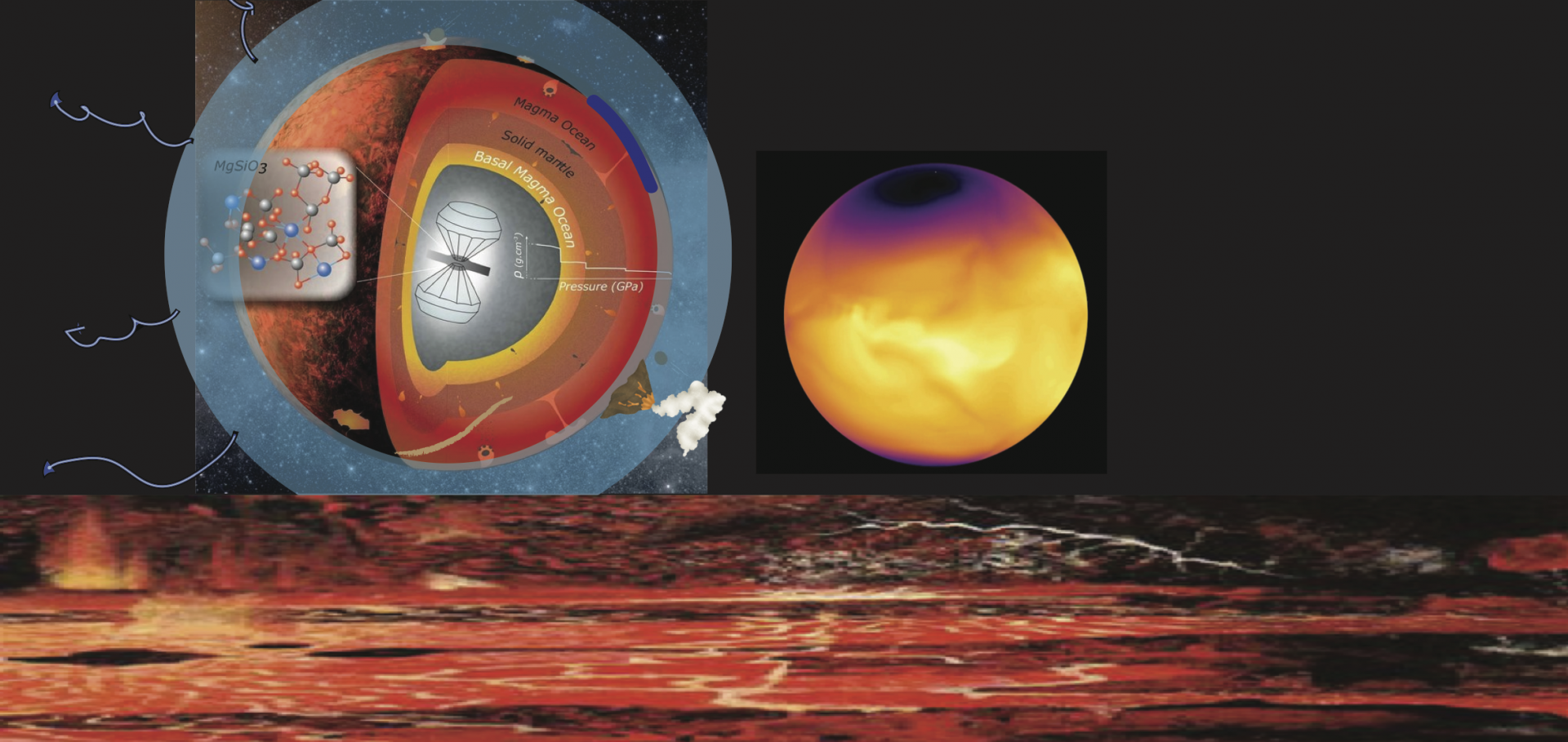
Redox processes of slightly-carbon-rich rocky planets
(2026)
Abstract:
Cloudy solutions for the clear skies of WASP-80b: 3D cloud feedback on the atmosphere and spectra of a warm Jupiter
Astronomy and Astrophysics 707 (2026)
Abstract:
Context. Close-in warm Jupiters orbiting M dwarf stars are expected to exhibit diverse atmospheric chemistry, with clouds playing a key role in shaping their albedo, heat distribution, and spectral properties. Aims. We study WASP-80b, a warm Jupiter orbiting an M dwarf star, using the latest JWST panchromatic emission and transmission spectra to comprehensively characterise its atmosphere, including cloud coverage, chemical composition, and particle sizes, and compare the observations with predictions from the general circulation models (GCMs). Methods. We used a GCM, ADAM (ADvanced Atmospheric MITgcm, formerly known as SPARC/MITgcm), combined with the latest JWST data to study the atmosphere of WASP-80b. A cloud module with radiatively active, tracer-based clouds was integrated with the GCM to study the effects on the atmosphere and the spectrum. Results. We find that the emission and transmission spectra of WASP-80b are only compatible with cloudless atmospheres or with clouds composed of sufficiently large particles, namely NaMantle Convection and Nightside Volcanism on Lava World K2-141 b
Monthly Notices of the Royal Astronomical Society Oxford University Press (OUP) (2026) stag390
Abstract:
Abstract Ultra-short period lava worlds offer a unique window into the coupled evolution of planetary interior and atmospheres under extreme irradiation. In this study, we investigate the mantle dynamics, nightside volcanism, and volatile outgassing on lava world K2-141 b (1.54 R⊕, 5.31 M⊕) using two-dimensional convection models with tracer-based volatile tracking. Our simulations explore a range of interior configurations, including models with and without plastic yielding, basal versus mixed heating, core cooling, and melt intrusion. In models without plastic yielding (i.e. with a strong lithosphere), we find that mantle upwellings form at the substellar and antistellar points, while downwellings form near the day-night terminators at the boundary between the magma ocean and cold, solid nightside. These downwellings facilitate the recycling of crustal material, representing a form of asymmetric, single-lid tectonics. The resulting magma ocean thickness varies from 200 to 300 km depending on the model parameters, corresponding to about 2-3 % of the planet’s radius. Continuous nightside volcanism produces a basaltic crust and gradually depletes the mantle of volatiles. We find that over a billion years, volcanic eruptions can outgas tens of bars of CO2 and H2O. We show that even relatively large volcanic eruptions on the nightside produce thermal emission signals of no more than 1 ppm, remaining below the current detectability threshold in thermal phase curves. However, for most models, outgassing rates are increased near the day-night terminators and future studies should assess whether such localised outgassing could lead to atmospheric signatures in transmission spectroscopy.Diurnal Variability Modulates Episodic Convection in Hothouse Climates Over Ocean and Swamp‐Like Surface Conditions
Journal of Advances in Modeling Earth Systems Wiley 18:2 (2026) e2025MS004992
Abstract:
Plain Language Summary: In hot and wet “hothouse” climate conditions, rainfall transitions from a pattern that fluctuates from about a mean of 3 mm day − 1 ${\text{day}}^{-1}$ to more intense outbursts that are separated by multi‐day dry spells. Previous studies on hothouse climates did not consider the role of the diurnal cycle even though it strongly controls precipitation in Earth's current climate. This study uses radiative‐convective equilibrium simulations to investigate the impact of rising temperatures on the transition to hothouse conditions, incorporating the diurnal cycle with both swamp‐like and open ocean surface conditions. We find that episodic precipitation occurs at surface temperatures above 322 K even when accounting for the diurnal cycle. However, the diurnal cycle significantly influences the timing of convection and rainfall at high temperatures with precipitation primarily starting late at night or in the early morning.Novel Physics of Escaping Secondary Atmospheres May Shape the Cosmic Shoreline
The Astrophysical Journal American Astronomical Society 998:2 (2026) 236