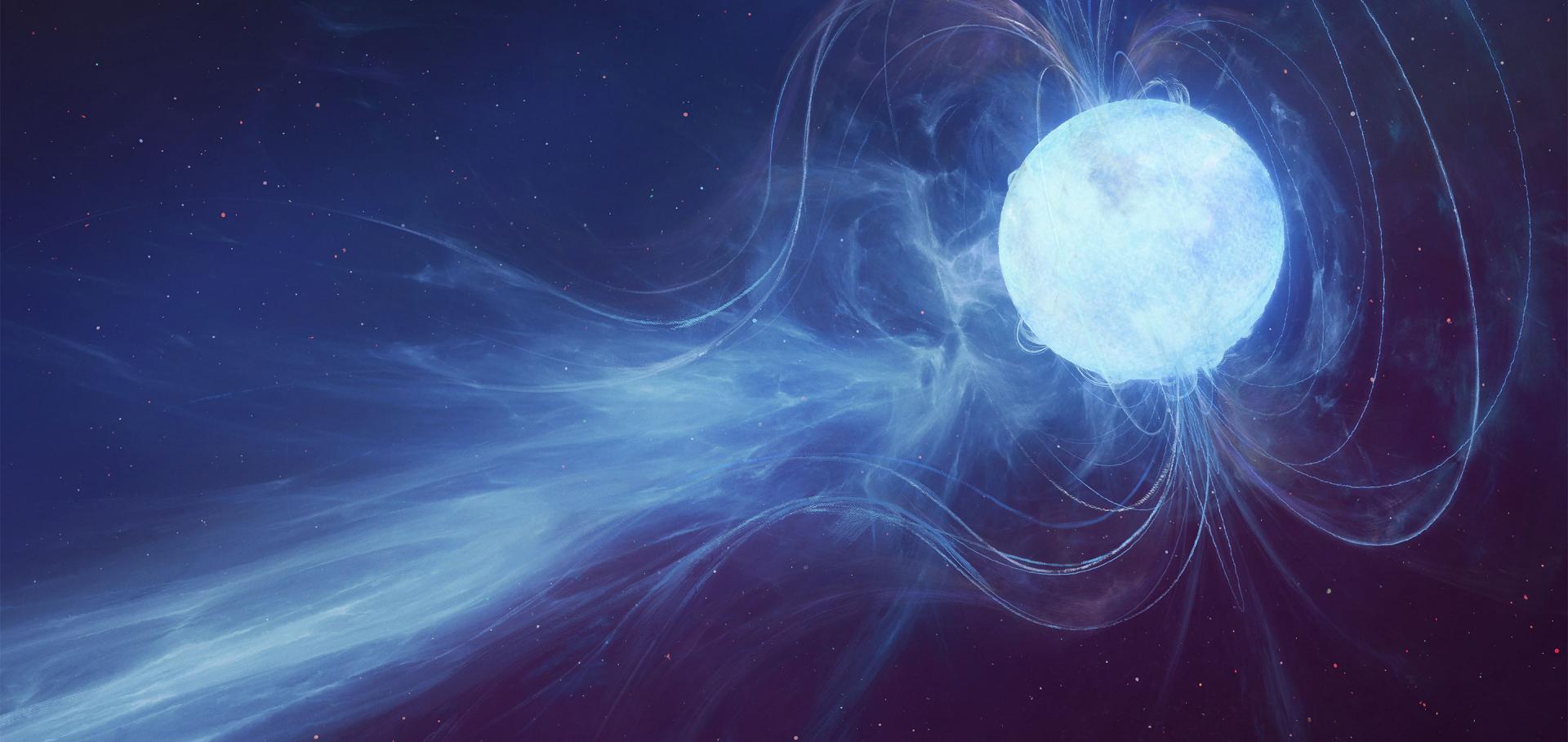
Bright X-ray pulsars as sources of MeV neutrinos in the sky

Monthly Notices of the Royal Astronomical Society Oxford University Press (OUP) 522:3 (2023) 3405-3411

Authors:

Aman Asthana, Alexander A Mushtukov, Alexandra A Dobrynina, Igor S Ognev

Multiwavelength observations of the extraordinary accretion event AT2021lwx

Monthly Notices of the Royal Astronomical Society Oxford University Press (OUP) 522:3 (2023) 3992-4002

Authors:

P Wiseman, Y Wang, S Hönig, N Castro-Segura, P Clark, C Frohmaier, MD Fulton, G Leloudas, M Middleton, TE Müller-Bravo, A Mummery, M Pursiainen, SJ Smartt, K Smith, M Sullivan, JP Anderson, JA Acosta Pulido, P Charalampopoulos, M Banerji, M Dennefeld, L Galbany, M Gromadzki, CP Gutiérrez, N Ihanec, E Kankare, A Lawrence, B Mockler, T Moore, M Nicholl, F Onori, T Petrushevska, F Ragosta, S Rest, M Smith, T Wevers, R Carini, T-W Chen, K Chambers, H Gao, M Huber, C Inserra, E Magnier, L Makrygianni, M Toy, F Vincentelli, DR Young

The Young Supernova Experiment Data Release 1 (YSE DR1): Light Curves and Photometric Classification of 1975 Supernovae

The Astrophysical Journal: Supplement Series American Astronomical Society 266:1 (2023) 9-9

Authors:

PD Aleo, K Malanchev, S Sharief, DO Jones, G Narayan, RJ Foley, VA Villar, CR Angus, VF Baldassare, MJ Bustamante-Rosell, D Chatterjee, C Cold, DA Coulter, KW Davis, S Dhawan, MR Drout, A Engel, KD French, A Gagliano, C Gall, J Hjorth, ME Huber, WV Jacobson-Galán, CD Kilpatrick, D Langeroodi

Abstract:

We present the Young Supernova Experiment Data Release 1 (YSE DR1), comprised of processed multicolor PanSTARRS1 griz and Zwicky Transient Facility (ZTF) gr photometry of 1975 transients with host-galaxy associations, redshifts, spectroscopic and/or photometric classifications, and additional data products from 2019 November 24 to 2021 December 20. YSE DR1 spans discoveries and observations from young and fast-rising supernovae (SNe) to transients that persist for over a year, with a redshift distribution reaching z approximate to 0.5. We present relative SN rates from YSE's magnitude- and volume-limited surveys, which are consistent with previously published values within estimated uncertainties for untargeted surveys. We combine YSE and ZTF data, and create multisurvey SN simulations to train the ParSNIP and SuperRAENN photometric classification algorithms; when validating our ParSNIP classifier on 472 spectroscopically classified YSE DR1 SNe, we achieve 82% accuracy across three SN classes (SNe Ia, II, Ib/Ic) and 90% accuracy across two SN classes (SNe Ia, core-collapse SNe). Our classifier performs particularly well on SNe Ia, with high (>90%) individual completeness and purity, which will help build an anchor photometric SNe Ia sample for cosmology. We then use our photometric classifier to characterize our photometric sample of 1483 SNe, labeling 1048 (similar to 71%) SNe Ia, 339 (similar to 23%) SNe II, and 96 (similar to 6%) SNe Ib/Ic. YSE DR1 provides a training ground for building discovery, anomaly detection, and classification algorithms, performing cosmological analyses, understanding the nature of red and rare transients, exploring tidal disruption events and nuclear variability, and preparing for the forthcoming Vera C. Rubin Observatory Legacy Survey of Space and Time.

Photometry and spectroscopy of the Type Icn supernova 2021ckj

Astronomy & Astrophysics EDP Sciences 673 (2023) a27

Authors:

T Nagao, H Kuncarayakti, K Maeda, T Moore, A Pastorello, S Mattila, K Uno, SJ Smartt, SA Sim, L Ferrari, L Tomasella, JP Anderson, T-W Chen, L Galbany, H Gao, M Gromadzki, CP Gutiérrez, C Inserra, E Kankare, EA Magnier, TE Müller-Bravo, A Reguitti, DR Young

MAXI J1848-015: The first detection of relativistically moving outflows from a globular cluster X-ray binary

Astrophysical Journal Letters IOP Publishing 948 (2023) L7

Authors:

A Bahramian, E Tremou, Aj Tetarenko, Jca Miller-Jones, Rp Fender, S Corbel, Dra Williams, J Strader, F Carotenuto, R Salinas, Ja Kennea, Se Motta, Pa Woudt, Jh Matthews, Td Russell

Abstract:

Over the past decade, observations of relativistic outflows from outbursting X-ray binaries in the Galactic field have grown significantly. In this work, we present the first detection of moving and decelerating radio-emitting outflows from an X-ray binary in a globular cluster. MAXI J1848−015 is a recently discovered transient X-ray binary in the direction of the globular cluster GLIMPSE-C01. Using observations from the Karl G. Jansky Very Large Array, and a monitoring campaign with the MeerKAT observatory for 500 days, we model the motion of the outflows. This represents some of the most intensive, long-term coverage of relativistically moving X-ray binary outflows to date. We use the proper motions of the outflows from MAXI J1848−015 to constrain the component of the intrinsic jet speed along the line of sight, β int cos θ ejection , to be =0.19 ± 0.02. Assuming it is located in GLIMPSE-C01, at 3.4 kpc, we determine the intrinsic jet speed, β int = 0.79 ± 0.07, and the inclination angle to the line of sight, θ ejection = 76° ± 2°. This makes the outflows from MAXI J1848−015 somewhat slower than those seen from many other known X-ray binaries. We also constrain the maximum distance to MAXI J1848−015 to be 4.3 kpc. Finally, we discuss the implications of our findings for the nature of the compact object in this system, finding that a black hole primary is a viable (but as-of-yet unconfirmed) explanation for the observed properties of MAXI J1848−015. If future data and/or analysis provide more conclusive evidence that MAXI J1848−015 indeed hosts a black hole, it would be the first black hole X-ray binary in outburst identified in a Galactic globular cluster.