

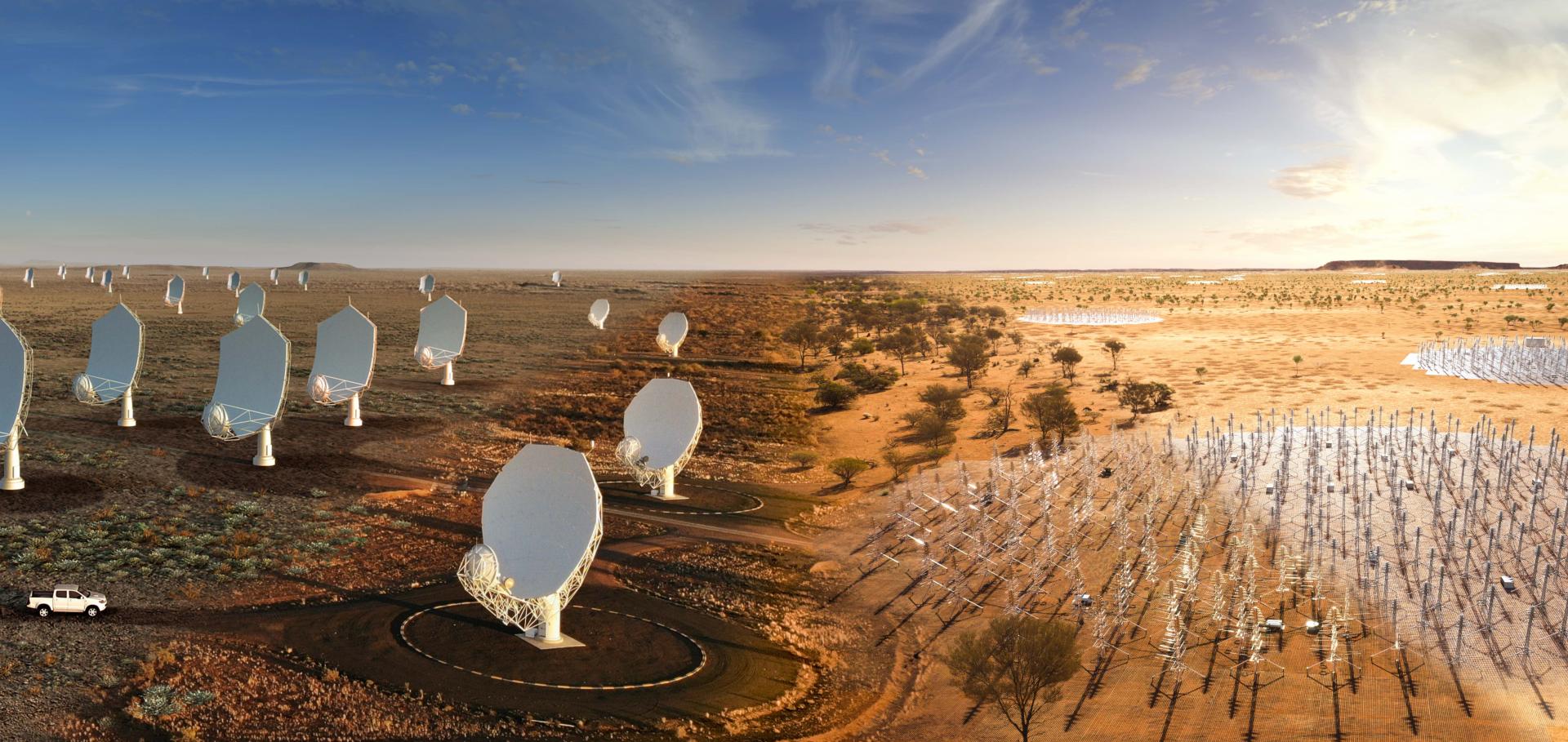
A MeerKAT view of the double pulsar eclipses
Astronomy & Astrophysics EDP Sciences 682 (2023) A26-A26
Abstract:
The double pulsar system, PSR J0737−3039A/B, consists of two neutron stars bound together in a highly relativistic orbit that is viewed nearly edge-on from the Earth. This alignment results in brief radio eclipses of the fast-rotating pulsar A when it passes behind the toroidal magnetosphere of the slow-rotating pulsar B. The morphology of these eclipses is strongly dependent on the geometric orientation and rotation phase of pulsar B, and their time evolution can be used to constrain the geodetic precession rate of the pulsar. We demonstrate a Bayesian inference framework for modelling high-sensitivity eclipse light curves obtained with MeerKAT between 2019 and 2023. Using a hierarchical inference approach, we obtained a precession rate of $ \Omega_{\mathrm{SO}}^{\mathrm{B}} = {5.16^\circ}^{+0.32^\circ}_{-0.34^\circ} $ yr−1 (68% confidence intervals) for pulsar B, consistent with predictions from general relativity to a relative uncertainty of 6.5%. This updated measurement provides a 6.1% test of relativistic spin-orbit coupling in the strong-field regime. We show that a simultaneous fit to all of our observed eclipses can in principle return a ∼1.5% test of spin-orbit coupling. However, systematic effects introduced by the current geometric orientation of pulsar B along with inconsistencies between the observed and predicted eclipse light curves result in difficult to quantify uncertainties when using this approach. Assuming the validity of general relativity, we definitively show that the spin axis of pulsar B is misaligned from the total angular momentum vector by 40.6° ±0.1° and that the orbit of the system is inclined by approximately 90.5° from the direction of our line of sight. Our measured geometry for pulsar B suggests the largely empty emission cone contains an elongated horseshoe-shaped beam centred on the magnetic axis, and that it may not be re-detected as a radio pulsar until early 2035Impact of Galactic dust non-Gaussianity on searches for B-modes from inflation
Monthly Notices of the Royal Astronomical Society Oxford University Press (OUP) 527:3 (2023) 5751-5766
Abstract:
<jats:title>ABSTRACT</jats:title> <jats:p>A key challenge in the search for primordial B-modes is the presence of polarized Galactic foregrounds, especially thermal dust emission. Power-spectrum-based analysis methods generally assume the foregrounds to be Gaussian random fields when constructing a likelihood and computing the covariance matrix. In this paper, we investigate how non-Gaussianity in the dust field instead affects CMB and foreground parameter inference in the context of inflationary B-mode searches, capturing this effect via modifications to the dust power-spectrum covariance matrix. For upcoming experiments such as the Simons Observatory, we find no dependence of the tensor-to-scalar ratio uncertainty $\sigma (r)$ on the degree of dust non-Gaussianity or the nature of the dust covariance matrix. We provide an explanation of this result, noting that when frequency decorrelation is negligible, dust in mid-frequency channels is cleaned using high-frequency data in a way that is independent of the spatial statistics of dust. We show that our results hold also for non-zero levels of frequency decorrelation that are compatible with existing data. We find, however, that neglecting the impact of dust non-Gaussianity in the covariance matrix can lead to inaccuracies in goodness-of-fit metrics. Care must thus be taken when using such metrics to test B-mode spectra and models, although we show that any such problems can be mitigated by using only cleaned spectrum combinations when computing goodness-of-fit statistics.</jats:p>A MeerKAT view of the double pulsar eclipses -- Geodetic precession of pulsar B and system geometry
(2023)
Extragalactic magnetism with SOFIA (SALSA Legacy Program). VII. A tomographic view of far-infrared and radio polarimetric observations through MHD simulations of galaxies
(2023)
FRB 20210405I: a nearby Fast Radio Burst localized to sub-arcsecond precision with MeerKAT
Monthly Notices of the Royal Astronomical Society Oxford University Press (OUP) 527:2 (2023) 3659-3673