

The photometric structure of the inner Galaxy
Monthly Notices of the Royal Astronomical Society Blackwell Publishing Inc. (1997)
Abstract:
The light distribution in the inner few kiloparsecs of the Milky Way is recovered non-parametrically from a dust-corrected near-infrared COBE/DIRBE surface brightness map of the inner Galaxy. The best fits to the photometry are obtained when the Sun is assumed to lie $\sim14\pm4\pc$ below the plane. The recovered density distributions clearly show an elongated three-dimensional bulge set in a highly non-axisymmetric disk. In the favoured models, the bulge has axis ratios $1{:}0.6{:}0.4$ and semi-major axis length $\sim2\kpc$. Its nearer long axis lies in the first quadrant. The bulge is surrounded by an elliptical disk that extends to $\sim2\kpc$ on the minor axis and $\sim3.5\kpc$ on the major axis. In all models there is a local density minimum $\sim2.2\kpc$ down the minor axis. The subsequent maximum $\sim3\kpc$ down the minor axis (corresponding to $l\simeq-22\deg$ and $l\simeq 17\deg$) may be associated with the Lagrange point L$_4$. From this identification and the length of the bulge-bar, we infer a pattern speed $\Omega_b\simeq 60-70\kms\kpc^{-1}$ for the bar. Experiments in which pseudo-data derived from models with spiral structure were deprojected under the assumption that the Galaxy is either eight-fold or four-fold symmetric, indicate that the highly non-axisymmetric disks recovered from the COBE data could reflect spiral structure within the Milky Way if that structure involves density contrasts greater than $\gta 3$ at NIR wavelengths. These experiments indicate that the angle $\phi_0$ between the Sun--centre line and a major axis of the bulge lies near $20\deg$.Spectroscopic evidence for a supermassive black hole in NGC 4486B
Astrophysical Journal Letters 482:2 (1997) L139-L142
Abstract:
T The stellar kinematics of the low-luminosity elliptical galaxy NGC 4486B have been measured in seeing s∗5 0-22 with the Canada-France-Hawaii Telescope and Subarcsecond Imaging Spectrograph. Lauer and collaborators have shown that NGC 4486B is similar to M31 in having a double nucleus. Here we show that it also resembles M31 in its kinematics. Like M31, NGC 4486B rotates fairly rapidly near the center (V 5 76 H 7 kms21 at 0-6) but more slowly farther out (V 3 20 H 6 km s21 at r 3 40). Also, the velocity dispersion gradient is very steep: s increases from 116 H 6 km s21 at r 5 20-60 to s 5 281 H 11 km s21 at the center. This is much higher than expected for an elliptical galaxy of absolute magnitude MB 3 216.8: even more than M31, NGC 4486B is far above the scatter in the Faber-Jackson correlation between s and bulge luminosity. Therefore, the King core mass-to-light ratio, M/LV 3 20, is unusually high compared with normal values for old stellar populations (M/LV 5 4 H 1 at MB 3 217). We construct simple dynamical models with isotropic velocity dispersions and show that they reproduce black hole (BH) masses derived by more detailed methods. We also fit axisymmetric, three-integral models. Isotropic models imply that NGC 4486B contains a central dark object, probably a BH, of mass MF 5 622 13 3 108 MJ. However, anisotropic models fit the data without a BH if the ratio of radial to azimuthal dispersions is 12 at r 3 10. Therefore, this is a less strong BH detection than the ones in M31, M32,and NGC 3115. A dark mass of 6 3 108 MJ is 19% of the mass Mbulge in stars; even if MF is somewhat smaller than the isotropic value, MF/Mbulge is likely to be unusually large. Double nuclei are a puzzle because the dynamical friction timescales for self-gravitating star clusters in close orbit around each other are short. Since both M31 and NGC 4486B contain central dark objects, our results support models in which the survival of a double nucleus is connected with the presence of a BH. For example, they support the Keplerian eccentric disk model due to Tremaine.Spectroscopic Evidence for a Supermassive Black Hole in NGC 4486B
(1997)
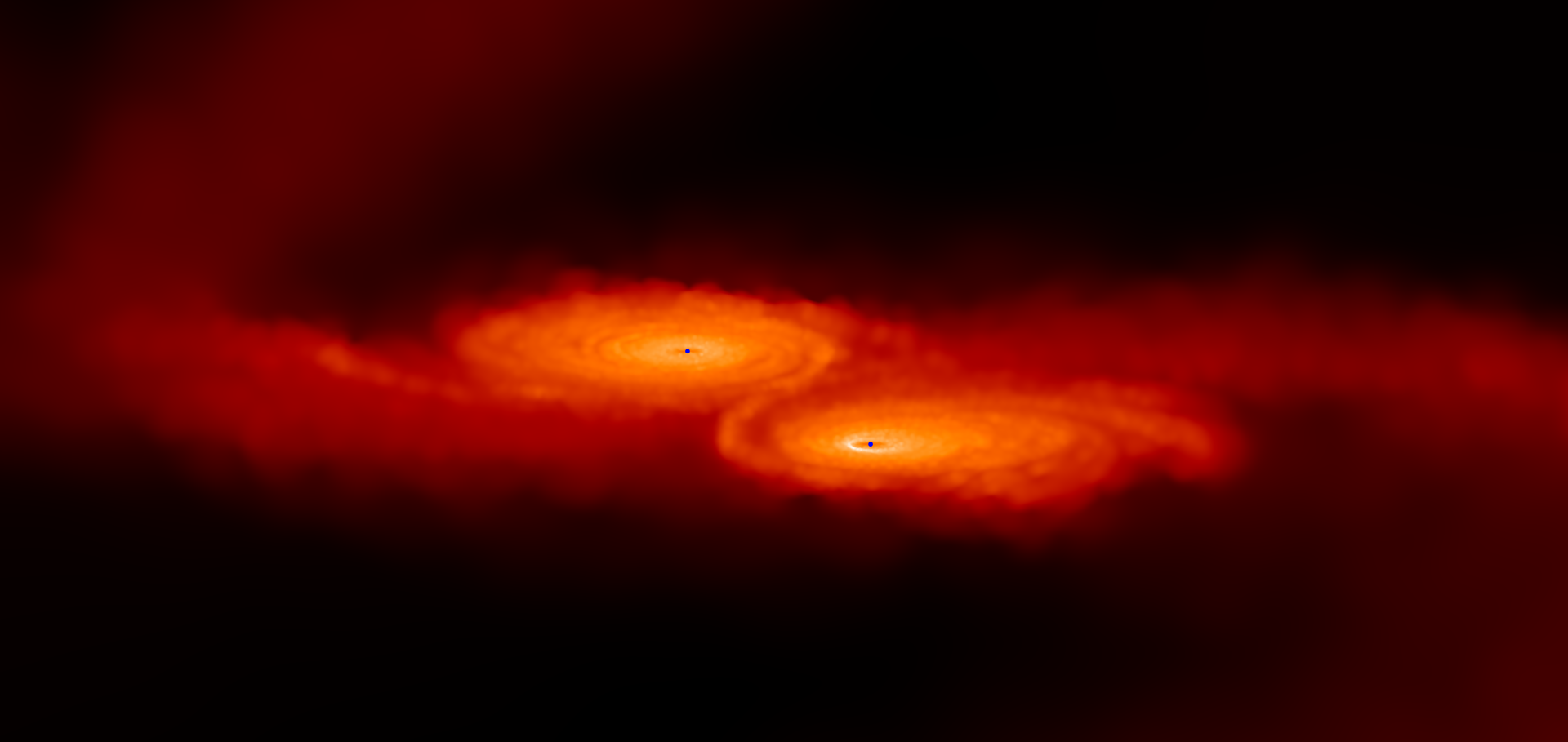
Precessing warped discs in close binary systems
ArXiv astro-ph/9701106 (1997)