
Home
Department Of Physics text logo
  • Research
    • Our research
    • Our research groups
    • Our research in action
    • Research funding support
    • Summer internships for undergraduates
  • Study
    • Undergraduates
    • Postgraduates
  • Engage
    • For young people
    • For teachers
    • For the public
    • For alumni
    • For business
  • Support
Menu
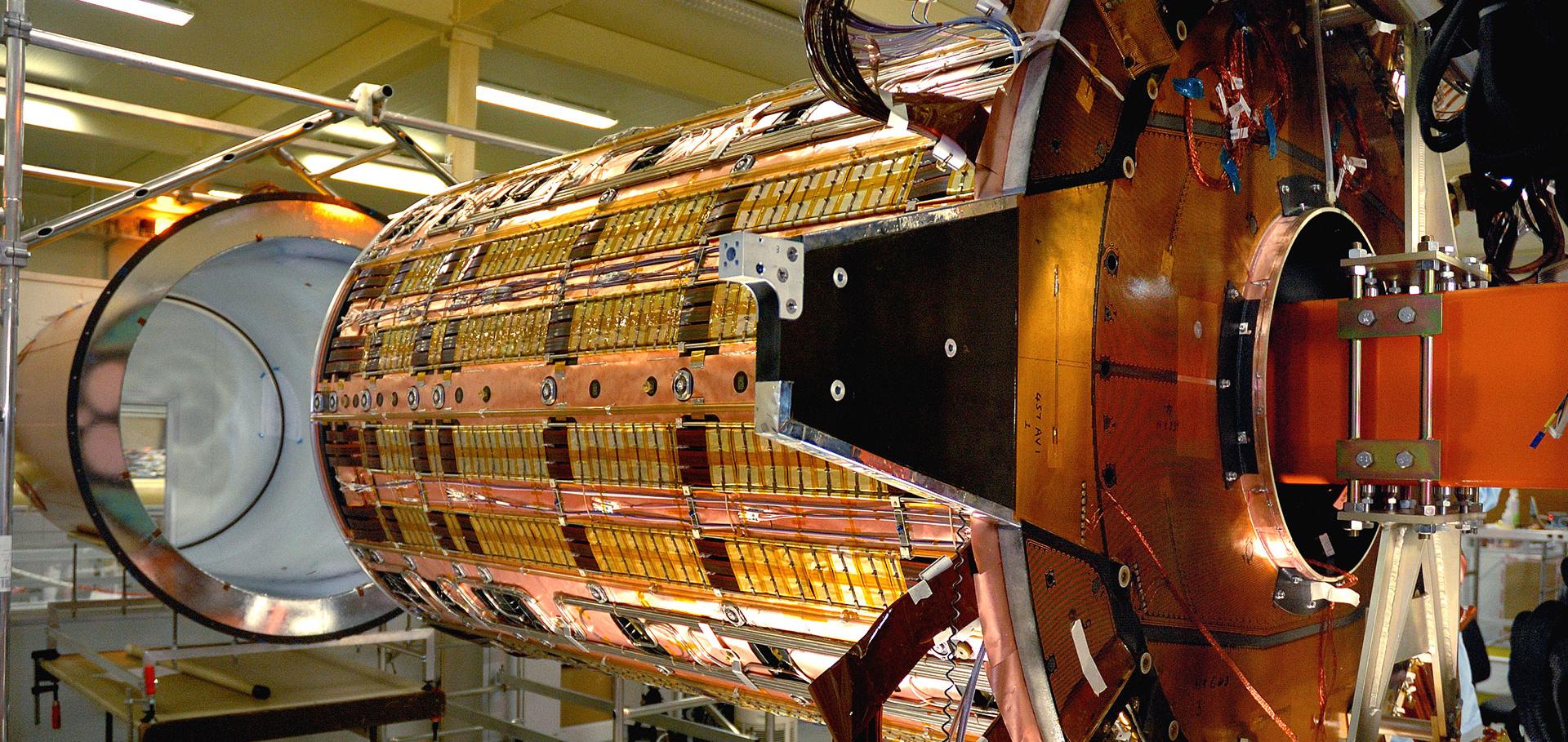
Insertion of STC into TRT at the Department of Physics, Oxford
Credit: CERN

Professor Daniela Bortoletto

Professor and Head of Particle Physics

Research theme

  • Instrumentation
  • Fundamental particles and interactions

Sub department

  • Particle Physics

Research groups

  • AION/Magis
  • ATLAS
  • Future Colliders
  • Mu3e
  • OPMD
daniela.bortoletto@physics.ox.ac.uk
Telephone: 01865 (2)73635
Denys Wilkinson Building, room 608c1
  • About
  • Students
  • Research
  • Teaching
  • Publications

Automatic selection of correlated double sampling timing parameters

Journal of Astronomical Telescopes, Instruments, and Systems Society of Photo-optical Instrumentation Engineers 5:4 (2019)

Authors:

Daniel Weatherill, Ian Shipsey, Kirk Arndt, Richard Plackett, Daniel Wood, Kaloyan Metodiev, Maria Mironova, Daniela Bortoletto, N Demetriou

Abstract:

Correlated double sampling (CDS) is a process used in many charge-coupled device readout systems to cancel the reset noise component that would otherwise dominate. CDS processing typically consists of subtracting the integrated video signal during a “signal” period from that during a “reset” period. The response of this processing depends, therefore, on the shape of the video signal with respect to the integration bounds. In particular, the amount of noise appearing in the final image and the linearity of the pixel value with signal charge are affected by the choice of the CDS timing intervals. We use a digital CDS readout system which highly oversamples the video signal (as compared with the pixel rate) to reconstruct pixel values for different CDS timings using identical raw video signal data. We use this technique to develop insights into optimal strategy for selecting CDS timings both in the digital case (where the raw video signal may be available) and in the general case (where it is not). In particular, we show that the linearity of the CDS operation allows subtraction of the raw video signals of pixels in bias images from those in illuminated images to directly show the effects of CDS processing on the final (subtracted) pixel values.
More details from the publisher
Details from ORA
More details
More details
Details from ArXiV

Search for electroweak production of charginos and sleptons decaying into final states with two leptons and missing transverse momentum in $\sqrt{s}=13$ TeV $pp$ collisions using the ATLAS detector

ArXiv 1908.08215 (2019)
Details from ArXiV

Search for flavour-changing neutral currents in processes with one top quark and a photon using 81 fb$^{-1}$ of $pp$ collisions at $\sqrt{s} = 13$ TeV with the ATLAS experiment

ArXiv 1908.08461 (2019)
Details from ArXiV

Search for supersymmetry in final states with two same-sign or three leptons and jets using 36 fb(-1) of root s = 13 TeV pp collision data with the ATLAS detector (vol 09, 084, 2017)

JOURNAL OF HIGH ENERGY PHYSICS 2019:8 (2019) ARTN 121

Authors:

M Aaboud, G Aad, B Abbott, Dc Abbott, O Abdinov, B Abeloos, Dk Abhayasinghe, Sh Abidi, Os AbouZeid, Nl Abraham, H Abramowicz, H Abreu, Y Abulaiti, Bs Acharya, S Adachi, L Adam, L Adamczyk, L Adamek, J Adelman, M Adersberger, A Adiguzel, T Adye, Aa Affolder, Y Afik, C Agheorghiesei, Ja Aguilar-Saavedra, F Ahmadov, G Aielli, S Akatsuka, Tpa Akesson, E Akilli, Av Akimov, Gl Alberghi, J Albert, P Albicocco, Mj Alconada Verzini, S Alderweireldt, M Aleksa, In Aleksandrov, C Alexa, D Alexandre, T Alexopoulos, M Alhroob, B Ali, G Alimonti, J Alison, Sp Alkire, C Allaire, Bmm Allbrooke, Bw Allen

Abstract:

© 2019, The Author(s). One correction is made to the figure 4e of the paper.
More details from the publisher
More details

Measurements of top-quark pair differential and double-differential cross-sections in the $\ell$+jets channel with $pp$ collisions at $\sqrt{s}=13$ TeV using the ATLAS detector

ArXiv 1908.07305 (2019)
Details from ArXiV

Pagination

  • First page First
  • Previous page Prev
  • …
  • Page 275
  • Page 276
  • Page 277
  • Page 278
  • Current page 279
  • Page 280
  • Page 281
  • Page 282
  • Page 283
  • …
  • Next page Next
  • Last page Last

Footer Menu

  • Contact us
  • Giving to the Dept of Physics
  • Work with us
  • Media

User account menu

  • Log in

Follow us

FIND US

Clarendon Laboratory,

Parks Road,

Oxford,

OX1 3PU

CONTACT US

Tel: +44(0)1865272200

University of Oxfrod logo Department Of Physics text logo
IOP Juno Champion logo Athena Swan Silver Award logo

© University of Oxford - Department of Physics

Cookies | Privacy policy | Accessibility statement

Built by: Versantus

  • Home
  • Research
  • Study
  • Engage
  • Our people
  • News & Comment
  • Events
  • Our facilities & services
  • About us
  • Giving to Physics
  • Current students
  • Staff intranet