Home
Department Of Physics text logo
  • Research
    • Our research
    • Our research groups
    • Our research in action
    • Research funding support
    • Summer internships for undergraduates
  • Study
    • Undergraduates
    • Postgraduates
  • Engage
    • For alumni
    • For business
    • For schools
    • For the public
  • Support
Menu
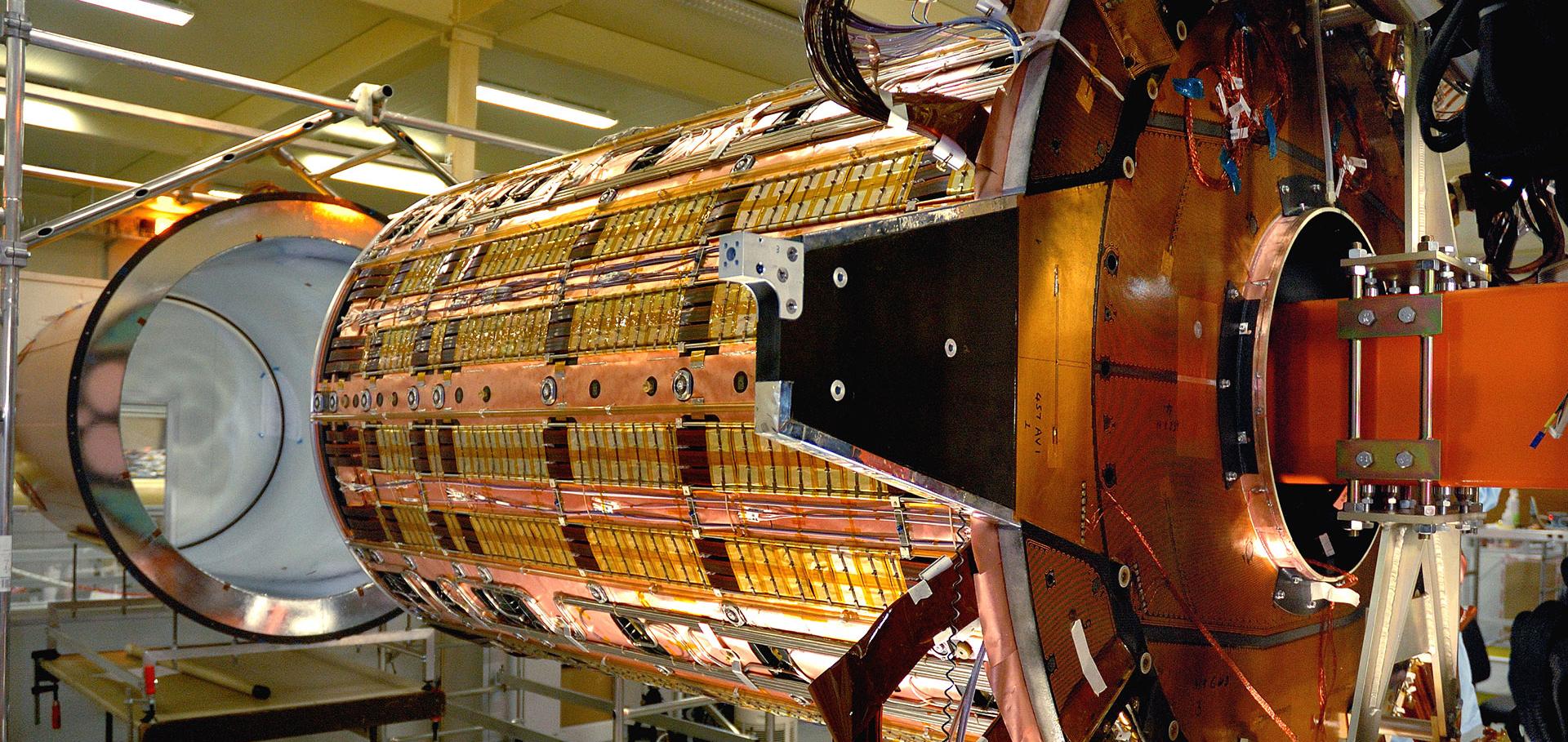
Insertion of STC into TRT at the Department of Physics, Oxford
Credit: CERN

Professor Daniela Bortoletto

Professor and Head of Particle Physics

Research theme

  • Instrumentation
  • Fundamental particles and interactions

Sub department

  • Particle Physics

Research groups

  • AION/Magis
  • ATLAS
  • Future Colliders
  • Mu3e
  • OPMD
daniela.bortoletto@physics.ox.ac.uk
Telephone: 01865 (2)73635
Denys Wilkinson Building, room 608c1
  • About
  • Students
  • Research
  • Teaching
  • Publications

ATLAS searches for additional scalars and exotic Higgs boson decays with the LHC Run 2 dataset

ArXiv 2405.04914 (2024)
Details from ArXiV

Observation of $t\bar{t}$ production in the lepton+jets and dilepton channels in $p$+Pb collisions at $\sqrt{s_\mathrm{NN}}=8.16$ TeV with the ATLAS detector

ArXiv 2405.05078 (2024)
Details from ArXiV

Underlying-event studies with strange hadrons in $pp$ collisions at $\sqrt{s} = 13$ TeV with the ATLAS detector

ArXiv 2405.05048 (2024)
Details from ArXiV

Calibration of a soft secondary vertex tagger using proton-proton collisions at $\sqrt{s}=$13 TeV with the ATLAS detector

ArXiv 2405.03253 (2024)
Details from ArXiV

The ATLAS Alarm Helper

EPJ Web of Conferences EDP Sciences 295 (2024) 02014-02014

Authors:

Florian Haslbeck, Carlos Solans Sánchez, Ignacio Asensi Tortajada, Daniela Bortoletto, André Rummler, Gustavo A Uribe

Abstract:

The Detector Safety System is the last line of defence to protect the ATLAS detector against abnormal and potentially even unforeseen situations. It is designed to return the detector to a safe state based on predefined actions triggered by alarms which are triggered on their part by specific sets of conditions. Every alarm whether it results in an action taken or not is followed up by the operations team that assesses the criticality, takes countermeasures and identifies the point of failure. From experience abnormal situations can result either from faults or from side effects of planned interventions which were either not properly identified despite the mandatory planning and review or where a mistake during execution occurred. In many cases there are multiple interventions ongoing simultaneously in order to profit from shutdown periods. The rapid analysis of alarms while the incident is ongoing is often complicated due to the complexity of the ATLAS detector and its infrastructure and the large number of responsible groups and experts. A new Alarm Helper tool was designed to assist the operation team, particularly the operator in the control room responsible for infrastructure and safety (SLIMOS – Shift Leader in Matters of Safety), by providing real-time information about ongoing interventions and the possible related causes of failure. The new tool will combine historical events, documentation, and limited knowledge about ongoing interventions. It extends the Expert System which visualizes and simulates infrastructure inter-dependencies and allows to trace faults or alarms to a list of potential points of failure. The new tool also proposes which experts should be contacted in the particular circumstances.
More details from the publisher
Details from ORA
More details

Pagination

  • First page First
  • Previous page Prev
  • …
  • Page 72
  • Page 73
  • Page 74
  • Page 75
  • Current page 76
  • Page 77
  • Page 78
  • Page 79
  • Page 80
  • …
  • Next page Next
  • Last page Last

Footer Menu

  • Contact us
  • Giving to the Dept of Physics
  • Work with us
  • Media

User account menu

  • Log in

Follow us

FIND US

Clarendon Laboratory,

Parks Road,

Oxford,

OX1 3PU

CONTACT US

Tel: +44(0)1865272200

University of Oxfrod logo Department Of Physics text logo
IOP Juno Champion logo Athena Swan Silver Award logo

© University of Oxford - Department of Physics

Cookies | Privacy policy | Accessibility statement

Built by: Versantus

  • Home
  • Research
  • Study
  • Engage
  • Our people
  • News & Comment
  • Events
  • Our facilities & services
  • About us
  • Giving to Physics
  • Current students
  • Staff intranet