
Home
Department Of Physics text logo
  • Research
    • Our research
    • Our research groups
    • Our research in action
    • Research funding support
    • Summer internships for undergraduates
  • Study
    • Undergraduates
    • Postgraduates
  • Engage
    • For young people
    • For teachers
    • For the public
    • For alumni
    • For business
  • Support
Menu
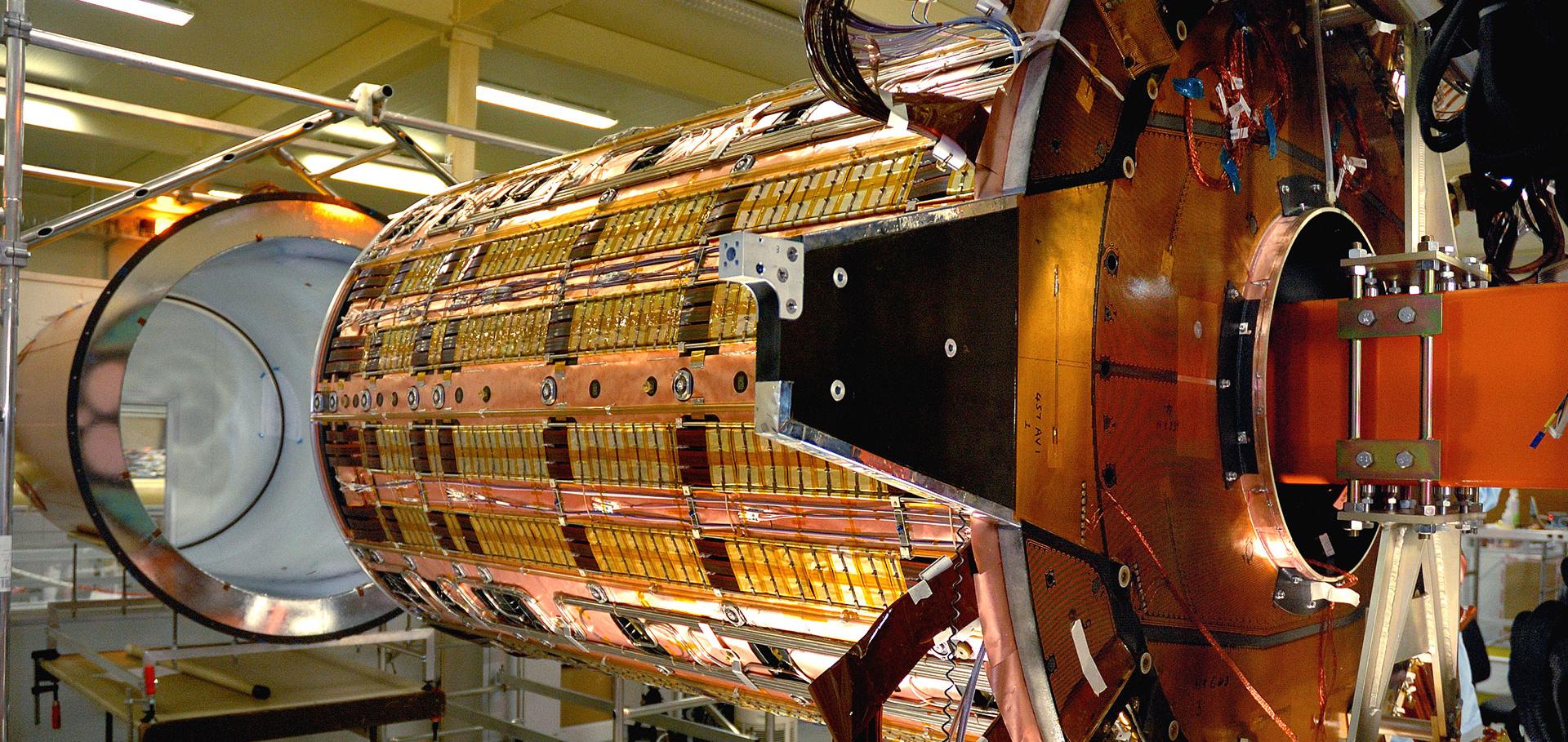
Insertion of STC into TRT at the Department of Physics, Oxford
Credit: CERN

Professor Daniela Bortoletto

Professor and Head of Particle Physics

Research theme

  • Instrumentation
  • Fundamental particles and interactions

Sub department

  • Particle Physics

Research groups

  • AION/Magis
  • ATLAS
  • Future Colliders
  • Mu3e
  • OPMD
daniela.bortoletto@physics.ox.ac.uk
Telephone: 01865 (2)73635
Denys Wilkinson Building, room 608c1
  • About
  • Students
  • Research
  • Teaching
  • Publications

Measurement of the B_c Meson Lifetime Using B_c ->J/Psi e nu

ArXiv hep-ex/0603027 (2006)

Authors:

CDF Collaboration, A Abulencia
Details from ArXiV

Measurement of mass and width of the excited charmed meson states D10 and D2*0 at CDF

Physical Review D Particles Fields Gravitation and Cosmology 73:5 (2006)

Authors:

A Abulencia, D Acosta, J Adelman, T Affolder, T Akimoto, MG Albrow, D Ambrose, S Amerio, D Amidei, A Anastassov, K Anikeev, A Annovi, J Antos, M Aoki, G Apollinari, JF Arguin, T Arisawa, A Artikov, W Ashmanskas, A Attal, F Azfar, P Azzi-Bacchetta, P Azzurri, N Bacchetta, H Bachacou, W Badgett, A Barbaro-Galtieri, VE Barnes, BA Barnett, S Baroiant, V Bartsch, G Bauer, F Bedeschi, S Behari, S Belforte, G Bellettini, J Bellinger, A Belloni, E Ben-Haim, D Benjamin, A Beretvas, J Beringer, T Berry, A Bhatti, M Binkley, D Bisello, M Bishai, RE Blair, C Blocker, K Bloom, B Blumenfeld, A Bocci, A Bodek, V Boisvert, G Bolla, A Bolshov, D Bortoletto, J Boudreau, S Bourov, A Boveia, B Brau, C Bromberg, E Brubaker, J Budagov, HS Budd, S Budd, K Burkett, G Busetto, P Bussey, KL Byrum, S Cabrera, M Campanelli, M Campbell, F Canelli, A Canepa, D Carlsmith, R Carosi, S Carron, M Casarsa, A Castro, P Catastini, D Cauz, M Cavalli-Sforza, A Cerri, L Cerrito, SH Chang, J Chapman, YC Chen, M Chertok, G Chiarelli, G Chlachidze, F Chlebana, I Cho, K Cho, D Chokheli, JP Chou, PH Chu, SH Chuang, K Chung, WH Chung

Abstract:

We report on precision measurements of the masses and widths of the narrow, orbitally excited states D10 and D2*0 using the CDF II detector at the Fermilab Tevatron. Both states (collectively called D**) are reconstructed in the decay channel D**→D*+π-. The D2*0 is also reconstructed in the D**→D+π- channel. Using a data set with an integrated luminosity of 210pb-1, the measured masses and widths for the D10 are 2421.7±0.7±0.6 MeV/c2 and 20.0±1.7±1.3 MeV/c2 respectively, while for the D2*0 they are 2463.3±0.6±0.8 MeV/c2 and 49.2±2.3±1.2 MeV/c2. These values are currently the single best measurements available. © 2006 The American Physical Society.
More details from the publisher

Measurement of the azimuthal angle distribution of leptons from W boson decays as a function of the W transverse momentum in pp - collisions at s=1.8TeV

Physical Review D - Particles, Fields, Gravitation and Cosmology 73:5 (2006)

Authors:

D Acosta, T Affolder, MG Albrow, D Ambrose, D Amidei, K Anikeev, J Antos, G Apollinari, T Arisawa, A Artikov, W Ashmanskas, F Azfar, P Azzi-Bacchetta, N Bacchetta, H Bachacou, W Badgett, A Barbaro-Galtieri, VE Barnes, BA Barnett, S Baroiant, M Barone, G Bauer, F Bedeschi, S Behari, S Belforte, WH Bell, G Bellettini, J Bellinger, D Benjamin, A Beretvas, A Bhatti, M Binkley, D Bisello, M Bishai, RE Blair, C Blocker, K Bloom, B Blumenfeld, A Bocci, A Bodek, G Bolla, A Bolshov, D Bortoletto, J Boudreau, C Bromberg, E Brubaker, J Budagov, HS Budd, K Burkett, G Busetto, KL Byrum, S Cabrera, M Campbell, W Carithers, D Carlsmith, A Castro, D Cauz, A Cerri, L Cerrito, J Chapman, C Chen, YC Chen, M Chertok, G Chiarelli, G Chlachidze, F Chlebana, ML Chu, JY Chung, WH Chung, YS Chung, CI Ciobanu, AG Clark, M Coca, A Connolly, M Convery, J Conway, M Cordelli, J Cranshaw, R Culbertson, D Dagenhart, S D'Auria, P De Barbaro, S De Cecco, S Dell'Agnello, M Dell'Orso, S Demers, L Demortier, M Deninno, D De Pedis, PF Derwent, C Dionisi, JR Dittmann, A Dominguez, S Donati, M D'Onofrio, T Dorigo, N Eddy, R Erbacher, D Errede, S Errede

Abstract:

We present the first measurement of the A2 and A3 angular coefficients of the W boson produced in proton-antiproton collisions. We study W→eνe and W→μνμ candidate events produced in association with at least one jet at CDF, during Run Ia and Run Ib of the Tevatron at s=1.8TeV. The corresponding integrated luminosity was 110pb-1. The jet balances the transverse momentum of the W and introduces QCD effects in W boson production. The extraction of the angular coefficients is achieved through the direct measurement of the azimuthal angle of the charged lepton in the Collins-Soper rest-frame of the W boson. The angular coefficients are measured as a function of the transverse momentum of the W boson. The electron, muon, and combined results are in good agreement with the standard model prediction, up to order αs2 in QCD. © 2006 The American Physical Society.
More details from the publisher
More details

Search for anomalous semileptonic decay of heavy flavor hadrons produced in association with a W boson at CDF II

Physical Review D Particles Fields Gravitation and Cosmology 73:5 (2006)

Authors:

A Abulencia, D Acosta, J Adelman, T Affolder, T Akimoto, MG Albrow, D Ambrose, S Amerio, D Amidei, A Anastassov, K Anikeev, A Annovi, J Antos, M Aoki, G Apollinari, JF Arguin, T Arisawa, A Artikov, W Ashmanskas, A Attal, F Azfar, P Azzi-Bacchetta, P Azzurri, N Bacchetta, H Bachacou, W Badgett, A Barbaro-Galtieri, VE Barnes, BA Barnett, S Baroiant, V Bartsch, G Bauer, F Bedeschi, S Behari, S Belforte, G Bellettini, J Bellinger, A Belloni, EB Haim, D Benjamin, A Beretvas, J Beringer, T Berry, A Bhatti, M Binkley, D Bisello, M Bishai, RE Blair, C Blocker, K Bloom, B Blumenfeld, A Bocci, A Bodek, V Boisvert, G Bolla, A Bolshov, D Bortoletto, J Boudreau, S Bourov, A Boveia, B Brau, C Bromberg, E Brubaker, J Budagov, HS Budd, S Budd, K Burkett, G Busetto, P Bussey, KL Byrum, S Cabrera, M Campanelli, M Campbell, F Canelli, A Canepa, D Carlsmith, R Carosi, S Carron, M Casarsa, A Castro, P Catastini, D Cauz, M Cavalli-Sforza, A Cerri, L Cerrito, SH Chang, J Chapman, YC Chen, M Chertok, G Chiarelli, G Chlachidze, F Chlebana, I Cho, K Cho, D Chokheli, JP Chou, PH Chu, SH Chuang, K Chung, WH Chung

Abstract:

We present a search for anomalous semileptonic decays of heavy flavor hadrons produced in association with a W boson in proton-antiproton collisions at s=1.96TeV. We use 162pb-1 of data collected with the CDF II detector at the Fermilab Tevatron Collider. We select events with one W boson and at least one jet with an identified secondary vertex. In the jets with a secondary vertex we look for a semileptonic decay to a muon. We compare the number of jets with both a secondary vertex and a semileptonic decay and the kinematic properties of these jets, with the standard model expectation of W plus heavy flavor production and decay. No discrepancy is seen between the observation and the expectation, and we set limits on the production cross section of a B-like hadron with an anomalously high semileptonic branching ratio. © 2006 The American Physical Society.
More details from the publisher

Search for second-generation scalar leptoquarks in pp̄ collisions at s=1.96TeV

Physical Review D Particles Fields Gravitation and Cosmology 73:5 (2006)

Authors:

A Abulencia, D Acosta, J Adelman, T Affolder, T Akimoto, MG Albrow, D Ambrose, S Amerio, D Amidei, A Anastassov, K Anikeev, A Annovi, J Antos, M Aoki, G Apollinari, JF Arguin, T Arisawa, A Artikov, W Ashmanskas, A Attal, F Azfar, P Azzi-Bacchetta, P Azzurri, N Bacchetta, H Bachacou, W Badgett, A Barbaro-Galtieri, VE Barnes, BA Barnett, S Baroiant, V Bartsch, G Bauer, F Bedeschi, S Behari, S Belforte, G Bellettini, J Bellinger, A Belloni, EB Haim, D Benjamin, A Beretvas, J Beringer, T Berry, A Bhatti, M Binkley, D Bisello, M Bishai, RE Blair, C Blocker, K Bloom, B Blumenfeld, A Bocci, A Bodek, V Boisvert, G Bolla, A Bolshov, D Bortoletto, J Boudreau, S Bourov, A Boveia, B Brau, C Bromberg, E Brubaker, J Budagov, HS Budd, S Budd, K Burkett, G Busetto, P Bussey, KL Byrum, S Cabrera, M Campanelli, M Campbell, F Canelli, A Canepa, D Carlsmith, R Carosi, S Carron, M Casarsa, A Castro, P Catastini, D Cauz, M Cavalli-Sforza, A Cerri, L Cerrito, SH Chang, J Chapman, YC Chen, M Chertok, G Chiarelli, G Chlachidze, F Chlebana, I Cho, K Cho, D Chokheli, JP Chou, PH Chu, SH Chuang, K Chung, WH Chung

Abstract:

Results on a search for pair production of second-generation scalar leptoquark in pp̄ collisions at s=1.96TeV are reported. The data analyzed were collected by the CDF detector during the 2002-2003 Tevatron Run II and correspond to an integrated luminosity of 198pb-1. Leptoquarks (LQ) are sought through their decay into (charged) leptons and quarks, with final state signatures represented by two muons and jets and one muon, large transverse missing energy and jets. We observe no evidence for LQ production and derive 95% C.L. upper limits on the LQ production cross sections as well as lower limits on their mass as a function of β, where β is the branching fraction for LQ→μq. © 2006 The American Physical Society.
More details from the publisher

Pagination

  • First page First
  • Previous page Prev
  • …
  • Page 801
  • Page 802
  • Page 803
  • Page 804
  • Current page 805
  • Page 806
  • Page 807
  • Page 808
  • Page 809
  • …
  • Next page Next
  • Last page Last

Footer Menu

  • Contact us
  • Giving to the Dept of Physics
  • Work with us
  • Media

User account menu

  • Log in

Follow us

FIND US

Clarendon Laboratory,

Parks Road,

Oxford,

OX1 3PU

CONTACT US

Tel: +44(0)1865272200

University of Oxfrod logo Department Of Physics text logo
IOP Juno Champion logo Athena Swan Silver Award logo

© University of Oxford - Department of Physics

Cookies | Privacy policy | Accessibility statement

Built by: Versantus

  • Home
  • Research
  • Study
  • Engage
  • Our people
  • News & Comment
  • Events
  • Our facilities & services
  • About us
  • Giving to Physics
  • Current students
  • Staff intranet