Home
Department Of Physics text logo
  • Research
    • Our research
    • Our research groups
    • Our research in action
    • Research funding support
    • Summer internships for undergraduates
  • Study
    • Undergraduates
    • Postgraduates
  • Engage
    • For alumni
    • For business
    • For schools
    • For the public
  • Support
Menu
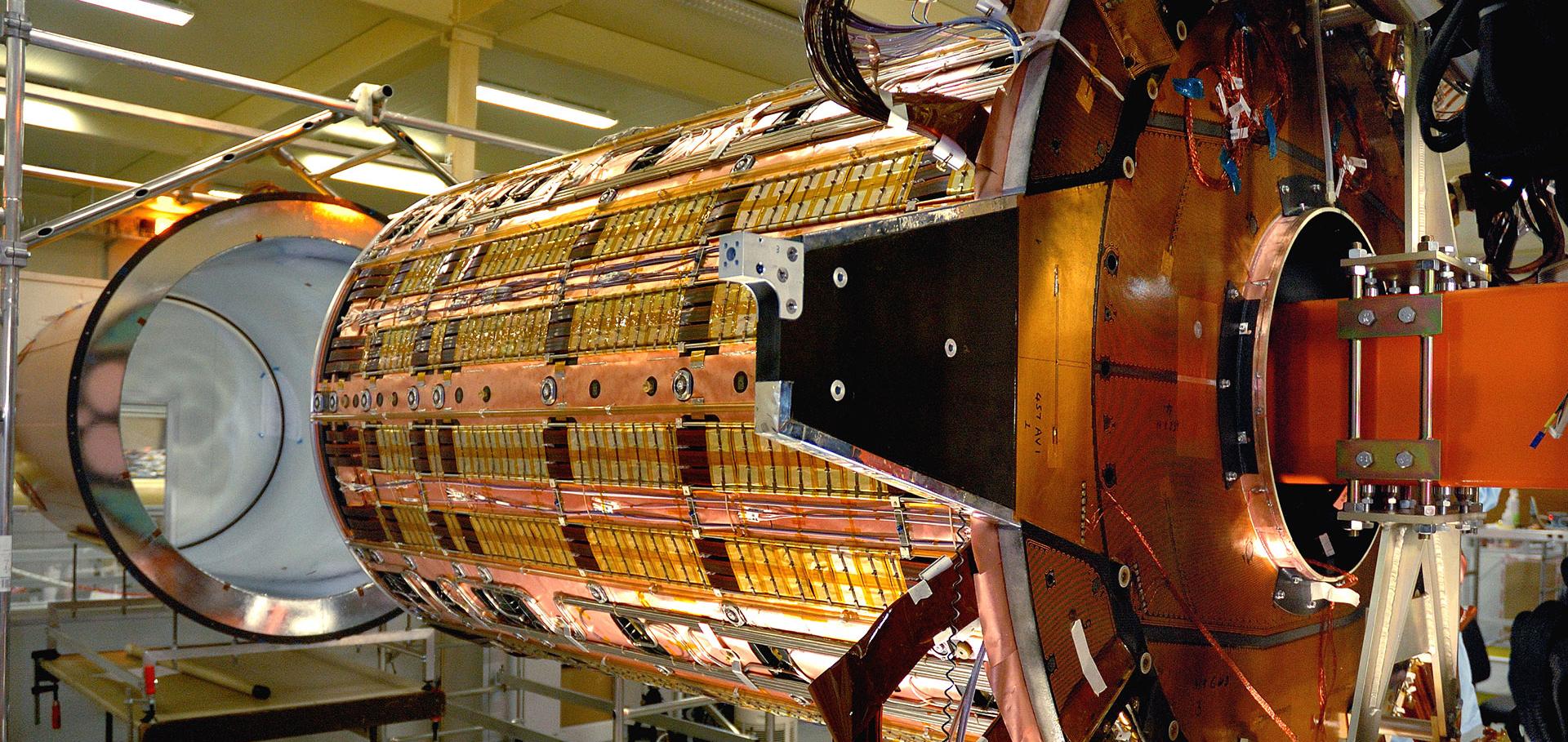
Insertion of STC into TRT at the Department of Physics, Oxford
Credit: CERN

Professor Amanda Cooper-Sarkar

Emeritus Professor

Research theme

  • Fundamental particles and interactions

Sub department

  • Particle Physics

Research groups

  • ATLAS
Amanda.Cooper-Sarkar@physics.ox.ac.uk
Telephone: 01865 (2)73406
Denys Wilkinson Building, room 659
  • About
  • Publications

Search for dark matter produced in association with a Standard Model Higgs boson decaying into b-quarks using the full Run 2 dataset from the ATLAS detector

Journal of High Energy Physics Springer Nature 2021:11 (2021) 209

Authors:

G Aad, B Abbott, Dc Abbott, A Abed Abud, K Abeling, Dk Abhayasinghe, Sh Abidi, Os AbouZeid, H Abramowicz, H Abreu, Y Abulaiti, Ac Abusleme Hoffman, Bs Acharya, B Achkar, L Adam, C Adam Bourdarios, L Adamczyk, L Adamek, J Adelman, A Adiguzel, S Adorni, T Adye, Aa Affolder, Y Afik, C Agapopoulou, Mn Agaras, J Agarwala, A Aggarwal, C Agheorghiesei, Ja Aguilar-Saavedra, A Ahmad, F Ahmadov, Ws Ahmed, X Ai, G Aielli, S Akatsuka, M Akbiyik, Tpa Akesson, Av Akimov, K Al Khoury, Gl Alberghi, J Albert, Mj Alconada Verzini, S Alderweireldt, M Aleksa, In Aleksandrov, C Alexa, T Alexopoulos, A Alfonsi, F Alfonsi

Abstract:

The production of dark matter in association with Higgs bosons is predicted in several extensions of the Standard Model. An exploration of such scenarios is presented, considering final states with missing transverse momentum and b-tagged jets consistent with a Higgs boson. The analysis uses proton-proton collision data at a centre-of-mass energy of 13 TeV recorded by the ATLAS experiment at the LHC during Run 2, amounting to an integrated luminosity of 139 fb−1. The analysis, when compared with previous searches, benefits from a larger dataset, but also has further improvements providing sensitivity to a wider spectrum of signal scenarios. These improvements include both an optimised event selection and advances in the object identification, such as the use of the likelihood-based significance of the missing transverse momentum and variable-radius track-jets. No significant deviation from Standard Model expectations is observed. Limits are set, at 95% confidence level, in two benchmark models with two Higgs doublets extended by either a heavy vector boson Z′ or a pseudoscalar singlet a and which both provide a dark matter candidate χ. In the case of the two-Higgs-doublet model with an additional vector boson Z′, the observed limits extend up to a Z′ mass of 3 TeV for a mass of 100 GeV for the dark matter candidate. The two-Higgs-doublet model with a dark matter particle mass of 10 GeV and an additional pseudoscalar a is excluded for masses of the a up to 520 GeV and 240 GeV for tan β = 1 and tan β = 10 respectively. Limits on the visible cross-sections are set and range from to 0.05 fb to 3.26 fb, depending on the missing transverse momentum and b-quark jet multiplicity requirements.
More details from the publisher
Details from ORA
More details

Search for R-parity-violating supersymmetry in a final state containing leptons and many jets with the ATLAS experiment using $$\sqrt{s} = 13\hbox { TeV}$$ proton–proton collision data

The European Physical Journal C SpringerOpen 81:11 (2021) 1023

Authors:

G Aad, B Abbott, DC Abbott, A Abed Abud, K Abeling, DK Abhayasinghe, SH Abidi, H Abramowicz, H Abreu, Y Abulaiti, AC Abusleme Hoffman, BS Acharya, B Achkar, L Adam, C Adam Bourdarios, L Adamczyk, L Adamek, J Adelman, A Adiguzel, S Adorni, T Adye, AA Affolder, Y Afik, C Agapopoulou, MN Agaras

Abstract:

In recent years, neural network-based classifica- tion has been used to improve data analysis at collider exper- iments. While this strategy proves to be hugely successful, the underlying models are not commonly shared with the public and rely on experiment-internal data as well as full detector simulations. We show a concrete implementation of a newly proposed strategy, so-called Classifier Surrogates, to be trained inside the experiments, that only utilise publicly accessible features and truth information. These surrogates approximate the original classifier distribution, and can be shared with the public. Subsequently, such a model can be evaluated by sampling the classification output from high- level information without requiring a sophisticated detector simulation. Technically, we show that continuous normaliz- ing flows are a suitable generative architecture that can be efficiently trained to sample classification results using con- ditional flow matching. We further demonstrate that these models can be easily extended by Bayesian uncertainties to indicate their degree of validity when confronted with unknown inputs by the user. For a concrete example of tag- ging jets from hadronically decaying top quarks, we demon- strate the application of flows in combination with uncer- tainty estimation through either inference of a mean-field Gaussian weight posterior, or Monte Carlo sampling network weights
More details from the publisher
Details from ORA
More details

Constraints on Higgs boson production with large transverse momentum using $H\rightarrow b\bar{b}$ decays in the ATLAS detector

ArXiv 2111.0834 (2021)
Details from ArXiV

Measurement of the t$$ \overline{t} $$t$$ \overline{t} $$ production cross section in pp collisions at $$ \sqrt{s} $$ = 13 TeV with the ATLAS detector

Journal of High Energy Physics Springer 2021:11 (2021) 118

Authors:

G Aad, B Abbott, DC Abbott, A Abed Abud, K Abeling, DK Abhayasinghe, SH Abidi, H Abramowicz, H Abreu, Y Abulaiti, AC Abusleme Hoffman, BS Acharya, B Achkar, L Adam, C Adam Bourdarios, L Adamczyk, L Adamek, J Adelman, A Adiguzel, S Adorni, T Adye, AA Affolder, Y Afik, C Agapopoulou, MN Agaras

Abstract:

Rare $B$, $D$, and $K$ decays offer unique opportunities to probe for evidence of new particles from physics beyond the Standard Model at mass scales extending from the electroweak scale to well above those directly accessible at the LHC. We review a selection of theoretical and experimental results on rare $B$, $D$, and $K$ decays illustrating the progress made during the past two years.Comment: 15 pages, 3 figures. To appear in the proceedings of the 9th International Workshop on the CKM Unitarity Triangle, Nov 28- Dec 2 2016, Mumba
More details from the publisher
Details from ORA
More details
More details

Search for associated production of a $Z$ boson with an invisibly decaying Higgs boson or dark matter candidates at $\sqrt{s}=13$ TeV with the ATLAS detector

ArXiv 2111.08372 (2021)
Details from ArXiV

Pagination

  • First page First
  • Previous page Prev
  • …
  • Page 159
  • Page 160
  • Page 161
  • Page 162
  • Current page 163
  • Page 164
  • Page 165
  • Page 166
  • Page 167
  • …
  • Next page Next
  • Last page Last

Footer Menu

  • Contact us
  • Giving to the Dept of Physics
  • Work with us
  • Media

User account menu

  • Log in

Follow us

FIND US

Clarendon Laboratory,

Parks Road,

Oxford,

OX1 3PU

CONTACT US

Tel: +44(0)1865272200

University of Oxfrod logo Department Of Physics text logo
IOP Juno Champion logo Athena Swan Silver Award logo

© University of Oxford - Department of Physics

Cookies | Privacy policy | Accessibility statement

Built by: Versantus

  • Home
  • Research
  • Study
  • Engage
  • Our people
  • News & Comment
  • Events
  • Our facilities & services
  • About us
  • Giving to Physics
  • Current students
  • Staff intranet