Home
Department Of Physics text logo
  • Research
    • Our research
    • Our research groups
    • Our research in action
    • Research funding support
    • Summer internships for undergraduates
  • Study
    • Undergraduates
    • Postgraduates
  • Engage
    • For alumni
    • For business
    • For schools
    • For the public
  • Support
Menu
CMP
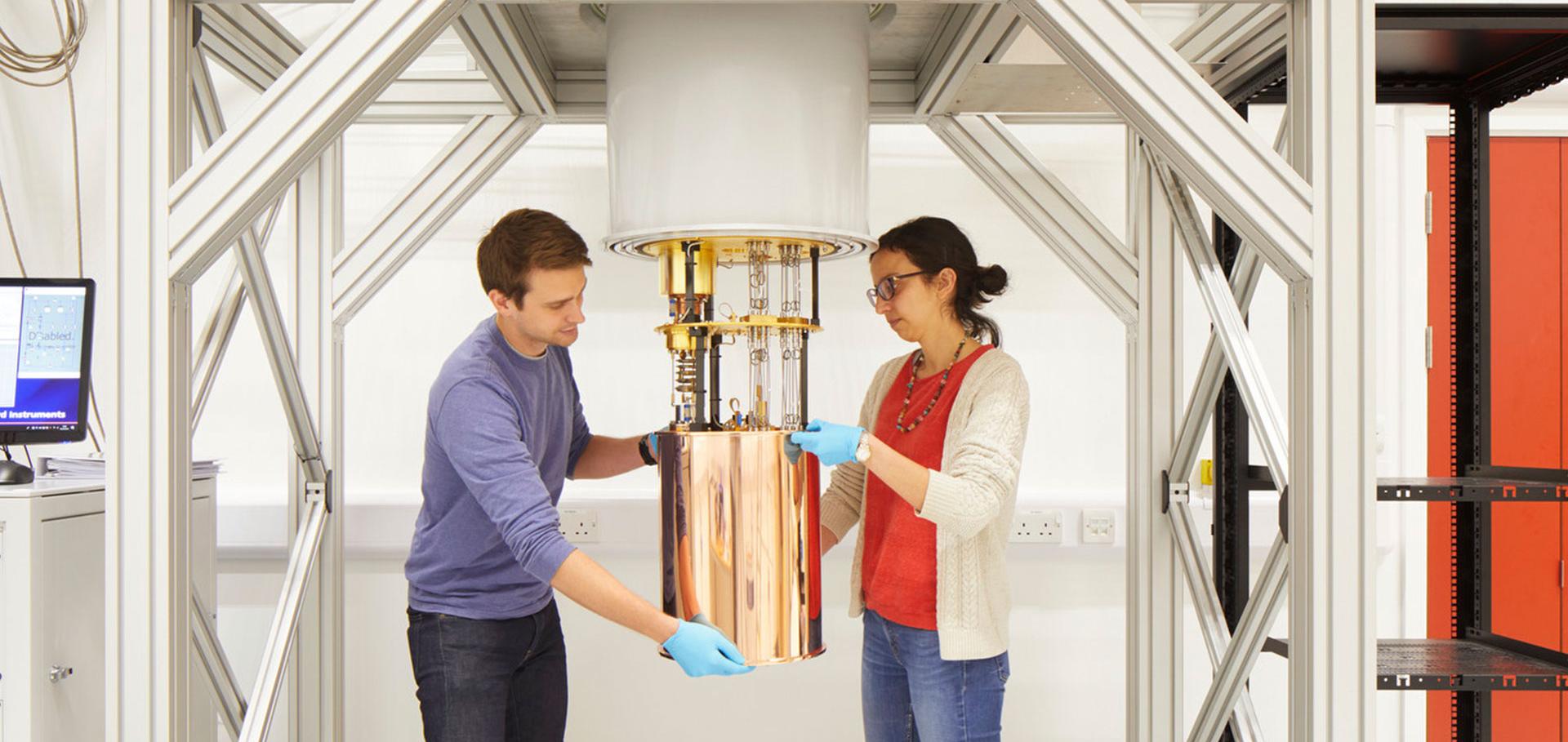
Credit: Jack Hobhouse

Simone Fasciati

Long Term Visitor

Sub department

  • Condensed Matter Physics

Research groups

  • Superconducting quantum devices
simone.fasciati@physics.ox.ac.uk
Clarendon Laboratory, room 103.2
  • About
  • Publications

Crosstalk dispersion and spatial scaling in superconducting qubit arrays

Physical Review Research American Physical Society (APS) 8:3 (2026) 033193

Authors:

Mohammed Alghadeer, Simon Pettersson Fors, Shuxiang Cao, Simone D Fasciati, Haru Ishizaka, Anton Frisk Kockum, Peter Leek, Mustafa Bakr

Abstract:

Crosstalk between qubits fundamentally limits the scalability of quantum processors, necessitating physics-based models that can handle the complexity of large qubit arrays. Here, we develop a comprehensive theoretical and experimental framework that captures residual interactions between both adjacent and nonadjacent qubits in fixed-frequency transmon lattices. The model integrates the combined effects of exponential localization in banded capacitance matrices, suppression of virtual couplings through detuning products across intermediate modes, and evanescent decay of below-cutoff electromagnetic fields, yielding predictive scaling relations for coupling strength as a function of spatial separation and spectral detuning. Experimental characterization of a 4 × 4 superconducting qubit lattice with inductive shunt pillars reveals exponential spatial decay and frequency-dependent suppression consistent with theoretical predictions, achieving quantitative agreement for all nearest-neighbor couplings across the 4 – 6 GHz operating range. Our results show that standard dispersive Hamiltonian approximations systematically overestimate long-range coupling when spatial and spectral dependencies are neglected; these errors propagate into circuit simulation and design strategies. Our framework provides design guidance for crosstalk mitigation in larger-scale quantum processors under realistic fabrication constraints, addressing a bottleneck in scalability.
More details from the publisher

Characterization of nanostructural imperfections in superconducting quantum circuits

Materials for Quantum Technology IOP Publishing 5:3 (2025) 035201

Authors:

Mohammed Alghadeer, Simone D Fasciati, Shuxiang Cao, Michele Piscitelli, Matthew C Spink, David G Hopkinson, Mohsen Danaie, Susannah C Speller, Peter J Leek, Mustafa Bakr

Abstract:

Decoherence in superconducting quantum circuits, caused by loss mechanisms like material imperfections and two-level system (TLS) defects, remains a major obstacle to improving the performance of quantum devices. In this work, we present atomic-level characterization of cross-sections of a Josephson junction and a spiral resonator to assess the quality of critical interfaces. Employing scanning transmission electron microscopy combined with energy-dispersive x-ray spectroscopy and electron-energy loss spectroscopy, we identify structural imperfections associated with oxide layer formation and carbon-based contamination, and correlate these imperfections to the patterning and etching steps in the fabrication process and environmental exposure. These results suggest that TLS imperfections at critical interfaces significantly contribute to limiting device performance, emphasizing the need for an improved fabrication process.
More details from the publisher
Details from ORA
More details

Multiplexed readout of superconducting qubits using a three-dimensional reentrant-cavity filter

Physical Review Applied American Physical Society (APS) 23:5 (2025) 054089

Authors:

Mustafa Bakr, Simone D Fasciati, Shuxiang Cao, Giulio Campanaro, James Wills, Mohammed Alghadeer, Michele Piscitelli, Boris Shteynas, Vivek Chidambaram, Peter J Leek
More details from the publisher
More details

Complementing the transmon by integrating a geometric shunt inductor

(2024)

Authors:

Simone D Fasciati, Boris Shteynas, Giulio Campanaro, Mustafa Bakr, Shuxiang Cao, Vivek Chidambaram, James Wills, Peter J Leek
More details from the publisher
Details from ArXiV

Efficient Characterization of Qudit Logical Gates with Gate Set Tomography Using an Error-Free Virtual Z Gate Model

Physical Review Letters American Physical Society (APS) 133:12 (2024) 120802

Authors:

Shuxiang Cao, Deep Lall, Mustafa Bakr, Giulio Campanaro, Simone D Fasciati, James Wills, Vivek Chidambaram, Boris Shteynas, Ivan Rungger, Peter J Leek
More details from the publisher
More details
More details

Pagination

  • Current page 1
  • Page 2
  • Page 3
  • Next page Next
  • Last page Last

Footer Menu

  • Contact us
  • Giving to the Dept of Physics
  • Work with us
  • Media

User account menu

  • Log in

Follow us

FIND US

Clarendon Laboratory,

Parks Road,

Oxford,

OX1 3PU

CONTACT US

Tel: +44(0)1865272200

University of Oxfrod logo Department Of Physics text logo
IOP Juno Champion logo Athena Swan Silver Award logo

© University of Oxford - Department of Physics

Cookies | Privacy policy | Accessibility statement

Built by: Versantus

  • Home
  • Research
  • Study
  • Engage
  • Our people
  • News & Comment
  • Events
  • Our facilities & services
  • About us
  • Giving to Physics
  • Current students
  • Staff intranet