Home
Department Of Physics text logo
  • Research
    • Our research
    • Our research groups
    • Our research in action
    • Research funding support
    • Summer internships for undergraduates
  • Study
    • Undergraduates
    • Postgraduates
  • Engage
    • For alumni
    • For business
    • For schools
    • For the public
  • Support
Menu
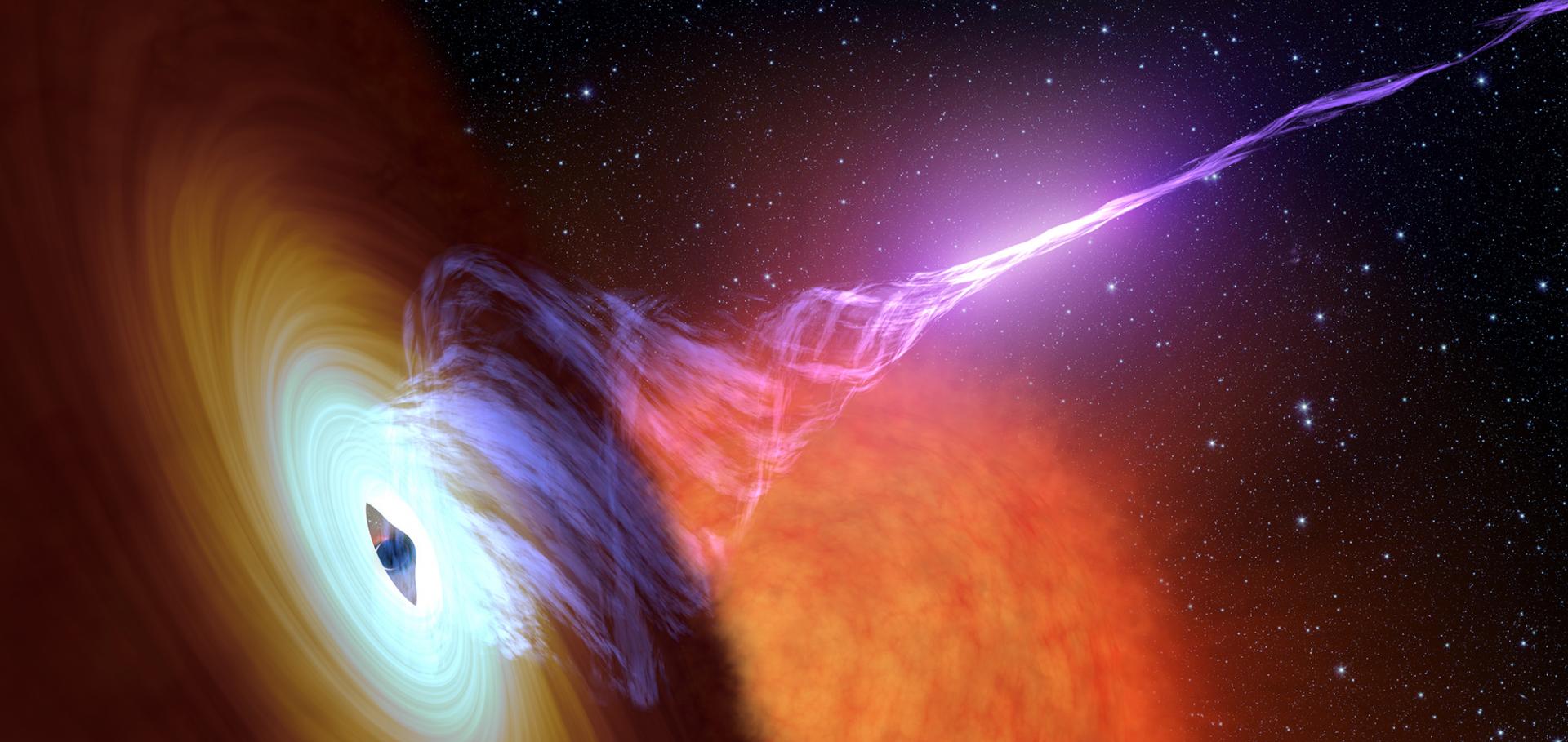
Relativistic Jet from Black Hole

An artist's impression of a relativistic jet propagating away from a black hole at close to the speed of light. Such jets are formed by the inner regions of the accretion flow: matter flowing inwards towards the black hole, via processes which are not yet fully understood. The accretion flow emits primarily in X-rays, the relativistic jet in the radio band: by combing observations in each band we can try and understand how such jets form and how much energy they carry away from the black hole.

Professor Rob Fender

Professor of Astrophysics

Research theme

  • Astronomy and astrophysics

Sub department

  • Astrophysics

Research groups

  • Hintze Centre for Astrophysical Surveys
  • MeerKAT
  • Pulsars, transients and relativistic astrophysics
  • Rubin-LSST
  • The Square Kilometre Array (SKA)
  • Gamma-ray astronomy
Rob.Fender@physics.ox.ac.uk
Telephone: 01865 (2)73435
Denys Wilkinson Building, room 712
  • About
  • Publications

Jets from a stellar-mass black hole are as relativistic as those from supermassive black holes

Nature Communications Springer Nature (2026)

Authors:

X Zhang, W Yu, F Carotenuto, R Fender, S Motta, A Bahramian, JCA Miller-Jones, TD Russell, S Corbel, PA Woudt, P Atri, C Knigge, GR Sivakoff, AK Hughes, J van den Eijnden, JH Matthews, MC Baglio, P Saikia

Abstract:

Relativistic jets from supermassive black holes in active galactic nuclei are amongst the most powerful phenomena in the universe. Similar jets from stellar-mass black holes offer a chance to study the phenomena on accessible observation time scales. However, such comparative studies across black hole masses and time scales remain hampered by the long-standing perception that stellar-mass black hole jets are in a less relativistic regime. Here, we show the detection of two distinct, relativistic jet ejections from the Galactic black hole X-ray binary 4U 1543−47 during a single outburst, with radio interferometry monitoring observations. Our measurements reveal a likely Lorentz factor of approximately 8 and a minimum of 4.6 at launch with 95% confidence, demonstrating that stellar-mass black holes in X-ray binaries can launch jets as relativistic as those seen in active galactic nuclei.
More details from the publisher
More details

The Homogeneous MeerKAT and Swift/XRT X-ray Binary Radio:X-ray Plane

(2026)

Authors:

Justine Crook-Mansour, Rob Fender, Andrew Hughes, Sara Motta, Patrick A Woudt, Arash Bahramian, Melania Del Santo, Zuobin Zhang, Thomas D Russell, Jakob van den Eijnden, Joe Bright, David Williams-Baldwin, Francesco Carotenuto, Stéphane Corbel, Fraser J Cowie, Alex Andersson, Noa Grollimund, James Matthews, Kelebogile Gasealahwe, Itumeleng Monaleng, Lauren Rhodes, Payaswini Saikia, Katie Savard, Evangelia Tremou, Xian Zhang

Detection of an extremely luminous radio counterpart to the Be/X-ray binary A0538−66

Monthly Notices of the Royal Astronomical Society Oxford University Press 548:1 (2026) stag224

Authors:

Justine Crook-Mansour, Rob Fender, Alex Andersson, Hao Qiu, Andrew K Hughes, Jakob van den Eijnden, Fraser J Cowie, Sara Motta, Itumeleng Monageng, Lorenzo Ducci, Sandro Mereghetti, Andries Mathiba, Dougal Dobie, Tara Murphy, David L Kaplan, Francesco Carotenuto, Phil Charles

Abstract:

We present the discovery of radio emission from the Be/X-ray binary A0538−66 with the Australian Square Kilometre Array Pathfinder, and results from a subsequent weekly monitoring campaign with the MeerKAT radio telescope. A0538−66, located in the Large Magellanic Cloud, hosts a neutron star with a short spin period ( ms) in a highly eccentric -d orbit . Its rare episodes of super-Eddington accretion, rapid optical and X-ray flares, and other peculiar properties make it an interesting system among high-mass X-ray binaries. Our MeerKAT data reveal that it is also one of the most radio-luminous neutron star X-ray binaries observed to date, reaching (at 1.28 GHz), with radio emission that appears to be orbitally modulated. We consider several possible mechanisms for the radio emission, and place A0538−66 in context by comparing it to similar systems.
More details from the publisher
Details from ORA
More details

Detection of an Extremely Luminous Radio Counterpart to the Be/X-ray Binary A0538-66

(2026)

Authors:

Justine Crook-Mansour, Rob Fender, Alex Andersson, Hao Qiu, Andrew K Hughes, Jakob van den Eijnden, Fraser J Cowie, Sara Motta, Itumeleng Monageng, Lorenzo Ducci, Sandro Mereghetti, Andries Mathiba, Dougal Dobie, Tara Murphy, David L Kaplan, Francesco Carotenuto, Phil Charles
More details from the publisher

Dynamic shocks powered by a wide, relativistic, super-Eddington outflow launched by an accreting neutron star in the mid-20th century

Monthly Notices of the Royal Astronomical Society Oxford University Press (OUP) (2026) stag163

Authors:

FJ Cowie, RP Fender, I Heywood, F Carotenuto, JH Matthews, B Reville, L Olivera-Nieto, AJ Cooper, AK Hughes, K Savard, PA Woudt, J van den Eijnden, N Grollimund, P Saikia

Abstract:

Abstract Accreting systems can launch powerful outflows which interact with the surrounding medium. We combine new radio observations of the accreting neutron star X-ray binary (XRB) Circinus X-1 (Cir X-1) with archival radio observations going back 24 years. The ∼3 pc scale wide-angle radio and X-ray emitting caps found around Cir X-1 are identified as synchrotron emitting shocks with significant proper motion and morphological evolution on decade timescales. Proper motion measurements of the shocks reveal they are mildly relativistic and decelerating, with apparent velocity of 0.14c ± 0.03c at a propagation distance of 2 pc. We demonstrate that these shocks are likely powered by a hidden relativistic (≳ 0.3c) wide-angle conical outflow launched in 1972 ± 3, in stark contrast to known structures around other XRBs formed by collimated jets over 1000s of years. The minimum time-averaged power of the outflow required to produce the observed synchrotron emission is ∼0.1LEdd, while the time-averaged power required for the kinetic energy of the shocks is $\sim 40 \left(\frac{n}{10^{-2} \textrm{cm}^{-3}}\right)L_\textrm{Edd}$, where n is the average ambient medium number density. This reveals the outflow powering the shocks is likely significantly super-Eddington. We measure significant linear polarisation up to 52 ± 6% in the shocks demonstrating the presence of an ordered magnetic field of strength ∼200 μG. We show that the shocks are potential PeVatrons, capable of accelerating electrons to ∼0.7 PeV and protons to ∼20 PeV, and we estimate the injection and energetic efficiencies of electron acceleration in the shocks. Finally, we predict that next generation gamma-ray facilities may be able to detect hadronic signatures from the shocks.
More details from the publisher
More details

Pagination

  • First page First
  • Previous page Prev
  • Page 1
  • Page 2
  • Page 3
  • Current page 4
  • Page 5
  • Page 6
  • Page 7
  • Page 8
  • Page 9
  • …
  • Next page Next
  • Last page Last

Footer Menu

  • Contact us
  • Giving to the Dept of Physics
  • Work with us
  • Media

User account menu

  • Log in

Follow us

FIND US

Clarendon Laboratory,

Parks Road,

Oxford,

OX1 3PU

CONTACT US

Tel: +44(0)1865272200

University of Oxfrod logo Department Of Physics text logo
IOP Juno Champion logo Athena Swan Silver Award logo

© University of Oxford - Department of Physics

Cookies | Privacy policy | Accessibility statement

Built by: Versantus

  • Home
  • Research
  • Study
  • Engage
  • Our people
  • News & Comment
  • Events
  • Our facilities & services
  • About us
  • Giving to Physics
  • Current students
  • Staff intranet