


The link between obscured accretion and mildly relativistic precessing jets
Monthly Notices of the Royal Astronomical Society Oxford University Press (OUP) (2026) stag1112
Abstract:
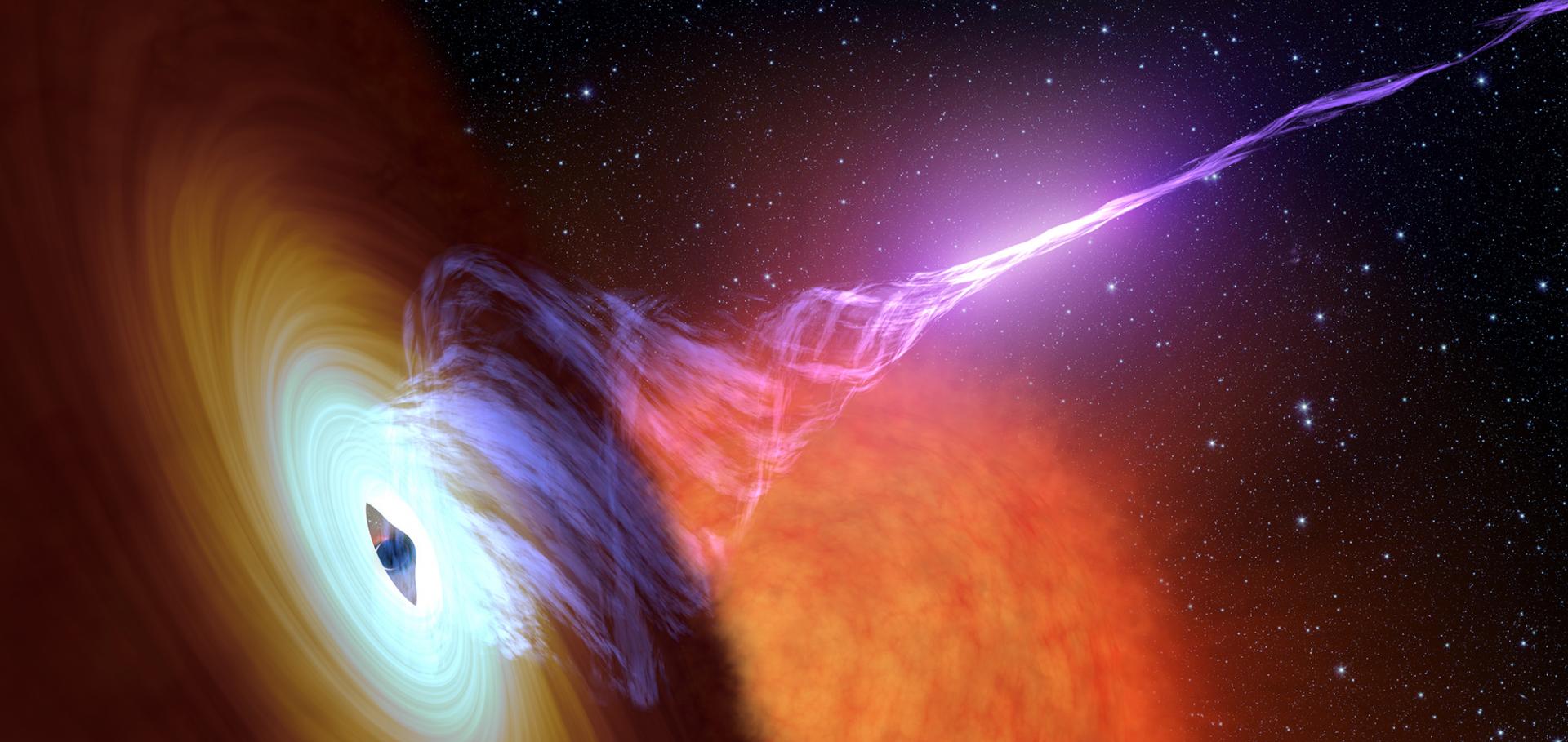
Abstract We have recently shown evidence that the most relativistic jets (with Lorentz factor >2) from stellar-mass black holes in X-ray binary systems may be locked to a fixed axis, likely the spin axis of the black hole. Slower, mildly relativistic jets (with velocities typically ~0.3c) are often seen to precess and can be associated with both neutron stars and black holes. In this paper we demonstrate an additional clear link between highly obscured systems and these lower-velocity, precessing jets. We speculate that this link may be due to mass-loading of the jets close to their launch sites, since these obscured systems are likely to be examples of (sometimes persistent, other times transient) super-Eddington accretion. The fastest relativistic jets are now seen to be both locked to a fixed direction, likely the black hole spin axis, and to be launched in low-density environments, while jets launched in dense environments are generally slower and very likely to precess.Observational Biases and Improved Modelling of Off-axis Relativistic Jets
Monthly Notices of the Royal Astronomical Society Oxford University Press (OUP) (2026) stag1187
Abstract:
Abstract Relativistic Doppler boosting significantly affects the observed emission of astrophysical jets resulting in observational biases. In this work we investigate the observational biases and modelling opportunities which arise due to relativistic boosting using two X-ray binary case studies. Using the one-sided jet ejecta from MAXI J1535-571, we demonstrate that incorporating non-detections of the receding jet ejecta into kinematic modelling can significantly improve parameter estimation, reducing posterior uncertainties by over $40{{\ \rm per\ cent}}$. For the bipolar jets of MAXI J1820+070, we recover the intrinsic jet rest-frame emission of both approaching and receding jet components, demonstrating that they follow a common powerlaw evolution. Using this rest-frame emission profile as a base model, we show that current observational strategies strongly bias against detecting ejecta with high initial Lorentz factors ≳ 5 and receding ejecta components across a broad region of parameter space. These results highlight the importance of observational strategy selection, particularly early-time and late-time observations, and leveraging non-detections in the modelling of relativistic jets. More generally, quantifying observational biases and maximising modelling capabilities by incorporating the non-detection of receding jets can be employed to enhance interpretation of future gravitational-wave/optically-triggered observations of off-axis, extragalactic jetted transients.Observational Biases and Improved Modelling of Off-axis Relativistic Jets
(2026)
Towards improved synchrotron self absorption energy estimates: accounting for inhomogeneous and non-spherical emitting regions
Monthly Notices of the Royal Astronomical Society Oxford University Press (OUP) (2026) stag1113
Abstract:
Abstract Synchrotron self absorption (SSA) is seen across a variety of astrophysical sources, and observation of an SSA peak in the spectrum is a powerful tool for estimating the physical conditions and the minimum energy of the emitting region. We begin with the (re)derivation of the usual SSA parameter estimates, carefully considering dependencies and assumptions, obtaining the most accurate traditional SSA minimum energy equations currently available. Traditional methods rely on the assumption that the emitting region is quasi-spherical and homogeneous. However, many observations of SSA show that the spectral index at frequencies below the peak is less than the expected +2.5 (non-thermal) or +2 (thermal). We argue that an inhomogeneous emitting region is the most likely explanation in many cases. Power law inhomogeneous cylindrical slab and broken power law inhomogeneous sphere models are used to investigate how the presence of inhomogeneity affects parameter estimates using traditional SSA methods. We find that in some cases inhomogeneity can lead to traditional SSA methods underestimating the minimum energy and the size of the emitting region by over an order of magnitude. Quantitative correction factors are found which can be applied to traditional estimates to correct for inhomogeneity, depending on the value of the observed flattened spectral index and the range in frequency over which this value is observed. Furthermore, we derive simple correction factors for non-spherical homogeneous emitting regions. Finally, we explore the effects of inhomogeneity on measurements of polarisation around the spectral peak, and on lightcurves for expanding emitting regions.Towards improved synchrotron self absorption energy estimates: accounting for inhomogeneous and non-spherical emitting regions
(2026)