Home
Department Of Physics text logo
  • Research
    • Our research
    • Our research groups
    • Our research in action
    • Research funding support
    • Summer internships for undergraduates
  • Study
    • Undergraduates
    • Postgraduates
  • Engage
    • For alumni
    • For business
    • For schools
    • For the public
  • Support
Menu
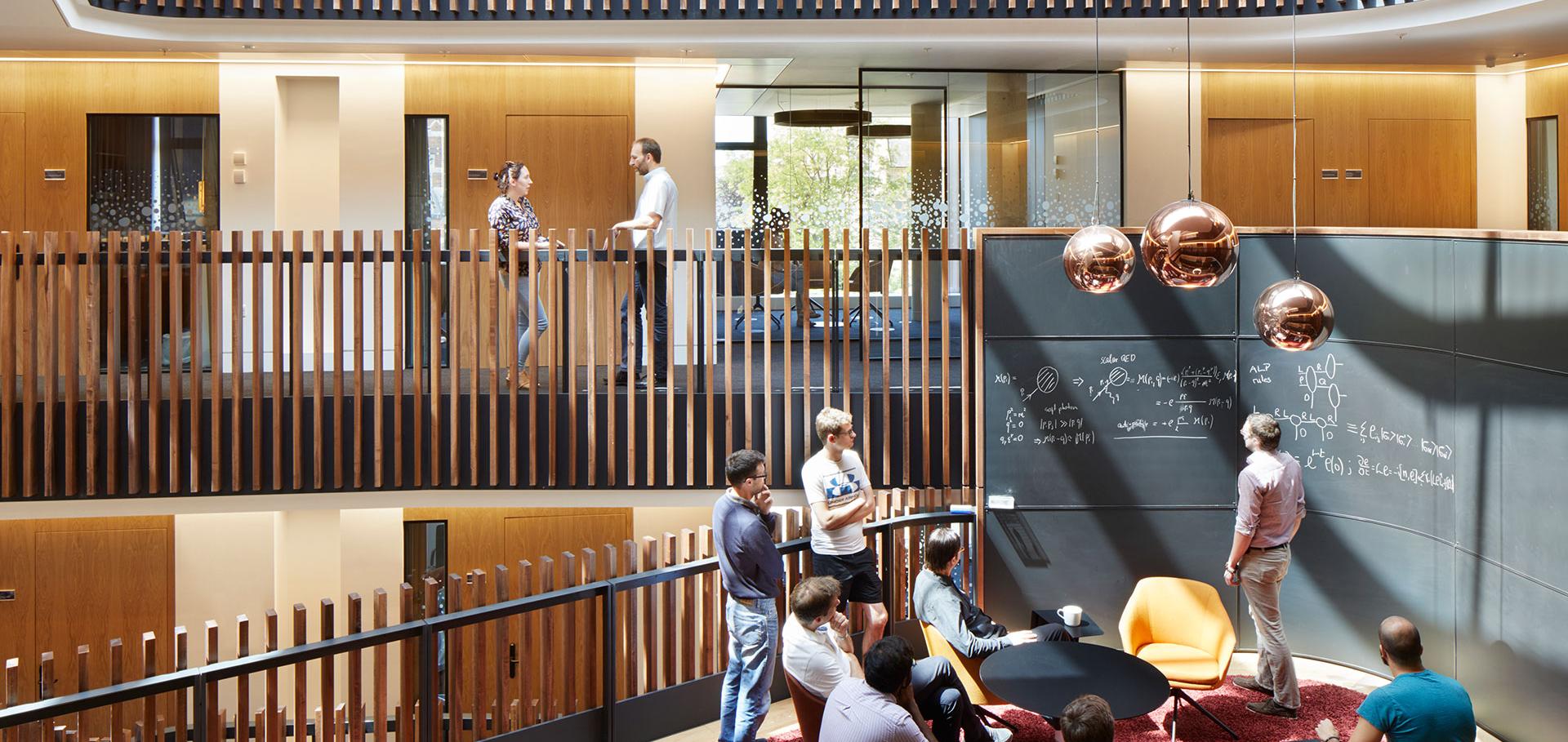
Theoretical physicists working at a blackboard collaboration pod in the Beecroft building.
Credit: Jack Hobhouse

Professor Felix Parra Diaz

Visitor

Research theme

  • Plasma physics

Sub department

  • Rudolf Peierls Centre for Theoretical Physics
felix.parradiaz@physics.ox.ac.uk
Rudolf Peierls Centre for Theoretical Physics
  • About
  • Publications

Reduction of core turbulence in I-mode plasmas in Alcator C-Mod

Nuclear Fusion IOP Publishing 54:8 (2014) 083019

Authors:

AE White, M Barnes, A Dominguez, M Greenwald, NT Howard, AE Hubbard, JW Hughes, DR Mikkelsen, FI Parra, ML Reinke, C Sung, J Walk, DG Whyte
More details from the publisher

The effect of diamagnetic flows on turbulent driven ion toroidal rotationa)

Physics of Plasmas AIP Publishing 21:5 (2014) 056106

Authors:

JP Lee, M Barnes, FI Parra, EA Belli, J Candy
More details from the publisher
More details

When omnigeneity fails

(2014)

Authors:

Felix I Parra, Ivan Calvo, Jose Luis Velasco, J Arturo Alonso
More details from the publisher
Details from ArXiV

Effect on plasma rotation of lower hybrid (LH) waves in Alcator C-Mod

AIP Conference Proceedings AIP Publishing 1580:1 (2014) 398-401

Authors:

JP Lee, M Barnes, RR Parker, JE Rice, FI Parra, PT Bonoli, ML Reinke
More details from the publisher
More details

Radially global $δf$ computation of neoclassical phenomena in a tokamak pedestal

ArXiv 1312.2148 (2013)

Authors:

Matt Landreman, Felix I Parra, Peter J Catto, Darin R Ernst, Istvan Pusztai

Abstract:

Conventional radially-local neoclassical calculations become inadequate if the radial gradient scale lengths of the H-mode pedestal become as small as the poloidal ion gyroradius. Here, we describe a radially global $\delta f$ continuum code that generalizes neoclassical calculations to allow stronger gradients. As with conventional neoclassical calculations, the formulation is time-independent and requires only the solution of a single sparse linear system. We demonstrate precise agreement with an asymptotic analytic solution of the radially global kinetic equation in the appropriate limits of aspect ratio and collisionality. This agreement depends crucially on accurate treatment of finite orbit width effects.
Details from ArXiV
More details from the publisher

Pagination

  • First page First
  • Previous page Prev
  • …
  • Page 17
  • Page 18
  • Page 19
  • Page 20
  • Current page 21
  • Page 22
  • Page 23
  • Page 24
  • Page 25
  • …
  • Next page Next
  • Last page Last

Footer Menu

  • Contact us
  • Giving to the Dept of Physics
  • Work with us
  • Media

User account menu

  • Log in

Follow us

FIND US

Clarendon Laboratory,

Parks Road,

Oxford,

OX1 3PU

CONTACT US

Tel: +44(0)1865272200

University of Oxfrod logo Department Of Physics text logo
IOP Juno Champion logo Athena Swan Silver Award logo

© University of Oxford - Department of Physics

Cookies | Privacy policy | Accessibility statement

Built by: Versantus

  • Home
  • Research
  • Study
  • Engage
  • Our people
  • News & Comment
  • Events
  • Our facilities & services
  • About us
  • Giving to Physics
  • Current students
  • Staff intranet