Home
Department Of Physics text logo
  • Research
    • Our research
    • Our research groups
    • Our research in action
    • Research funding support
    • Summer internships for undergraduates
  • Study
    • Undergraduates
    • Postgraduates
  • Engage
    • For young people
    • For teachers
    • For the public
    • For alumni
    • For business
  • Support
Menu
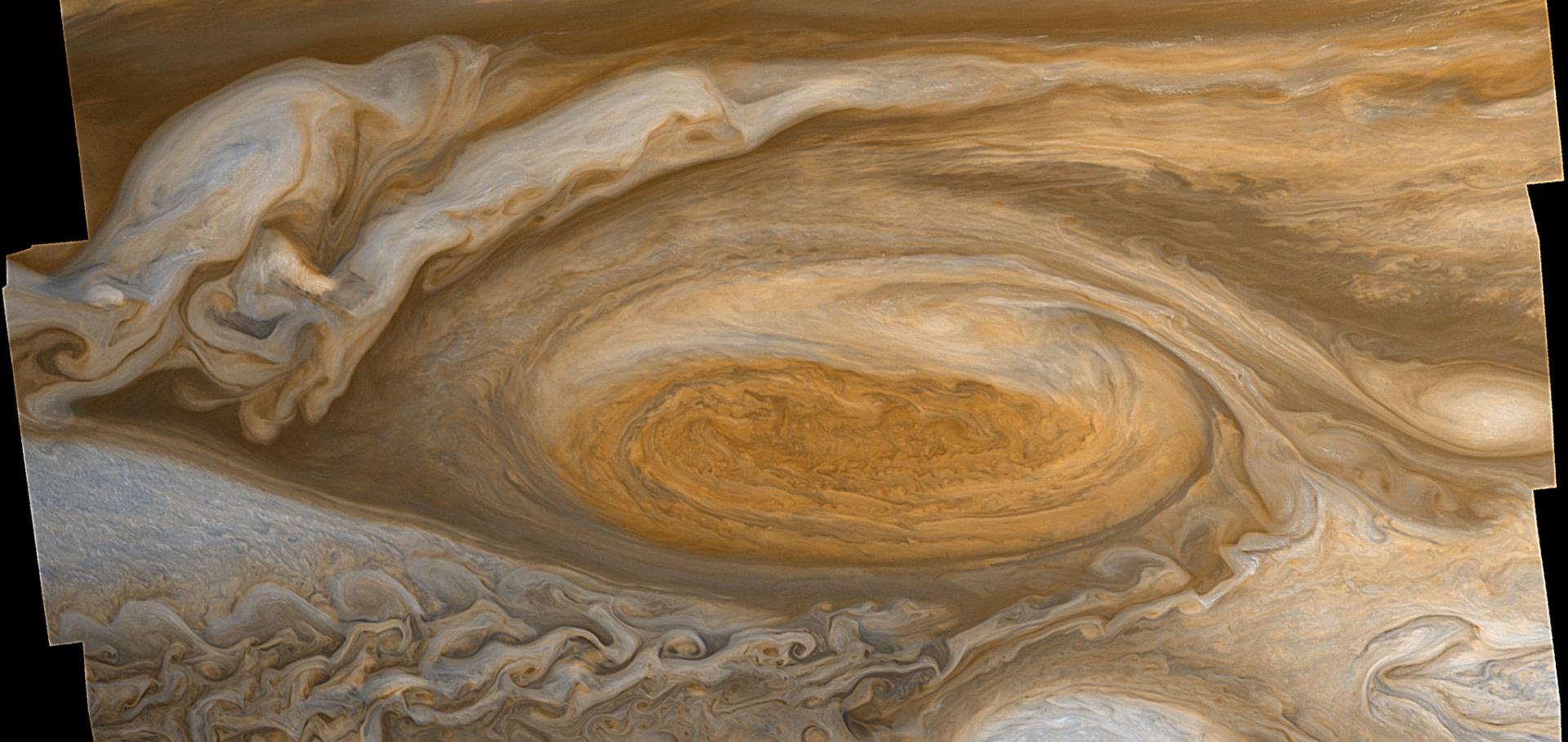
Image of Jupiter's Great Red Spot from Voyager 1

Image of Jupiter's Great Red Spot, obtained during the fly-by of Jupiter by NASA's Voyager 1 spacecraft in 1979.

Credit: NASA/JPL

Prof. Peter Read

Emeritus/researcher

Research theme

  • Climate physics
  • Exoplanets and planetary physics

Sub department

  • Atmospheric, Oceanic and Planetary Physics

Research groups

  • Geophysical and Astrophysical Fluid Dynamics
  • Planetary Climate Dynamics
Peter.Read@physics.ox.ac.uk
Telephone: 01865 (2)72082
Atmospheric Physics Clarendon Laboratory, room 210
  • About
  • Publications

Ertel potential vorticity versus Bernoulli streamfunction on Mars

QUARTERLY JOURNAL OF THE ROYAL METEOROLOGICAL SOCIETY 143:702 (2017) 37-52

Authors:

TE Dowling, ME Bradley, J Du, SR Lewis, PL Read
More details from the publisher
Details from ORA
More details
More details

Obituary: Raymond Hide, CBE ScD FRS

Weather Wiley 72:1 (2017) 24-25
More details from the publisher

Exploring the Venus global super-rotation using a comprehensive general circulation model

PLANETARY AND SPACE SCIENCE 134 (2016) 1-18

Authors:

JM Mendonca, PL Read
More details from the publisher
Details from ORA
More details
More details

Exploring the Venus global super-rotation using a comprehensive General Circulation Model

(2016)

Authors:

João M Mendonça, Peter L Read
More details from the publisher

A regime diagram for ocean geostrophic turbulence

Quarterly Journal of the Royal Meteorological Society (2016)

Authors:

A Klocker, DP Marshall, SR Keating, PL Read

Abstract:

© 2016 Royal Meteorological Society.A two-dimensional regime diagram for geostrophic turbulence in the ocean is constructed by plotting observation-based estimates of the non-dimensional eddy length-scale against a nonlinearity parameter equal to the ratio of the root-mean-square eddy velocity and baroclinic Rossby phase speed. Two estimates of the eddy length-scale are compared: the equivalent eddy radius inferred from the area enclosed by contours of sea-surface height, and the 'unsuppressed' mixing length, based on an estimate of the eddy diffusivity with mean flow effects removed. For weak nonlinearity, as found in the Tropics, the mixing length mostly corresponds to the stability threshold for baroclinic instability whereas the eddy radius corresponds to the Rhines scale; it is suggested that this mismatch is indicative of the inverse energy cascade that occurs at low latitudes in the ocean and the zonal elongation of eddies. At larger values of nonlinearity, as found at mid- and high latitudes, the eddy length-scales are much shorter than the stability threshold, within a factor of 2.5 of the Rossby deformation radius.
More details from the publisher
Details from ORA
More details

Pagination

  • First page First
  • Previous page Prev
  • …
  • Page 14
  • Page 15
  • Page 16
  • Page 17
  • Current page 18
  • Page 19
  • Page 20
  • Page 21
  • Page 22
  • …
  • Next page Next
  • Last page Last

Footer Menu

  • Contact us
  • Giving to the Dept of Physics
  • Work with us
  • Media

User account menu

  • Log in

Follow us

FIND US

Clarendon Laboratory,

Parks Road,

Oxford,

OX1 3PU

CONTACT US

Tel: +44(0)1865272200

University of Oxfrod logo Department Of Physics text logo
IOP Juno Champion logo Athena Swan Silver Award logo

© University of Oxford - Department of Physics

Cookies | Privacy policy | Accessibility statement

Built by: Versantus

  • Home
  • Research
  • Study
  • Engage
  • Our people
  • News & Comment
  • Events
  • Our facilities & services
  • About us
  • Giving to Physics
  • Current students
  • Staff intranet