

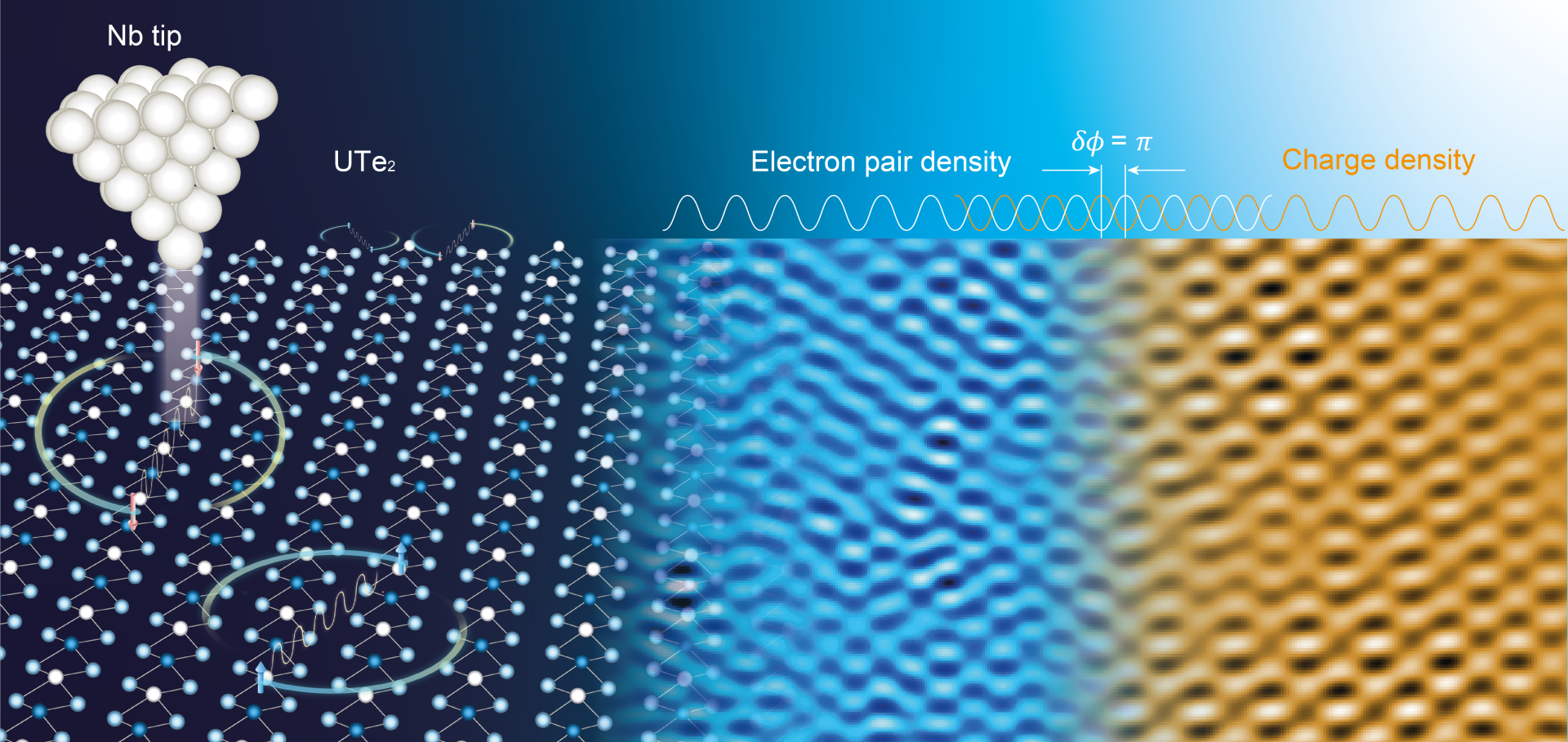


Visualizing the Odd-parity Superconducting Order Parameter and its Quasiparticle Surface Band in UTe2
ArXiv 2602.0249 (2026)
Quasiparticle interference and spectral function of the Ute2 superconductive surface band
Physical Review B American Physical Society 112:21 (2025) 214509
Abstract:
We compute the (0-11) surface spectral function, the surface density of states (DOS), and the quasiparticle interference (QPI) patterns, both in the normal state and superconducting state of UTe2. We consider all possible nonchiral and chiral order parameters (OPs) that could, in principle, describe the superconductivity in this compound. We describe the formation of surface states whose maximum intensity energy depends on the nature of the pairing. We also study the QPI patterns resulting from the scattering of these surface states. Along the lines of [Nat. Phys. 21, 1555 (2025)1745-247310.1038/s41567-025-03000-w], we show that the main feature distinguishing between various OPs is a QPI peak that is only observed experimentally in the superconducting state. The energy dispersion and the stability of this peak is consistent among the nonchiral OPs only with a B3u pairing. Moreover, B3u is the only nonchiral pairing that shows a peak at zero energy in the DOS, consistent with the experimental observations.Odd-parity quasiparticle interference in the superconductive surface state of UTe 2
Nature Physics Nature Research 21:10 (2025) 1555-1562
Abstract:
Although no known material exhibits intrinsic topological superconductivity, where a spin-triplet electron pairing potential has odd parity, UTe2 is now the leading candidate. Generally, the parity of a superconducting order parameter can be established using Bogoliubov quasiparticle interference imaging. However, odd-parity superconductors should support a topological quasiparticle surface band at energies within the maximum superconducting energy gap. Quasiparticle interference should then be dominated by the electronic structure of the quasiparticle surface band and only reveal the characteristics of the bulk order parameter indirectly. Here we demonstrate that at the (0–11) cleave surface of UTe2, a band of Bogoliubov quasiparticles appears only in the superconducting state. Performing high-resolution quasiparticle interference measurements then allows us to explore the dispersion of states in this superconductive surface band, showing that they exist only within the range of Fermi momenta projected onto the (0–11) surface. Finally, we develop a theoretical framework to predict the quasiparticle interference signatures of this surface band at the (0–11) surface. Its predictions are consistent with the experimental results if the bulk superconducting order parameter exhibits time-reversal conserving, odd-parity, a-axis nodal, B3u symmetry.Pair Wavefunction Symmetry in UTe2 from Zero-Energy Surface State Visualization
ArXiv 2501.16636 (2025)
Discovery of orbital ordering in Bi2Sr2CaCu2O8+x
Nature Materials Nature Research 23:4 (2024) 492-498