Home
Department Of Physics text logo
  • Research
    • Our research
    • Our research groups
    • Our research in action
    • Research funding support
    • Summer internships for undergraduates
  • Study
    • Undergraduates
    • Postgraduates
  • Engage
    • For alumni
    • For business
    • For schools
    • For the public
  • Support
Menu
Atomic and Laser Physics
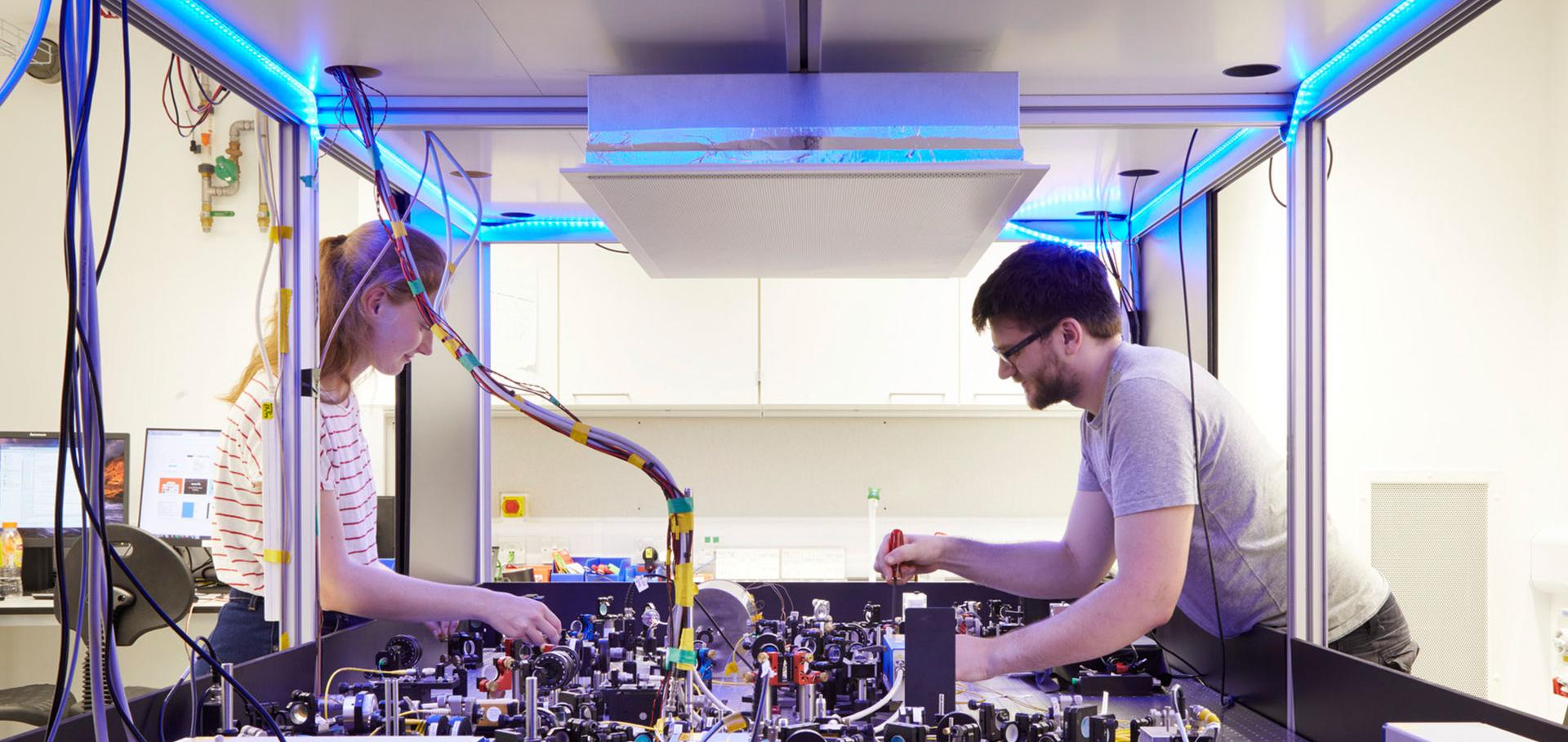
Credit: Jack Hobhouse

Professor Ian Walmsley CBE FRS FCGI

Director, Oxford Quantum Institute

Sub department

  • Atomic and Laser Physics
Ian.Walmsley@physics.ox.ac.uk
Telephone: 01865 772209
  • About
  • Publications

Distinguishability and many-particle interference

Physical Review Letters American Physical Society (2017)

Authors:

Adrian Menssen, Alex E Jones, Benjamin J Metcalf, MC Tichy, Stefanie Barz, W Steven Kolthammer, Ian A Walmsley

Abstract:

Quantum interference of two independent particles in pure quantum states is fully described by the particles’ distinguishability: the closer the particles are to being identical, the higher the degree of quantum interference. When more than two particles are involved, the situation becomes more complex and interference capability extends beyond pairwise distinguishability, taking on a surprisingly rich character. Here, we study many-particle interference using three photons. We show that the distinguishability between pairs of photons is not sufficient to fully describe the photons’ behaviour in a scattering process, but that a collective phase, the triad phase, plays a role. We are able to explore the full parameter space of three-photon interference by generating heralded single photons and interfering them in a fibre tritter. Using multiple degrees of freedom—temporal delays and polarisation—we isolate three-photon interference from two-photon interference. Our experiment disproves the view that pairwise two-photon distinguishability uniquely determines the degree of non-classical many-particle interference.
Details from ORA
More details from the publisher
More details
More details
Details from ArXiV

Nonclassicality Criteria in Multiport Interferometry

Physical Review Letters American Physical Society 117:21 (2016)

Authors:

L Rigovacca, C Di Franco, Benjamin J Metcalf, Ian Walmsley, MS Kim

Abstract:

Interference lies at the heart of the behavior of classical and quantum light. It is thus crucial to understand the boundaries between which interference patterns can be explained by a classical electromagnetic description of light and which, on the other hand, can only be understood with a proper quantum mechanical approach. While the case of two-mode interference has received a lot of attention, the multimode case has not yet been fully explored. Here we study a general scenario of intensity interferometry: we derive a bound on the average correlations between pairs of output intensities for the classical wavelike model of light, and we show how it can be violated in a quantum framework. As a consequence, this violation acts as a nonclassicality witness, able to detect the presence of sources with sub-Poissonian photon-number statistics. We also develop a criterion that can certify the impossibility of dividing a given interferometer into two independent subblocks.
More details from the publisher
Details from ORA
More details
More details
Details from ArXiV

Editorial: Building Quantum Networks

PHYSICAL REVIEW APPLIED 6:4 (2016) ARTN 040001

Authors:

IA Walmsley, J Nunn
More details from the publisher
Details from ORA
More details

Free-space spectro-temporal and spatio-temporal conversion for pulsed light.

Optics Letters Optica Publishing Group 41:18 (2016) 4328-4331

Authors:

E Poem, T Hiemstra, A Eckstein, X-M Jin, IA Walmsley
More details from the publisher
More details
More details

Quantum Correlations from the Conditional Statistics of Incomplete Data.

Physical review letters 117:8 (2016) 083601-083601

Authors:

J Sperling, TJ Bartley, G Donati, M Barbieri, X-M Jin, A Datta, W Vogel, IA Walmsley

Abstract:

We study, in theory and experiment, the quantum properties of correlated light fields measured with click-counting detectors providing incomplete information on the photon statistics. We establish a correlation parameter for the conditional statistics, and we derive the corresponding nonclassicality criteria for detecting conditional quantum correlations. Classical bounds for Pearson's correlation parameter are formulated that allow us, once they are violated, to determine nonclassical correlations via the joint statistics. On the one hand, we demonstrate nonclassical correlations in terms of the joint click statistics of light produced by a parametric down-conversion source. On the other hand, we verify quantum correlations of a heralded, split single-photon state via the conditional click statistics together with a generalization to higher-order moments. We discuss the performance of the presented nonclassicality criteria to successfully discern joint and conditional quantum correlations. Remarkably, our results are obtained without making any assumptions on the response function, quantum efficiency, and dark-count rate of photodetectors.
More details from the publisher
More details
More details

Pagination

  • First page First
  • Previous page Prev
  • …
  • Page 6
  • Page 7
  • Page 8
  • Page 9
  • Current page 10
  • Page 11
  • Page 12
  • Page 13
  • Page 14
  • …
  • Next page Next
  • Last page Last

Footer Menu

  • Contact us
  • Giving to the Dept of Physics
  • Work with us
  • Media

User account menu

  • Log in

Follow us

FIND US

Clarendon Laboratory,

Parks Road,

Oxford,

OX1 3PU

CONTACT US

Tel: +44(0)1865272200

University of Oxfrod logo Department Of Physics text logo
IOP Juno Champion logo Athena Swan Silver Award logo

© University of Oxford - Department of Physics

Cookies | Privacy policy | Accessibility statement

Built by: Versantus

  • Home
  • Research
  • Study
  • Engage
  • Our people
  • News & Comment
  • Events
  • Our facilities & services
  • About us
  • Giving to Physics
  • Current students
  • Staff intranet