

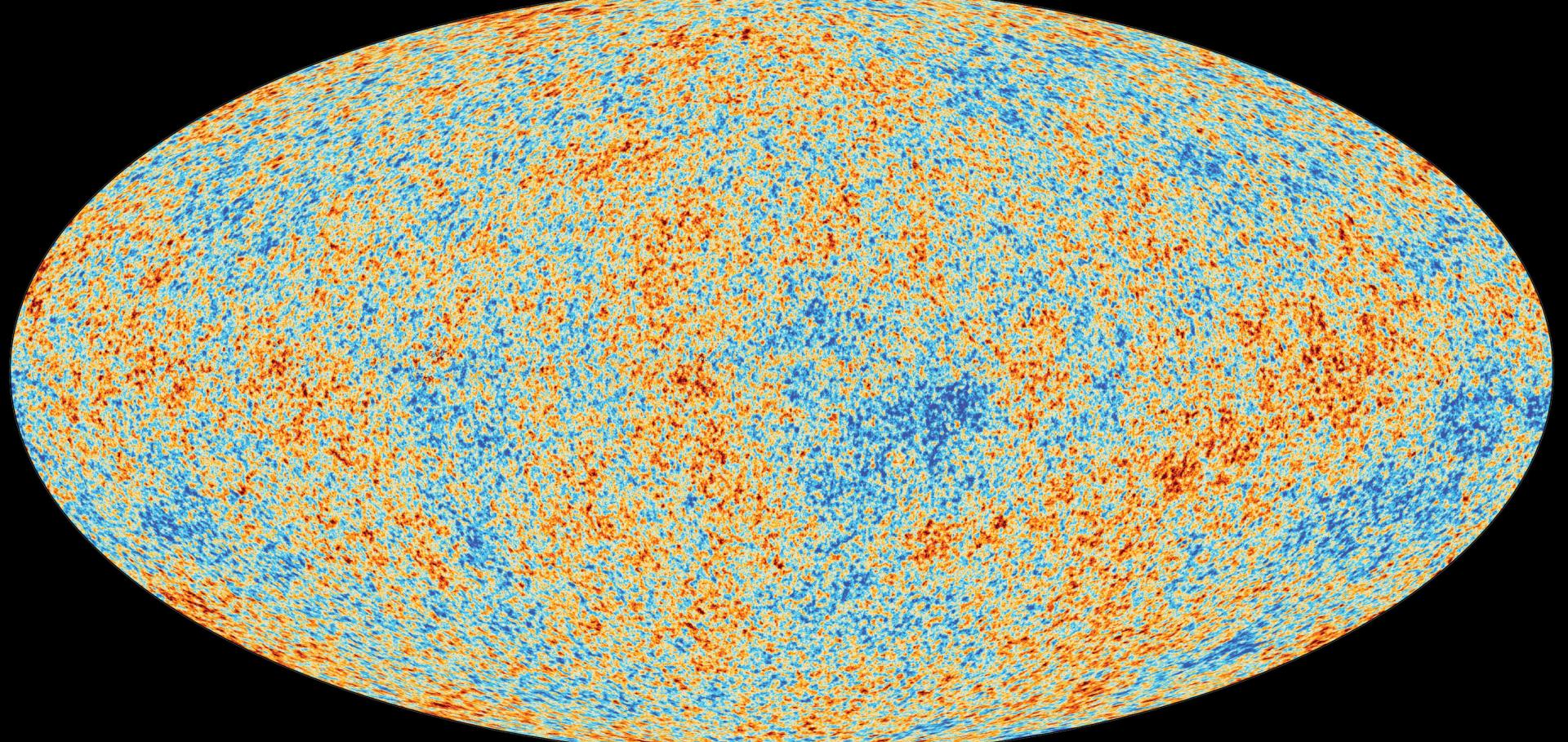
Inference of the optical depth to reionization from low multipole temperature and polarization Planck data
Monthly Notices of the Royal Astronomical Society 507:1 (2021) 1072-1091
Abstract:
This paper explores methods for constructing low multipole temperature and polarization likelihoods from maps of the cosmic microwave background anisotropies that have complex noise properties and partial sky coverage. We use Planck 2018 High Frequency Instrument (HFI) and updated SRoll2 temperature and polarization maps to test our methods. We present three likelihood approximations based on quadratic cross spectrum estimators: (i) a variant of the simulation-based likelihood (SimBaL) techniques used in the Planck legacy papers to produce a low multipole EE likelihood; (ii) a semi-analytical likelihood approximation (momento) based on the principle of maximum entropy; (iii) a density-estimation 'likelihood-free' scheme (delfi). Approaches (ii) and (iii) can be generalized to produce low multipole joint temperature-polarization (TTTEEE) likelihoods. We present extensive tests of these methods on simulations with realistic correlated noise. We then analyse the Planck data and confirm the robustness of our method and likelihoods on multiple inter- and intra-frequency detector set combinations of SRoll2 maps. The three likelihood techniques give consistent results and support a low value of the optical depth to reoinization, τ, from the HFI. Our best estimate of τ comes from combining the low multipole SRoll2momento (TTTEEE) likelihood with the CamSpec high multipole likelihood and is τ = 0.0627+0.0050-0.0058. This is consistent with the SRoll2 team's determination of τ, though slightly higher by ∼0.5σ, mainly because of our joint treatment of temperature and polarization.Theoretical priors in scalar-tensor cosmologies: shift-symmetric Horndeski models
Physical Review D American Physical Society 104:8 (2021) 83502
Abstract:
Attempts at constraining theories of late time accelerated expansion often assume broad priors for the parameters in their phenomenological description. Focusing on shift-symmetric scalar-tensor theories with standard gravitational wave speed, we show how a more careful analysis of their dynamical evolution leads to much narrower priors. In doing so, we propose a simple and accurate parametrization of these theories, capturing the redshift dependence of the equation of state, w (z), and the kinetic braiding parameter, αB(z) , with only two parameters each, and derive their statistical distribution (also known as theoretical priors) that fit the cosmology of the underlying model. We have considered two versions of the shift-symmetric model, one where the energy density of dark energy is given solely by the scalar field and another where it also has a contribution from the cosmological constant. By including current data, we show how theoretical priors can be used to improve constraints by up to an order of magnitude. Moreover, we show that shift-symmetric theories without a cosmological constant are observationally viable. We work up to quartic order in first derivatives of the scalar in the action, and our results suggest this truncation is a good approximation to more general shift-symmetric theories. This work establishes an actionable link between phenomenological parametrizations and Lagrangian-based theories, the two main approaches to test cosmological gravity and cosmic acceleration.Normal, dust-obscured galaxies in the epoch of reionization
Nature Springer Nature 597:7877 (2021) 489-492
Catalogues of voids as antihalos in the local Universe
(2021)