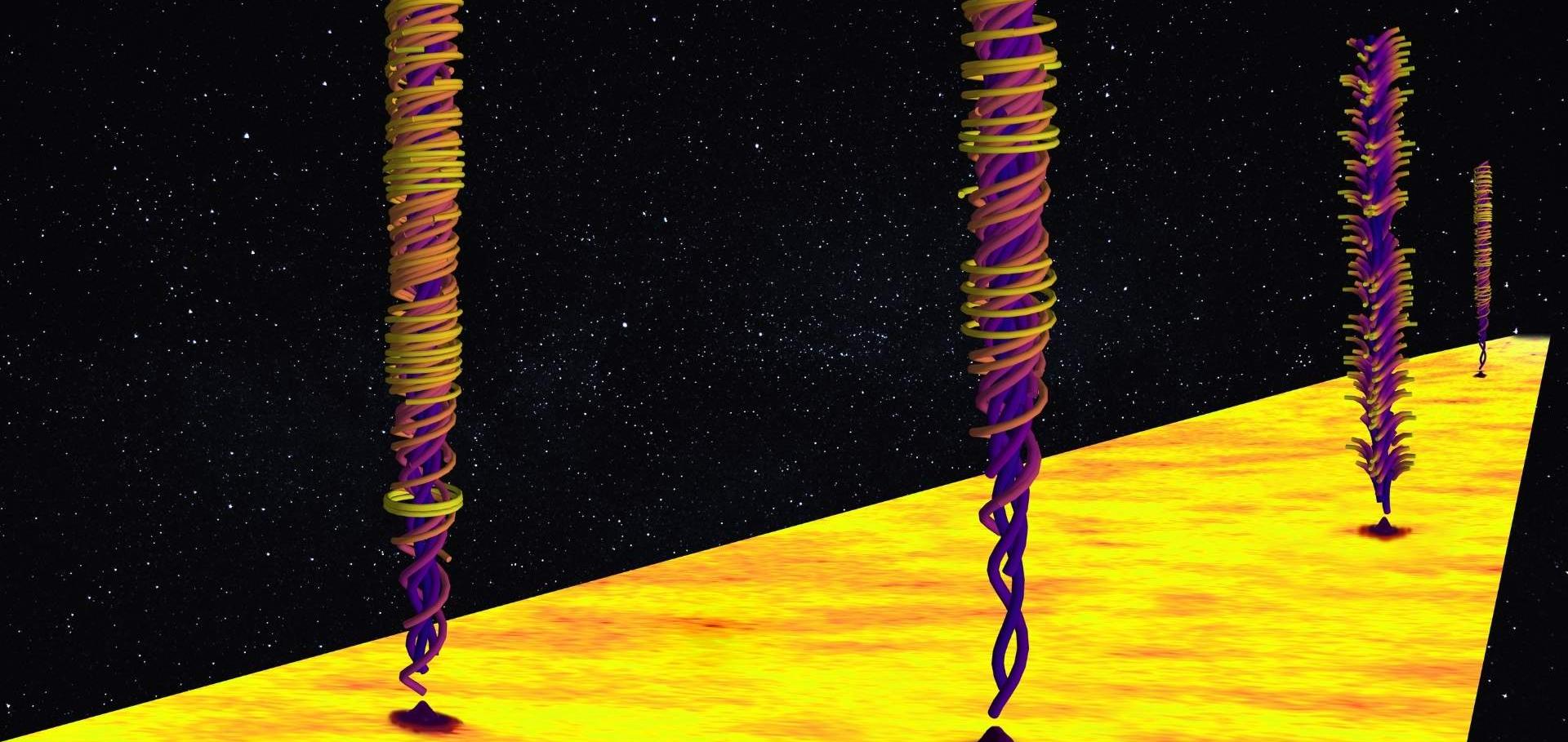
Route towards stable homochiral topological textures in A -type antiferromagnets

Physical Review B American Physical Society (APS) 105:22 (2022) 224424

Authors:

Jack Harrison, Hariom Jani, Paolo G Radaelli

A cost-effective quantum eraser demonstration

(2022)

Authors:

Aarushi Khandelwal, Jit Bin Joseph Tan, Tze Kwang Leong, Yarong Yang, T Venkatesan, Hariom Jani

Nanostructured Iron Vanadate Photoanodes with Enhanced Visible Absorption and Charge Separation

ACS Applied Energy Materials 5:3 (2022) 3409-3416

Authors:

M Zhang, Y Fang, YF Tay, Y Liu, L Wang, H Jani, FF Abdi, LH Wong

Abstract:

Nanostructuring has been an effective method to improve the charge separation of semiconductors with poor charge transport properties. FeVO4is a promising photoanode with a band gap of ∼2.1 eV, theoretical photocurrent of 13 mA cm-1, and solar-to-hydrogen efficiency of up to 16%. However, its photoelectrochemical (PEC) activity is limited by the low charge transport properties. In this report, a two-step synthesis method is found to control the growth of FeVO4photoanodes to become a nanorod or film. Nanostructured FeVO4is demonstrated to achieve higher photocurrent density due to the higher charge separation efficiency and enlarged absorption range. In addition, the band gap of FeVO4nanorods has decreased by 0.16 eV, which is attributed to the formation of vanadium vacancy, as supported by calculation results. This work demonstrates that nanostructuring and vacancy incorporation synergistically improve the PEC performance of FeVO4-based photoanodes.

Modern Physics demonstrations with DIY Smartphone Spectrometers

(2022)

Authors:

Aarushi Khandelwal, Tze Kwang Leong, Yarong Yang, Loo Kang Wee, Félix J García Clemente, T Venkatesan, Hariom Jani

Unravelling a new many-body large-hole polaron in a transition metal oxide that promotes high photocatalytic activity

npg Asia Materials Nature Research 14:1 (2022) 19

Authors:

Xiao Chi, Lily Mandal, Cuibo Liu, Angga Dito Fauzi, Anindita Chaudhuri, Thomas J Whitcher, Hariom Kirit Jani, Zhongxin Chen, Shibo Xi, Caozheng Diao, Muhammad Avicenna Naradipa, Xiaojiang Yu, Ping Yang, Antonio Helio Castro-Neto, Mark BH Breese, Kian Ping Loh, Thirumalai Venky Venkatesan, Andrivo Rusydi

Abstract:

In this work we investigate the delocalized excitons and excitons trapped by a polaron formation in \BVO{} by means of resonant Raman spectroscopy. We record Raman spectra with 16 laser lines between 1.9 and \SI{2.6}{\eV} and analyze intensity variations of the Raman peaks for different vibrational modes. The resonant Raman cross sections of the \Ag{} modes contain two types of resonances. The first high-energy resonance near \SI{2.45}{\eV} belongs to a transition between delocalized states; it is close to absorption edge measured at \SI{2.3}{\eV} and exhibits a characteristic \SI{50}{\meV} anisotropy between polarization parallel and perpendicular to the $c$ axis. The high energy Raman resonance occurs inside the gap at \SI{1.94}{\eV} for all crystallographic directions. The in-gap resonance can involve a localized transition. We attribute it to an exciton-polaron, formed by a small localized electron polaron of Holstein type and delocalized holes. It manifests in the vibrations of vanadium and oxygen atoms where polaron localization occurs and the resonance energy matches theoretical predictions. The vibrational modes couple to the polaron with different efficiency determined from resonant Raman profiles.Comment: main: 8 pages, 4 figures, supporting: 4 pages, 3 figure