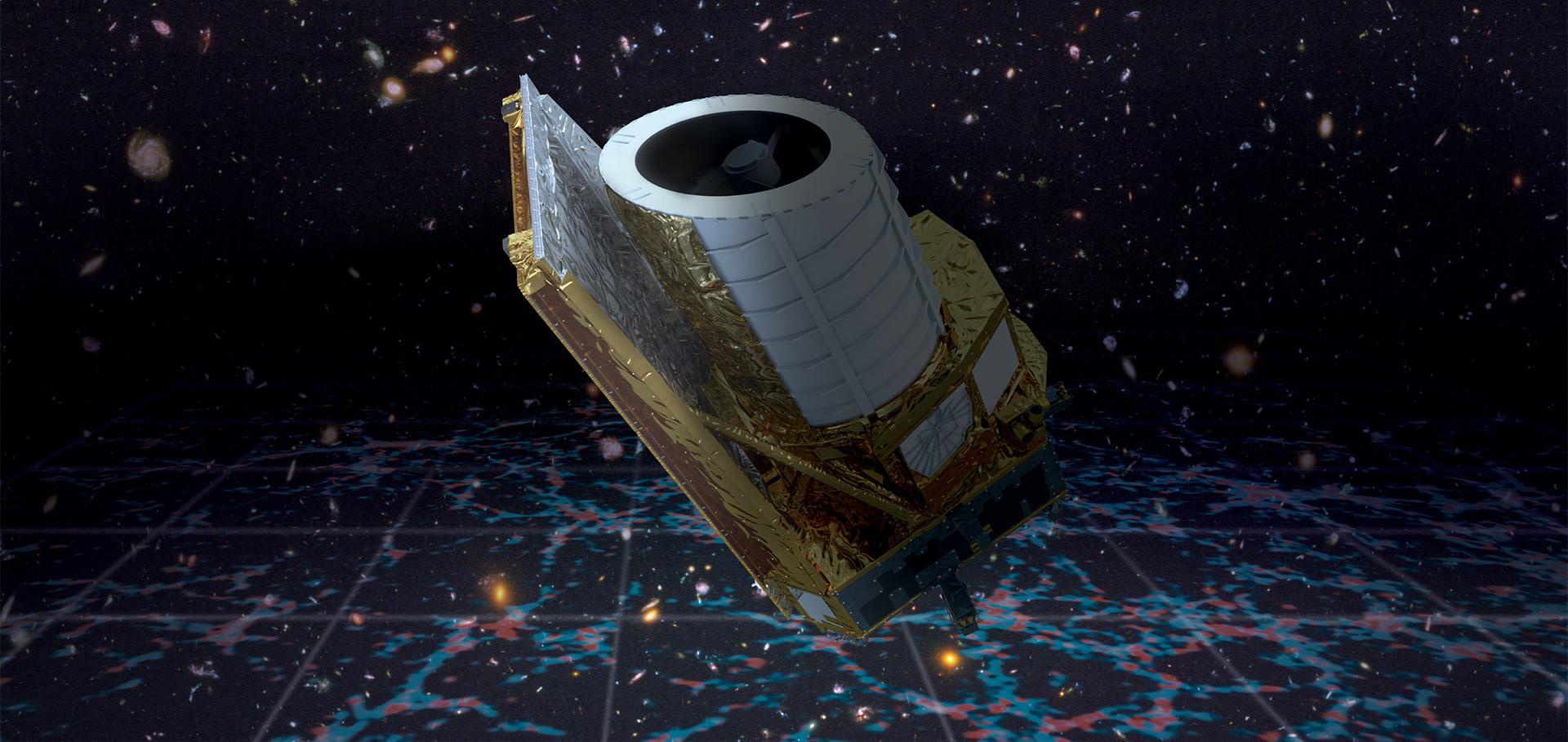
Euclid: Forecast constraints on consistency tests of the ΛCDM model

Astronomy & Astrophysics EDP Sciences 660 (2022) A67-A67

Authors:

S Nesseris, D Sapone, M Martinelli, D Camarena, V Marra, Z Sakr, J Garcia-Bellido, CJAP Martins, C Clarkson, A Da Silva, P Fleury, L Lombriser, JP Mimoso, S Casas, V Pettorino, I Tutusaus, A Amara, N Auricchio, C Bodendorf, D Bonino, E Branchini, M Brescia, V Capobianco, C Carbone, J Carretero, CAJ Duncan

Abstract:

Context. The standard cosmological model is based on the fundamental assumptions of a spatially homogeneous and isotropic universe on large scales. An observational detection of a violation of these assumptions at any redshift would immediately indicate the presence of new physics. Aims. We quantify the ability of the Euclid mission, together with contemporary surveys, to improve the current sensitivity of null tests of the canonical cosmological constant Λ and the cold dark matter (ΛCDM) model in the redshift range 0 < z < 1.8. Methods. We considered both currently available data and simulated Euclid and external data products based on a ΛCDM fiducial model, an evolving dark energy model assuming the Chevallier-Polarski-Linder parameterization or an inhomogeneous Lemaître-Tolman-Bondi model with a cosmological constant Λ, and carried out two separate but complementary analyses: a machine learning reconstruction of the null tests based on genetic algorithms, and a theory-agnostic parametric approach based on Taylor expansion and binning of the data, in order to avoid assumptions about any particular model. Results. We find that in combination with external probes, Euclid can improve current constraints on null tests of the ΛCDM by approximately a factor of three when using the machine learning approach and by a further factor of two in the case of the parametric approach. However, we also find that in certain cases, the parametric approach may be biased against or missing some features of models far from ΛCDM. Conclusions. Our analysis highlights the importance of synergies between Euclid and other surveys. These synergies are crucial for providing tighter constraints over an extended redshift range for a plethora of different consistency tests of some of the main assumptions of the current cosmological paradigm.

Euclid preparation

Astronomy & Astrophysics EDP Sciences 658 (2022) a126

Authors:

A Moneti, HJ McCracken, M Shuntov, OB Kauffmann, P Capak, I Davidzon, O Ilbert, C Scarlata, S Toft, J Weaver, R Chary, J Cuby, AL Faisst, DC Masters, C McPartland, B Mobasher, DB Sanders, R Scaramella, D Stern, I Szapudi, H Teplitz, L Zalesky, A Amara, N Auricchio, C Bodendorf, D Bonino, E Branchini, S Brau-Nogue, M Brescia, J Brinchmann, V Capobianco, C Carbone, J Carretero, FJ Castander, M Castellano, S Cavuoti, A Cimatti, R Cledassou, G Congedo, CJ Conselice, L Conversi, Y Copin, L Corcione, A Costille, M Cropper, A Da Silva, H Degaudenzi, M Douspis, F Dubath, CAJ Duncan, X Dupac, S Dusini, S Farrens, S Ferriol, P Fosalba, M Frailis, E Franceschi, M Fumana, B Garilli, B Gillis, C Giocoli, BR Granett, A Grazian, F Grupp, SVH Haugan, H Hoekstra, W Holmes, F Hormuth, P Hudelot, K Jahnke, S Kermiche, A Kiessling, M Kilbinger, T Kitching, R Kohley, M Kümmel, M Kunz, H Kurki-Suonio, S Ligori, PB Lilje, I Lloro, E Maiorano, O Mansutti, O Marggraf, K Markovic, F Marulli, R Massey, S Maurogordato, M Meneghetti, E Merlin, G Meylan, M Moresco, L Moscardini, E Munari, SM Niemi, C Padilla, S Paltani, F Pasian, K Pedersen, S Pires, M Poncet, L Popa, L Pozzetti, F Raison, R Rebolo, J Rhodes, H Rix, M Roncarelli, E Rossetti, R Saglia, P Schneider, A Secroun, G Seidel, S Serrano, C Sirignano, G Sirri, L Stanco, P Tallada-Crespí, AN Taylor, I Tereno, R Toledo-Moreo, F Torradeflot, Y Wang, N Welikala, J Weller, G Zamorani, J Zoubian, S Andreon, S Bardelli, S Camera, J Graciá-Carpio, E Medinaceli, S Mei, G Polenta, E Romelli, F Sureau, M Tenti, T Vassallo, A Zacchei, E Zucca, C Baccigalupi, A Balaguera-Antolínez, F Bernardeau, A Biviano, M Bolzonella, E Bozzo, C Burigana, R Cabanac, A Cappi, CS Carvalho, S Casas, G Castignani, C Colodro-Conde, J Coupon, HM Courtois, D Di Ferdinando, M Farina, F Finelli, P Flose-Reimberg, S Fotopoulou, S Galeotta, K Ganga, J Garcia-Bellido, E Gaztanaga, G Gozaliasl, I Hook, B Joachimi, V Kansal, E Keihanen, CC Kirkpatrick, V Lindholm, G Mainetti, D Maino, R Maoli, M Martinelli, N Martinet, M Maturi, RB Metcalf, G Morgante, N Morisset, A Nucita, L Patrizii, D Potter, A Renzi, G Riccio, AG Sánchez, D Sapone, M Schirmer, M Schultheis, V Scottez, E Sefusatti, R Teyssier, O Tubio, I Tutusaus, J Valiviita, M Viel, H Hildebrandt

Euclid preparation

Astronomy & Astrophysics EDP Sciences 657 (2022) a92

Authors:

AS Borlaff, P Gómez-Alvarez, B Altieri, PM Marcum, R Vavrek, R Laureijs, R Kohley, F Buitrago, J-C Cuillandre, P-A Duc, LM Gaspar Venancio, A Amara, S Andreon, N Auricchio, R Azzollini, C Baccigalupi, A Balaguera-Antolínez, M Baldi, S Bardelli, R Bender, A Biviano, C Bodendorf, D Bonino, E Bozzo, E Branchini, M Brescia, J Brinchmann, C Burigana, R Cabanac, S Camera, GP Candini, V Capobianco, A Cappi, C Carbone, J Carretero, CS Carvalho, S Casas, FJ Castander, M Castellano, G Castignani, S Cavuoti, A Cimatti, R Cledassou, C Colodro-Conde, G Congedo, CJ Conselice, L Conversi, Y Copin, L Corcione, J Coupon, HM Courtois, M Cropper, A Da Silva, H Degaudenzi, D Di Ferdinando, M Douspis, F Dubath, CAJ Duncan, X Dupac, S Dusini, A Ealet, M Fabricius, M Farina, S Farrens, PG Ferreira, S Ferriol, F Finelli, P Flose-Reimberg, P Fosalba, M Frailis, E Franceschi, M Fumana, S Galeotta, K Ganga, B Garilli, B Gillis, C Giocoli, G Gozaliasl, J Graciá-Carpio, A Grazian, F Grupp, SVH Haugan, W Holmes, F Hormuth, K Jahnke, E Keihanen, S Kermiche, A Kiessling, M Kilbinger, CC Kirkpatrick, T Kitching, JH Knapen, B Kubik, M Kümmel, M Kunz, H Kurki-Suonio, P Liebing, S Ligori, PB Lilje, V Lindholm, I Lloro, G Mainetti, D Maino, O Mansutti, O Marggraf, K Markovic, M Martinelli, N Martinet, D Martínez-Delgado, F Marulli, R Massey, M Maturi, S Maurogordato, E Medinaceli, S Mei, M Meneghetti, E Merlin, RB Metcalf, G Meylan, M Moresco, G Morgante, L Moscardini, E Munari, R Nakajima, C Neissner, SM Niemi, JW Nightingale, A Nucita, C Padilla, S Paltani, F Pasian, L Patrizii, K Pedersen, WJ Percival, V Pettorino, S Pires, M Poncet, L Popa, D Potter, L Pozzetti, F Raison, R Rebolo, A Renzi, J Rhodes, G Riccio, E Romelli, M Roncarelli, C Rosset, E Rossetti, R Saglia, AG Sánchez, D Sapone, M Sauvage, P Schneider, V Scottez, A Secroun, G Seidel, S Serrano, C Sirignano, G Sirri, J Skottfelt, L Stanco, JL Starck, F Sureau, P Tallada-Crespí, AN Taylor, M Tenti, I Tereno, R Teyssier, R Toledo-Moreo, F Torradeflot, I Tutusaus, EA Valentijn, L Valenziano, J Valiviita, T Vassallo, M Viel, Y Wang, J Weller, L Whittaker, A Zacchei, G Zamorani, E Zucca

Euclid preparation

Astronomy & Astrophysics EDP Sciences 657 (2022) a91

Authors:

S Ilić, N Aghanim, C Baccigalupi, JR Bermejo-Climent, G Fabbian, L Legrand, D Paoletti, M Ballardini, M Archidiacono, M Douspis, F Finelli, K Ganga, C Hernández-Monteagudo, M Lattanzi, D Marinucci, M Migliaccio, C Carbone, S Casas, M Martinelli, I Tutusaus, P Natoli, P Ntelis, L Pagano, L Wenzl, A Gruppuso, T Kitching, M Langer, N Mauri, L Patrizii, A Renzi, G Sirri, L Stanco, M Tenti, P Vielzeuf, F Lacasa, G Polenta, V Yankelevich, A Blanchard, Z Sakr, A Pourtsidou, S Camera, VF Cardone, M Kilbinger, M Kunz, K Markovic, V Pettorino, AG Sánchez, D Sapone, A Amara, N Auricchio, R Bender, C Bodendorf, D Bonino, E Branchini, M Brescia, J Brinchmann, V Capobianco, J Carretero, FJ Castander, M Castellano, S Cavuoti, A Cimatti, R Cledassou, G Congedo, CJ Conselice, L Conversi, Y Copin, L Corcione, A Costille, M Cropper, A Da Silva, H Degaudenzi, F Dubath, CAJ Duncan, X Dupac, S Dusini, A Ealet, S Farrens, P Fosalba, M Frailis, E Franceschi, P Franzetti, M Fumana, B Garilli, W Gillard, B Gillis, C Giocoli, A Grazian, F Grupp, L Guzzo, SVH Haugan, H Hoekstra, W Holmes, F Hormuth, P Hudelot, K Jahnke, S Kermiche, A Kiessling, R Kohley, B Kubik, M Kümmel, H Kurki-Suonio, R Laureijs, S Ligori, PB Lilje, I Lloro, O Mansutti, O Marggraf, F Marulli, R Massey, S Maurogordato, M Meneghetti, E Merlin, G Meylan, M Moresco, B Morin, L Moscardini, E Munari, SM Niemi, C Padilla, S Paltani, F Pasian, K Pedersen, W Percival, S Pires, M Poncet, L Popa, L Pozzetti, F Raison, R Rebolo, J Rhodes, M Roncarelli, E Rossetti, R Saglia, R Scaramella, P Schneider, A Secroun, G Seidel, S Serrano, C Sirignano, JL Starck, P Tallada-Crespí, AN Taylor, I Tereno, R Toledo-Moreo, F Torradeflot, EA Valentijn, L Valenziano, GA Verdoes Kleijn, Y Wang, N Welikala, J Weller, G Zamorani, J Zoubian, E Medinaceli, S Mei, C Rosset, F Sureau, T Vassallo, A Zacchei, S Andreon, A Balaguera-Antolínez, M Baldi, S Bardelli, A Biviano, S Borgani, E Bozzo, C Burigana, R Cabanac, A Cappi, CS Carvalho, G Castignani, C Colodro-Conde, J Coupon, HM Courtois, J Cuby, S de la Torre, D Di Ferdinando, H Dole, M Farina, PG Ferreira, P Flose-Reimberg, S Galeotta, G Gozaliasl, J Graciá-Carpio, E Keihanen, CC Kirkpatrick, V Lindholm, G Mainetti, D Maino, N Martinet, M Maturi, RB Metcalf, G Morgante, C Neissner, J Nightingale, AA Nucita, D Potter, G Riccio, E Romelli, M Schirmer, M Schultheis, V Scottez, R Teyssier, A Tramacere, J Valiviita, M Viel, L Whittaker, E Zucca

Deep Extragalactic VIsible Legacy Survey (DEVILS): identification of AGN through SED fitting and the evolution of the bolometric AGN luminosity function

Monthly Notices of the Royal Astronomical Society Oxford University Press 509:4 (2021) 4940-4961

Authors:

Jessica E Thorne, Aaron SG Robotham, Luke JM Davies, Sabine Bellstedt, Michael JI Brown, Scott M Croom, Ivan Delvecchio, Brent Groves, Matt J Jarvis, Stanislav S Shabala, Nick Seymour, Imogen H Whittam, Matias Bravo, Robin HW Cook, Simon P Driver, Benne Holwerda, Steven Phillipps, Malgorzata Siudek

Abstract:

Active galactic nuclei (AGN) are typically identified through radio, mid-infrared, or X-ray emission or through the presence of broad and/or narrow emission lines. AGN can also leave an imprint on a galaxy’s spectral energy distribution (SED) through the re-processing of photons by the dusty torus. Using the SED fitting code PROSPECT with an incorporated AGN component, we fit the far-ultraviolet to far-infrared SEDs of ∼494 000 galaxies in the D10-COSMOS field and ∼230 000 galaxies from the GAMA survey. By combining an AGN component with a flexible star formation and metallicity implementation, we obtain estimates for the AGN luminosities, stellar masses, star formation histories, and metallicity histories for each of our galaxies. We find that PROSPECT can identify AGN components in 91 per cent of galaxies pre-selected as containing AGN through narrow-emission line ratios and the presence of broad lines. Our PROSPECT-derived AGN luminosities show close agreement with luminosities derived for X-ray selected AGN using both the X-ray flux and previous SED fitting results. We show that incorporating the flexibility of an AGN component when fitting the SEDs of galaxies with no AGN has no significant impact on the derived galaxy properties. However, in order to obtain accurate estimates of the stellar properties of AGN host galaxies, it is crucial to include an AGN component in the SED fitting process. We use our derived AGN luminosities to map the evolution of the AGN luminosity function for 0 < z < 2 and find good agreement with previous measurements and predictions from theoretical models.