Mature but Still Growing: JWST Detection of the Earliest Intracluster Light at z ∼ 2

The Astrophysical Journal Letters American Astronomical Society 1002:1 (2026) L17

Authors:

Hyungjin Joo, M James Jee, Kyle Finner, Zachary P Scofield, Sangjun Cha, Jinhyub Kim, Ranga-Ram Chary, Andreas Faisst, Bomee Lee

Abstract:

We present a JWST analysis of intracluster light (ICL) in XLSSC 122 at z = 1.98, currently the most distant known strong-lensing galaxy cluster with an evolved member population. Using deep JWST imaging complemented by Hubble Space Telescope data and careful control of systematics, we robustly detect diffuse emission extending to several hundred kiloparsecs from the brightest cluster galaxy (BCG) down to ∼29magarcsec−2 . Multicomponent point-spread-function-convolved Sérsic modeling separates the surface brightness profiles into three components: a BCG core, a BCG envelope, and an ICL component, with stable Sérsic indices across wavelengths. Nearly flat color profiles indicate minimal radial variation in the stellar populations of the BCG envelope and the ICL. The median ICL fraction measured across seven bands is ∼17%, demonstrating that the buildup of intracluster stars in massive halos was already well underway by z ∼ 2. The ICL fraction peaks near 5000 Å in the rest frame, which provides the first confirmation at z > 1 that this characteristic rise is a feature of dynamically active clusters. We also detect a southern excess of ICL relative to the best-fit Sérsic model and quantify it using wavelet-based modeling, providing additional support that this system is dynamically active. The BCG + ICL light distribution and strong-lensing mass map show strong morphological agreement within ∼100 kpc. These findings establish the ICL as an early forming and dynamically informative component of massive halos.

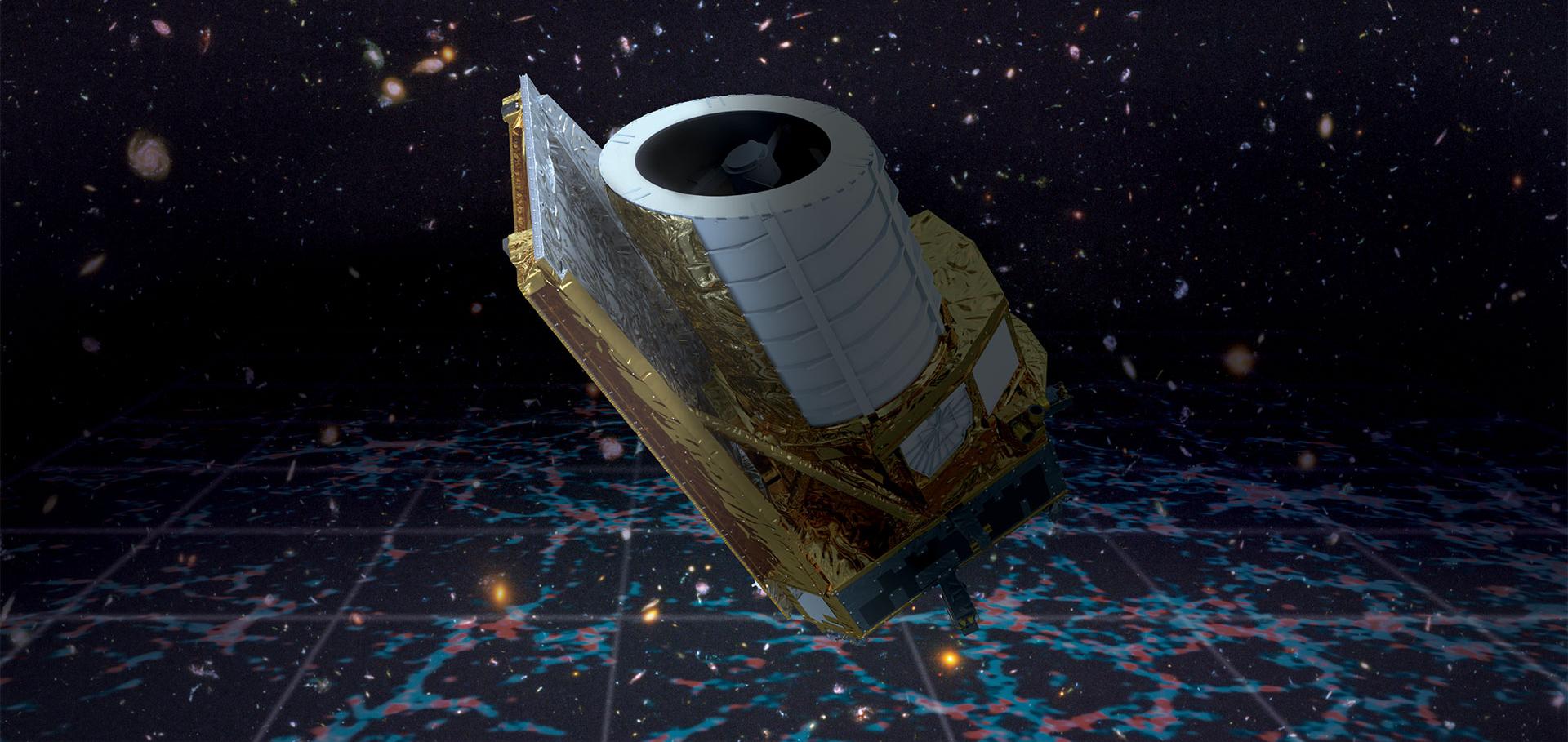
Euclid: Optimising tomographic redshift binning for 3 × 2 pt power spectrum constraints on dark energy

Astronomy and Astrophysics 708 (2026)

Authors:

JHW Wong, ML Brown, CAJ Duncan, A Amara, S Andreon, C Baccigalupi, M Baldi, S Bardelli, D Bonino, E Branchini, M Brescia, J Brinchmann, A Caillat, S Camera, V Capobianco, C Carbone, J Carretero, S Casas, M Castellano, G Castignani, S Cavuoti, A Cimatti, C Colodro-Conde, G Congedo, CJ Conselice, L Conversi, Y Copin, F Courbin, HM Courtois, A Da Silva, H Degaudenzi, G De Lucia, AM Di Giorgio, J Dinis, F Dubath, X Dupac, S Dusini, M Farina, S Farrens, F Faustini, S Ferriol, M Frailis, E Franceschi, S Galeotta, K George, W Gillard, B Gillis, C Giocoli, A Grazian, F Grupp, L Guzzo, SVH Haugan, W Holmes, I Hook, F Hormuth, A Hornstrup, S Ilić, K Jahnke, M Jhabvala, E Keihänen, S Kermiche, A Kiessling, B Kubik, M Kunz, H Kurki-Suonio, S Ligori, PB Lilje, V Lindholm, I Lloro, G Mainetti, E Maiorano, O Mansutti, O Marggraf, K Markovic, M Martinelli, N Martinet, F Marulli, R Massey, E Medinaceli, S Mei, M Melchior, Y Mellier, M Meneghetti, E Merlin, G Meylan, M Moresco, L Moscardini, C Neissner, SM Niemi, C Padilla, S Paltani, F Pasian, K Pedersen, V Pettorino, S Pires, G Polenta, M Poncet, LA Popa, F Raison, A Renzi

Abstract:

The tomographic approach to analysing the 3 × 2 pt signal involves dividing the observed galaxy sample into a configuration of redshift bins. We present a simulation-based method to explore the optimum tomographic binning strategy for Euclid, focussing on the expected configuration of its first major data release (DR1). To do so, we 1) simulated a Euclid-like observation and generated mock shear catalogues from multiple realisations of the 3 × 2 pt fields on the sky; and 2) measured the 3 × 2 pt Pseudo-Cℓ power spectra for a given tomographic configuration and derived the constraints they place on the standard dark energy equation-of-state parameters, (w0, wa). For a simulation including Gaussian-distributed photometric redshift uncertainties and shape noise under a ΛCDM cosmology, we find that bins that are equipopulated with galaxies yield the best constraints on (w0, wa) for an analysis of the full 3 × 2 pt signal or the angular clustering component only. For the cosmic shear component, the optimum (w0, wa) constraints can be achieved by bins equally spaced in fiducial comoving distance. However, the advantage with respect to alternative binning choices is only of a few per cent in the size of the 1σ (w0, wa) contour and we conclude that the cosmic shear is relatively insensitive to the binning methodology. We find that the information gain extracted on (w0, wa) for any 3 × 2 pt component starts to become saturated beyond roughly seven or eight bins. Any marginal gains resulting from a greater number of bins are likely to be limited by additional uncertainties present in a real measurement and the increasing demand for accuracy of the covariance matrix. Finally, we considered a 5% contamination from catastrophic photometric redshift outliers and found that if these errors are not mitigated in the analysis, the bias induced in the 3 × 2 pt signal for ten equipopulated bins results in dark energy constraints that are inconsistent with the fiducial ΛCDM cosmology at ≳3σ.

Euclid preparation

Astronomy & Astrophysics EDP Sciences 708 (2026) a105

Authors:

J Bel, S Gouyou Beauchamps, P Baratta, L Blot, C Carbone, P-S Corasaniti, E Sefusatti, S Escoffier, W Gillard, A Amara, S Andreon, N Auricchio, C Baccigalupi, M Baldi, S Bardelli, P Battaglia, A Biviano, E Branchini, M Brescia, J Brinchmann, S Camera, G Cañas-Herrera, V Capobianco, VF Cardone, J Carretero, S Casas, M Castellano, G Castignani, S Cavuoti, KC Chambers, A Cimatti, C Colodro-Conde, G Congedo, CJ Conselice, L Conversi, Y Copin, A Costille, F Courbin, HM Courtois, A Da Silva, H Degaudenzi, S de la Torre, G De Lucia, F Dubath, CAJ Duncan, X Dupac, M Farina, R Farinelli, F Faustini, S Ferriol, F Finelli, N Fourmanoit, M Frailis, E Franceschi, M Fumana, S Galeotta, K George, B Gillis, C Giocoli, J Gracia-Carpio, A Grazian, F Grupp, L Guzzo, SVH Haugan, W Holmes, F Hormuth, A Hornstrup, K Jahnke, M Jhabvala, B Joachimi, E Keihänen, S Kermiche, B Kubik, M Kunz, H Kurki-Suonio, AMC Le Brun, S Ligori, PB Lilje, V Lindholm, I Lloro, G Mainetti, D Maino, E Maiorano, O Mansutti, O Marggraf, K Markovic, M Martinelli, N Martinet, F Marulli, R Massey, E Medinaceli, Y Mellier, M Meneghetti, E Merlin, G Meylan, A Mora, M Moresco, L Moscardini, C Neissner, S-M Niemi, C Padilla, S Paltani, F Pasian, K Pedersen, WJ Percival, V Pettorino, S Pires, G Polenta, M Poncet, LA Popa, F Raison, A Renzi, J Rhodes, G Riccio, F Rizzo, E Romelli, M Roncarelli, R Saglia, Z Sakr, AG Sánchez, D Sapone, B Sartoris, P Schneider, T Schrabback, M Scodeggio, A Secroun, G Seidel, M Seiffert, S Serrano, P Simon, C Sirignano, G Sirri, L Stanco, J Steinwagner, P Tallada-Crespí, AN Taylor, I Tereno, N Tessore, S Toft, R Toledo-Moreo, F Torradeflot, I Tutusaus, L Valenziano, J Valiviita, T Vassallo, A Veropalumbo, Y Wang, J Weller, G Zamorani, E Zucca, M Ballardini, E Bozzo, C Burigana, R Cabanac, M Calabrese, D Di Ferdinando, JA Escartin Vigo, L Gabarra, J Martín-Fleitas, S Matthew, N Mauri, RB Metcalf, A Pezzotta, M Pöntinen, C Porciani, I Risso, V Scottez, M Sereno, M Tenti, M Viel, M Wiesmann, Y Akrami, S Alvi, IT Andika, S Anselmi, M Archidiacono, F Atrio-Barandela, D Bertacca, M Bethermin, A Blanchard, S Borgani, ML Brown, S Bruton, A Calabro, B Camacho Quevedo, F Caro, CS Carvalho, T Castro, F Cogato, S Conseil, S Contarini, AR Cooray, S Davini, G Desprez, A Díaz-Sánchez, JJ Diaz, S Di Domizio, JM Diego, A Enia, Y Fang, AG Ferrari, A Finoguenov, A Franco, K Ganga, J García-Bellido, T Gasparetto, V Gautard, E Gaztanaga, F Giacomini, F Gianotti, G Gozaliasl, M Guidi, CM Gutierrez, A Hall, C Hernández-Monteagudo, H Hildebrandt, J Hjorth, JJE Kajava, Y Kang, V Kansal, D Karagiannis, K Kiiveri, CC Kirkpatrick, S Kruk, M Lattanzi, J Le Graet, L Legrand, M Lembo, F Lepori, G Leroy, GF Lesci, J Lesgourgues, L Leuzzi, TI Liaudat, J Macias-Perez, G Maggio, M Magliocchetti, F Mannucci, R Maoli, CJAP Martins, L Maurin, M Miluzio, P Monaco, C Moretti, G Morgante, S Nadathur, K Naidoo, A Navarro-Alsina, S Nesseris, L Pagano, F Passalacqua, K Paterson, L Patrizii, A Pisani, D Potter, S Quai, M Radovich, P Reimberg, P-F Rocci, G Rodighiero, S Sacquegna, M Sahlén, DB Sanders, E Sarpa, A Schneider, D Sciotti, E Sellentin, LC Smith, JG Sorce, K Tanidis, C Tao, G Testera, R Teyssier, S Tosi, A Troja, M Tucci, C Valieri, A Venhola, D Vergani, F Vernizzi, G Verza, P Vielzeuf, NA Walton

Abstract:

We investigate the non-Gaussian features in the distribution of the matter power spectrum multipoles. Using the COVMOS method, we generated 100 000 mock realisations of dark matter density fields in both real and redshift space across multiple redshifts and cosmological models. We derived an analytical framework linking the non-Gaussianity of the power spectrum distribution to higher-order statistics of the density field, including the trispectrum and pentaspectrum. We explored the effect of redshift-space distortions, the geometry of the survey, the Fourier binning, the integral constraint, and the shot noise on the skewness of the distribution of the power spectrum measurements. Our results demonstrate that the likelihood of the estimated matter power spectrum significantly deviates from a Gaussian assumption on non-linear scales, particularly at low redshift. This departure is primarily driven by the pentaspectrum contribution, which dominates over the trispectrum at intermediate scales. We also examined the impact of the finiteness of the survey geometry in the context of the Euclid mission, and we find that both the shape of the survey and the integral constraint amplify the skewness.

Euclid preparation

Astronomy & Astrophysics EDP Sciences 708 (2026) a104

Authors:

L Zalesky, JR Weaver, CJR McPartland, G Murphree, I Valdes, CK Jespersen, S Taamoli, N Chartab, N Allen, SWJ Barrow, DB Sanders, S Toft, B Mobasher, I Szapudi, B Altieri, A Amara, S Andreon, N Auricchio, C Baccigalupi, M Baldi, S Bardelli, P Battaglia, A Biviano, D Bonino, E Branchini, M Brescia, J Brinchmann, A Caillat, S Camera, G Cañas-Herrera, V Capobianco, C Carbone, J Carretero, S Casas, FJ Castander, M Castellano, G Castignani, S Cavuoti, KC Chambers, A Cimatti, C Colodro-Conde, G Congedo, CJ Conselice, L Conversi, Y Copin, F Courbin, HM Courtois, A Da Silva, H Degaudenzi, G De Lucia, AM Di Giorgio, H Dole, F Dubath, CAJ Duncan, X Dupac, S Dusini, A Ealet, S Escoffier, M Farina, R Farinelli, S Farrens, F Faustini, S Ferriol, F Finelli, P Fosalba, S Fotopoulou, M Frailis, E Franceschi, M Fumana, K George, B Gillis, C Giocoli, J Gracia-Carpio, A Grazian, F Grupp, S Gwyn, SVH Haugan, W Holmes, I Hook, F Hormuth, A Hornstrup, K Jahnke, M Jhabvala, B Joachimi, E Keihänen, S Kermiche, A Kiessling, B Kubik, K Kuijken, M Kümmel, M Kunz, H Kurki-Suonio, AMC Le Brun, D Le Mignant, S Ligori, PB Lilje, V Lindholm, I Lloro, G Mainetti, D Maino, E Maiorano, O Mansutti, O Marggraf, K Markovic, M Martinelli, N Martinet, F Marulli, R Massey, S Maurogordato, HJ McCracken, E Medinaceli, S Mei, Y Mellier, M Meneghetti, E Merlin, G Meylan, A Mora, M Moresco, L Moscardini, R Nakajima, C Neissner, S-M Niemi, JW Nightingale, C Padilla, S Paltani, F Pasian, K Pedersen, V Pettorino, G Polenta, M Poncet, LA Popa, L Pozzetti, F Raison, R Rebolo, A Renzi, J Rhodes, G Riccio, E Romelli, M Roncarelli, R Saglia, Z Sakr, D Sapone, B Sartoris, JA Schewtschenko, M Schirmer, P Schneider, T Schrabback, A Secroun, E Sefusatti, G Seidel, S Serrano, P Simon, C Sirignano, G Sirri, L Stanco, J-L Starck, J Steinwagner, P Tallada-Crespí, D Tavagnacco, AN Taylor, HI Teplitz, I Tereno, R Toledo-Moreo, F Torradeflot, A Tsyganov, I Tutusaus, L Valenziano, J Valiviita, T Vassallo, G Verdoes Kleijn, A Veropalumbo, Y Wang, J Weller, A Zacchei, G Zamorani, E Zucca, M Bolzonella, E Bozzo, C Burigana, M Calabrese, D Di Ferdinando, JA Escartin Vigo, L Gabarra, S Matthew, N Mauri, A Pezzotta, M Pöntinen, C Porciani, V Scottez, M Tenti, M Viel, M Wiesmann, Y Akrami, V Allevato, IT Andika, S Anselmi, M Archidiacono, F Atrio-Barandela, M Ballardini, D Bertacca, M Bethermin, A Blanchard, L Blot, S Borgani, ML Brown, S Bruton, R Cabanac, A Calabro, B Camacho Quevedo, A Cappi, F Caro, CS Carvalho, T Castro, R Chary, F Cogato, T Contini, AR Cooray, O Cucciati, S Davini, F De Paolis, G Desprez, A Díaz-Sánchez, S Di Domizio, JM Diego, AG Ferrari, A Finoguenov, K Ganga, J García-Bellido, T Gasparetto, E Gaztanaga, F Giacomini, F Gianotti, G Gozaliasl, A Gregorio, M Guidi, CM Gutierrez, A Hall, WG Hartley, S Hemmati, H Hildebrandt, J Hjorth, M Huertas-Company, O Ilbert, JJE Kajava, Y Kang, V Kansal, D Karagiannis, CC Kirkpatrick, S Kruk, M Lattanzi, J Le Graet, L Legrand, M Lembo, G Leroy, J Lesgourgues, TI Liaudat, A Loureiro, J Macias-Perez, G Maggio, M Magliocchetti, C Mancini, F Mannucci, R Maoli, J Martín-Fleitas, CJAP Martins, L Maurin, RB Metcalf, M Miluzio, P Monaco, C Moretti, G Morgante, C Murray, K Naidoo, P Natoli, A Navarro-Alsina, S Nesseris, K Paterson, L Patrizii, A Pisani, D Potter, I Risso, P-F Rocci, M Sahlén, E Sarpa, J Schaye, A Schneider, M Schultheis, D Sciotti, E Sellentin, M Sereno, F Shankar, LC Smith, SA Stanford, K Tanidis, C Tao, G Testera, R Teyssier, S Tosi, A Troja, M Tucci, C Valieri, A Venhola, D Vergani, G Verza, P Vielzeuf, NA Walton

Abstract:

The Cosmic Dawn Survey pre-launch catalogues cover an effective 10.13 deg 2 area with uniform deep Spitzer /IRAC data ( m ∼ 25 mag, 5 σ ), the largest area covered to these depths at IR wavelengths. We used these data to gain new insight into the growth of stellar mass across cosmic history by characterising the evolution of the galaxy stellar mass function through 0.2 z ≤ 6.5. The total volume (0.62 Gpc 3 ) represents an order of magnitude increase compared to previous works that explored z > 3 and significantly reduces cosmic variance, thus yielding strong constraints on the abundance of galaxies above the characteristic stellar mass (ℳ ★ ) across this ten billion year period. The evolution of the galaxy stellar mass function is generally consistent with results from the literature but now provides firm estimates of the number density where only upper limits were previously available. Contrasting the galaxy stellar mass function with the dark matter halo mass function suggests that massive galaxies (ℳ ≳ 10 11 M ⊙ ) at z > 3.5 required integrated star-formation efficiencies of ℳ/(ℳ h f b )≳ 0.25–0.5, in excess of the commonly held view of a ‘universal peak efficiency’ from studies on the stellar-to-halo mass relation. Such increased efficiencies imply an evolving peak in the stellar-to-halo mass relation at z > 3.5 that can be maintained if feedback mechanisms from active galactic nuclei and stellar processes are ineffective at early times. In addition, a significant fraction of the most massive quiescent galaxies are observed to be in place by z ∼ 2.5–3. The apparent lack of change in their number density by z ∼ 0.2 is consistent with relatively little mass growth from mergers. Utilising the unique volume, we find evidence of an environmental dependence of the galaxy stellar mass function all the way through z ∼ 3.5 for the first time, though a more careful characterisation of the density field is ultimately required for confirmation.

Identifying Transient Hosts in LSST’s Deep Drilling Fields with Galaxy Catalogs

The Astrophysical Journal American Astronomical Society 1000:2 (2026) 289

Authors:

JG Weston, DR Young, SJ Smartt, M Nicholl, MJ Jarvis, IH Whittam

Abstract:

The upcoming Vera C. Rubin Observatory Legacy Survey of Space and Time (LSST) will enable astronomers to discover rare and distant astrophysical transients. Host-galaxy association is crucial for selecting the most scientifically interesting transients for follow-up. LSST deep drilling field (DDF) observations will detect distant transients occurring in galaxies below the detection limits of most all-sky catalogs. Here, we investigate the use of preexisting, field-specific catalogs for host identification in the DDFs and a ranking of their usefulness. We have compiled a database of 70 deep catalogs that overlap with the Rubin DDFs and constructed thin catalogs to be homogenized and combined for transient-host matching. A systematic ranking of their utility is discussed and applied based on the inclusion of information such as spectroscopic redshifts and morphological information. Utilizing this data against a Dark Energy Survey sample of supernovae with pre-identified hosts in the XMM-Large Scale Structure and the Extended Chandra Deep Field-South fields, we evaluate different methods for transient-host association in terms of both accuracy and processing speed. We also apply light data-cleaning techniques to identify and remove contaminants within our associations, such as diffraction spikes and blended galaxies where the correct host cannot be determined with confidence. We use a lightweight machine learning approach in the form of extreme gradient boosting to generate confidence scores in our contaminant selections and associated metrics. Finally, we discuss the computational expense of implementation within the LSST transient alert brokers, which will require efficient, fast-paced processing to handle the large stream of survey data.