

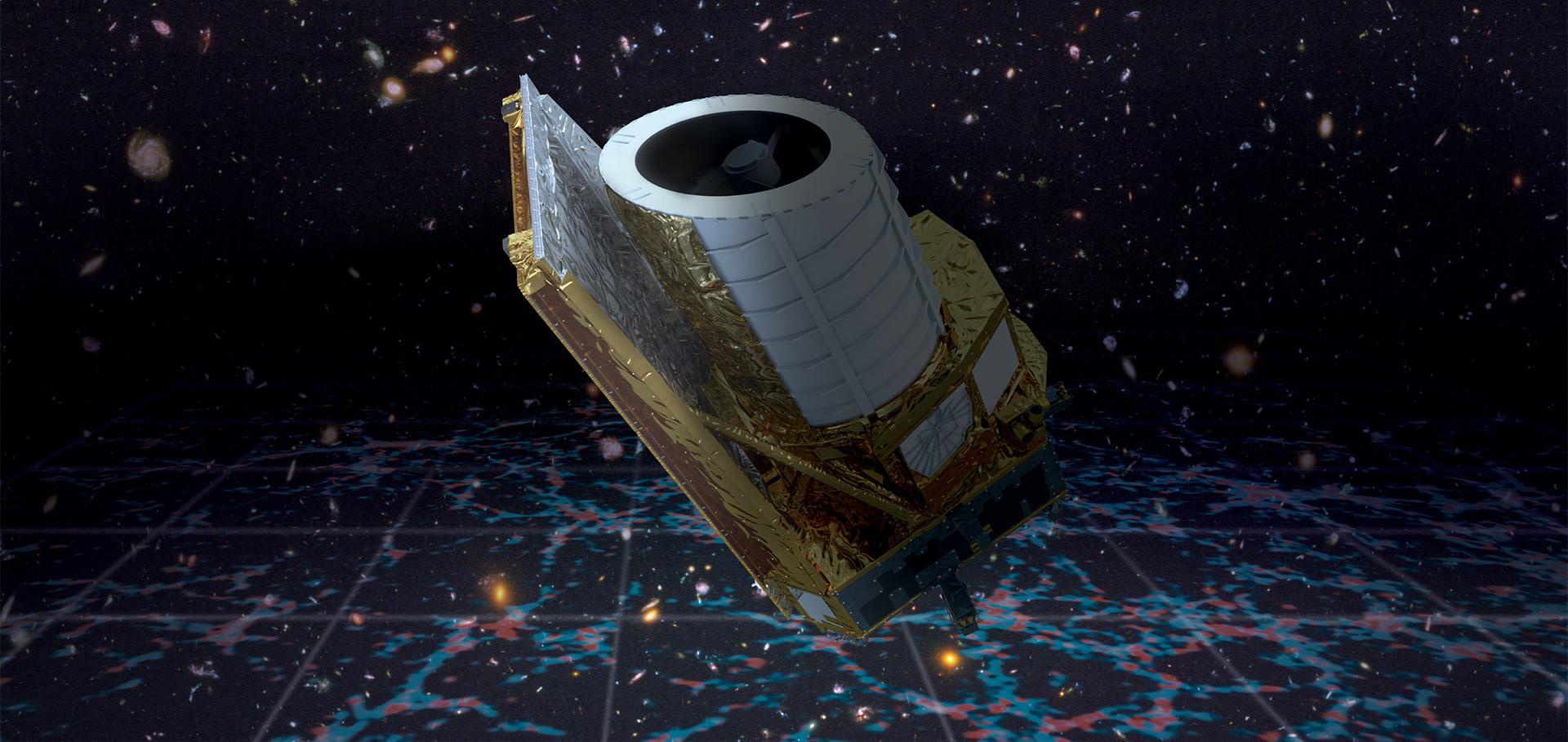
Euclid Quick Data Release (Q1)
Astronomy & Astrophysics EDP Sciences 711 (2026) a285
Abstract:
The slitless spectroscopy mode of the Near-Infrared Spectrometer and Photometer (NISP) on board the Euclid telescope has enabled efficient spectroscopy of objects within a large field of view. Nevertheless, the relatively low spectral resolution, overlapping spectra, and contamination pose challenges to source classification and redshift determination using the NISP spectra alone. In this work, we present a large and homogeneous sample of bright quasars identified from the Euclid Quick Data Release (Q1), constructed by combining high-purity candidate selections from Gaia and WISE with the new spectroscopic capabilities of Euclid . Through visual inspection of the Euclid spectra of these quasar candidates, we identify approximately 3500 quasars and determine reliable redshifts in the range of 0 < z ≲ 4.8. Of these, 2686 are new spectroscopic identifications relative to existing public compilations. We generated the first Euclid composite spectrum of quasars covering rest-frame near-ultraviolet (NUV) to near-infrared (NIR) wavelengths without telluric lines, which will be pivotal to NIR quasar spectral analysis. We obtained an empirical spectroscopic depth of J E ≲ 21.5 and H E ≲ 21.3 at the sensitivity of the Wide Field Survey, beyond which the number of securely identified quasars declines sharply. Accordingly, the sample presented in this paper comprises spectroscopically confirmed quasars brighter than these limits. We analysed morphological parameters from the Visible Camera (VIS) using Sérsic and model-independent (CAS) metrics, and a deep-learning point spread function fraction ( f PSF ) to track nuclear dominance. The VIS morphologies show a clear redshift dependence: at low redshift ( z < 0.5), obvious host structures are common and a single Sérsic model fits about half of the sources; at intermediate redshift (0.5 < z < 2), the nuclear component dominates, with 90% of the Sérsic fits saturating at the upper index limit. In this intermediate redshift regime, f PSF is available, and we use it as a more reliable compactness measure than the single-Sérsic and CAS parameters to quantify nuclear versus host emission. We also explore the novel Euclid NIR colour space and discuss the role of these quasars in refining active galactic nucleus selection techniques for future Euclid data releases.Probing the environments of FRI and FRII radio galaxies in LoTSS DR2 with galaxy clusters
Astronomy & Astrophysics EDP Sciences 710 (2026) A326-A326
Abstract:
Applications of 1.4 GHz diagnostics to Type Ia Supernova host galaxies
Monthly Notices of the Royal Astronomical Society Oxford University Press 549:1 (2026) stag832
Abstract:
Type Ia supernova (SN Ia) standardization parameters exhibit evidence for systematic variation across the host galaxy star formation rate–stellar mass (SFR) plane, motivating the incorporation of galaxy SFR information in cosmological inference. SFRs are commonly estimated via spectral energy distribution (SED) fitting with far-infrared (FIR) measurements to account for dust-obscured star formation. Such FIR coverage will, however, be limited for upcoming time-domain surveys such as the Rubin Observatory Legacy Survey of Space and Time (LSST), necessitating the use of alternative SFR tracers. Here, we reconstruct the SFR– plane using 1.4 GHz diagnostics, to test the consistency of host classifications against FIR-constrained SED-based estimates. Within this plane, SN Ia host galaxies are divided into three regions: Region 1 (low mass), Region 2 (high-mass star forming), and Region 3 (high-mass passive). We find that per cent of SN hosts retain identical region assignments when using radio versus FIR-constrained SED-derived SFRs. Measuring SN Ia nuisance parameters () within each subregion, we find consistent values between the two SFR– plane reconstructions, indicating limited sensitivity to SFR estimator choice, with the largest deviations in Region 3 at . Across the three 1.4 GHz SFR– subregions, we confirm the region-dependent variation in SN Ia standardization parameters – particularly – reported in our earlier SED-based analysis. With near-complete radio coverage of the LSST footprint anticipated from current and forthcoming radio continuum surveys (e.g. Square Kilometre Array), radio SFR calibrations will become an increasingly useful and scalable approach to host galaxy classification, supporting the construction of robust SN Ia subsamples for precision cosmology.Mature but Still Growing: JWST Detection of the Earliest Intracluster Light at z ∼ 2
The Astrophysical Journal Letters American Astronomical Society 1002:1 (2026) L17
Abstract:
We present a JWST analysis of intracluster light (ICL) in XLSSC 122 at z = 1.98, currently the most distant known strong-lensing galaxy cluster with an evolved member population. Using deep JWST imaging complemented by Hubble Space Telescope data and careful control of systematics, we robustly detect diffuse emission extending to several hundred kiloparsecs from the brightest cluster galaxy (BCG) down to ∼29magarcsec−2 . Multicomponent point-spread-function-convolved Sérsic modeling separates the surface brightness profiles into three components: a BCG core, a BCG envelope, and an ICL component, with stable Sérsic indices across wavelengths. Nearly flat color profiles indicate minimal radial variation in the stellar populations of the BCG envelope and the ICL. The median ICL fraction measured across seven bands is ∼17%, demonstrating that the buildup of intracluster stars in massive halos was already well underway by z ∼ 2. The ICL fraction peaks near 5000 Å in the rest frame, which provides the first confirmation at z > 1 that this characteristic rise is a feature of dynamically active clusters. We also detect a southern excess of ICL relative to the best-fit Sérsic model and quantify it using wavelet-based modeling, providing additional support that this system is dynamically active. The BCG + ICL light distribution and strong-lensing mass map show strong morphological agreement within ∼100 kpc. These findings establish the ICL as an early forming and dynamically informative component of massive halos.Identifying Transient Hosts in LSST’s Deep Drilling Fields with Galaxy Catalogs
The Astrophysical Journal American Astronomical Society 1000:2 (2026) 289