

Atmospheric dynamics of temperate sub-neptunes. I. Dry dynamics
The Astrophysical Journal IOP Publishing 927:1 (2022) 38
Abstract:
Sub-Neptunes (planets with radii between 2 and 4 R⊕) are abundant around M-dwarf stars, yet the atmospheric dynamics of these planets is relatively unexplored. In this paper, we aim to provide a basic underpinning of the dry dynamics of general low-mean-molecular-weight, temperate sub-Neptune atmospheres. We use the ExoFMS general circulation model (GCM) with an idealized gray-gas radiation scheme to simulate planetary atmospheres with different levels of instellation and rotation rates, using the atmosphere of K2-18b as our control. We find that the atmospheres of tidally locked (TL), temperate sub-Neptunes have weak horizontal temperature gradients owing to their slow rotation rates and hydrogen-dominated composition. The zonal wind structure is dominated by high-latitude cyclostrophic jets driven by the conservation of angular momentum. At low pressures we observe superrotating equatorial jets, which we propose are driven by a Rossby–Kelvin instability similar to the type seen in simulations of idealized atmospheres with axisymmetric forcing. By viewing the flow in TL coordinates, we find the predominant overturning circulation to be between the day side and night side, and we derive scaling relations linking the TL stream function and vertical velocities to instellation. Comparing our results to the only other GCM study of K2-18b, we find significant qualitative differences in dynamics, highlighting the need for further collaboration and investigation into the effects of different dynamical cores and physical parameterizations. This paper provides a baseline for studying the dry dynamics of temperate sub-Neptunes, which will be built on in part II with the introduction of moist effects.Impact of Variable Photospheric Radius on Exoplanet Atmospheric Retrievals
ArXiv 2203.01839 (2022)
New Constraints on Titan’s Stratospheric n-Butane Abundance
The Planetary Science Journal American Astronomical Society 3:3 (2022) 59-59
Abstract:
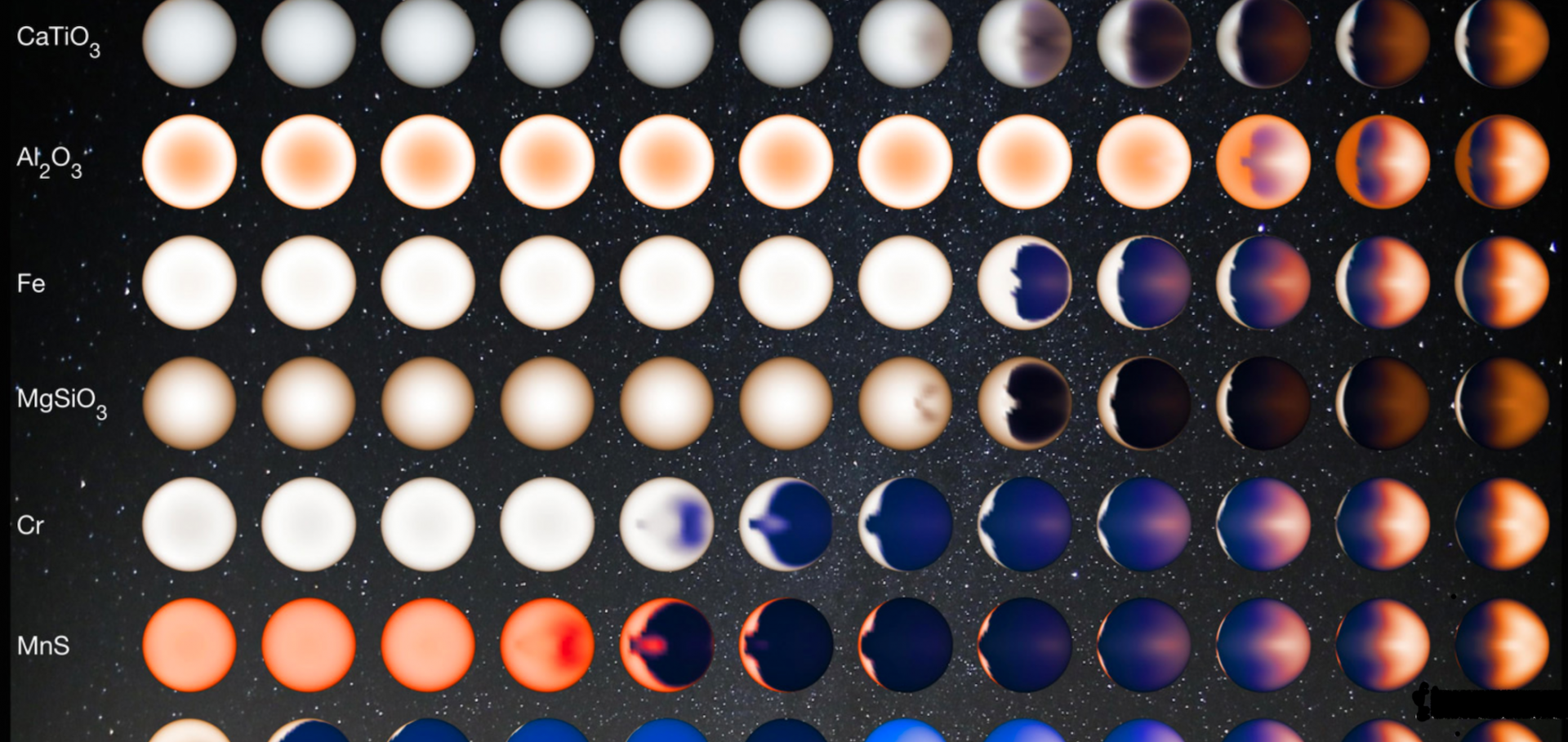
Diurnal variations in the stratosphere of the ultrahot giant exoplanet WASP-121b
Nature Astronomy Nature Research 6:4 (2022) 471-479
Abstract:
The temperature profile of a planetary atmosphere is a key diagnostic of radiative and dynamical processes governing the absorption, redistribution and emission of energy. Observations have revealed dayside stratospheres that either cool1,2 or warm3,4 with altitude for a small number of gas giant exoplanets, whereas other dayside stratospheres are consistent with constant temperatures5,6,7. Here we report spectroscopic phase curve measurements for the gas giant WASP-121b (ref.8) that constrain stratospheric temperatures throughout the diurnal cycle. Variations measured for a water vapour spectral feature reveal a temperature profile that transitions from warming with altitude on the dayside hemisphere to cooling with altitude on the nightside hemisphere. The data are well explained by models assuming chemical equilibrium, with water molecules thermally dissociating at low pressures on the dayside and recombining on the nightside9,10. Nightside temperatures are low enough for perovskite (CaTiO3) to condense, which could deplete titanium from the gas phase11,12 and explain recent non-detections at the day–night terminator13,14,15,16. Nightside temperatures are also consistent with the condensation of refractory species such as magnesium, iron and vanadium. Detections15,16,17,18 of these metals at the day–night terminator suggest, however, that if they do form nightside clouds, cold trapping does not efficiently remove them from the upper atmosphere. Horizontal winds and vertical mixing could keep these refractory condensates aloft in the upper atmosphere of the nightside hemisphere until they are recirculated to the hotter dayside hemisphere and vaporizedTESS Giants Transiting Giants. II. The Hottest Jupiters Orbiting Evolved Stars
The Astronomical Journal IOP Publishing 163:3 (2022) 120-120