

The Effect of Interior Heat Flux on the Atmospheric Circulation of Hot and Ultra-hot Jupiters
The Astrophysical Journal Letters American Astronomical Society 941:2 (2022) L40-L40
Abstract:
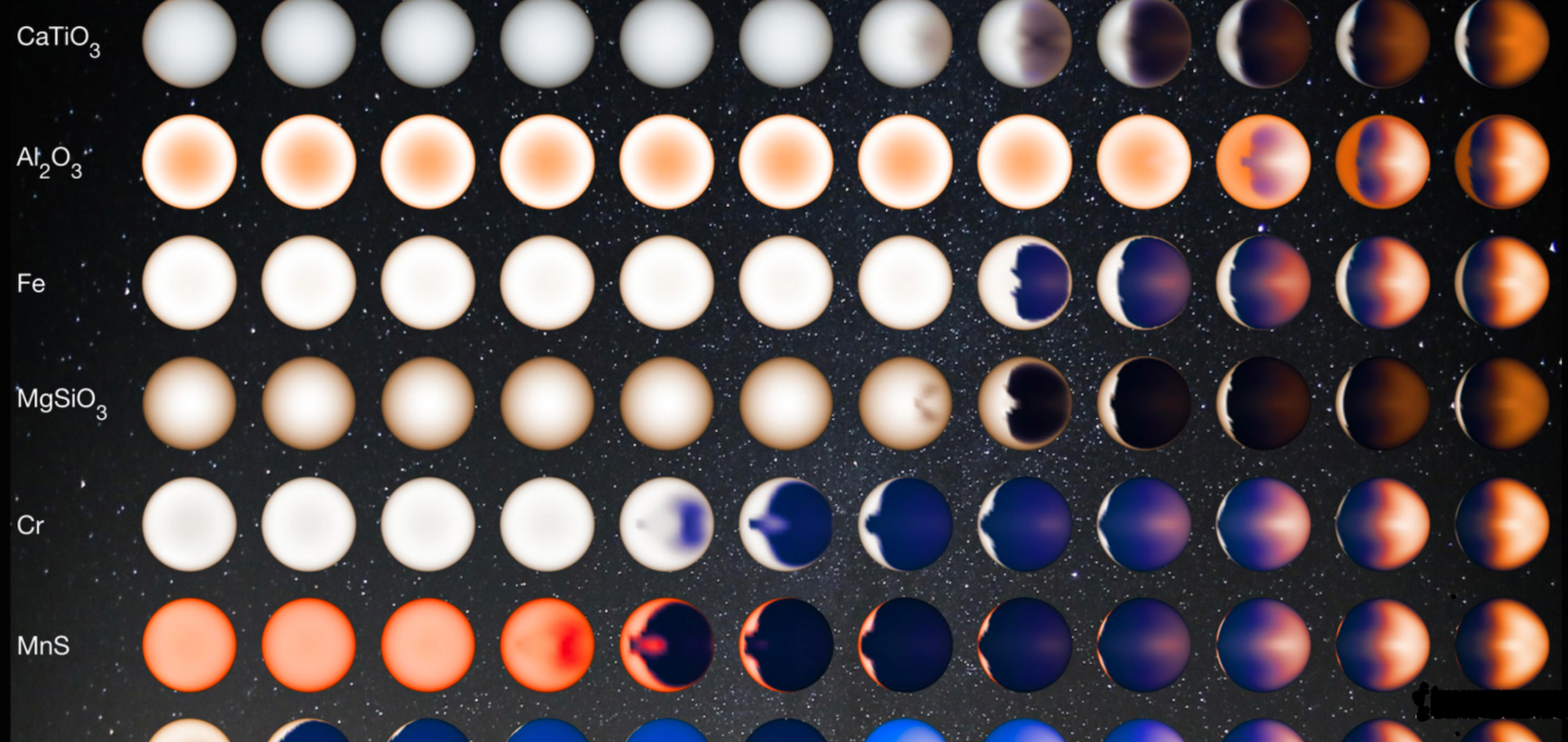
Many hot and ultra-hot Jupiters have inflated radii, implying that their interiors retain significant entropy from formation. These hot interiors lead to an enhanced internal heat flux that impinges upon the atmosphere from below. In this work, we study the effect of this hot interior on the atmospheric circulation and thermal structure of hot and ultra-hot Jupiters. To do so, we incorporate the population-level predictions from evolutionary models of hot and ultra-hot Jupiters as input for a suite of General Circulation Models (GCMs) of their atmospheric circulation with varying semi-major axis and surface gravity. We conduct simulations with and without a hot interior, and find that there are significant local differences in temperature of up to hundreds of Kelvin and in wind speeds of hundreds of m s$^{-1}$ or more across the observable atmosphere. These differences persist throughout the parameter regime studied, and are dependent on surface gravity through the impact on photosphere pressure. These results imply that the internal evolution and atmospheric thermal structure and dynamics of hot and ultra-hot Jupiters are coupled. As a result, a joint approach including both evolutionary models and GCMs may be required to make robust predictions for the atmospheric circulation of hot and ultra-hot Jupiters.Comment: Accepted at ApJL, 17 pages, 8 figureIs the Hot, Dense Sub-Neptune TOI-824 b an Exposed Neptune Mantle? Spitzer Detection of the Hot Dayside and Reanalysis of the Interior Composition
The Astrophysical Journal American Astronomical Society 941:1 (2022) 89-89
Abstract:
Even though sub-Neptunes likely represent the most common outcome of planet formation, their natures remain poorly understood. In particular, planets near 1.5-2.5$\,R_\oplus$ often have bulk densities that can be explained equally well with widely different compositions and interior structures, resulting in grossly divergent implications for their formation. Here, we present the full 0.6-5.2$\,\mu \mathrm{m}$ JWST NIRISS/SOSS+NIRSpec/G395H transmission spectrum of the 2.2$\,R_\oplus$ TOI-270d ($4.78\,M_\oplus$, $T_\mathrm{eq}$=350-380 K), delivering unprecedented sensitivity for atmospheric characterization in the sub-Neptune regime. We detect five vibrational bands of CH$_4$ at 1.15, 1.4, 1.7, 2.3, and 3.3$\,\mu$m (9.4$\sigma$), the signature of CO$_2$ at 4.3$\,\mu$m (4.8$\sigma$), water vapor (2.5$\sigma$), and potential signatures of SO$_2$ at 4.0$\,\mu \mathrm{m}$ and CS$_2$ at 4.6$\,\mu\mathrm{m}$. Intriguingly, we find an overall highly metal-rich atmosphere, with a mean molecular weight of $5.47_{-1.14}^{+1.25}$. We infer an atmospheric metal mass fraction of $58_{-12}^{+8}\%$ and a C/O of $0.47_{-0.19}^{+0.16}$, indicating that approximately half the mass of the outer envelope is in high-molecular-weight volatiles (H$_2$O, CH$_4$, CO, CO$_2$) rather than H$_2$/He. We introduce a sub-Neptune classification scheme and identify TOI-270d as a "miscible-envelope sub-Neptune" in which H$_2$/He is well-mixed with the high-molecular-weight volatiles in a miscible supercritical metal-rich envelope. For a fully miscible envelope, we conclude that TOI-270d's interior is $90_{-4}^{+3}\,$wt$\,\%$ rock/iron, indicating that it formed as a rocky planet that accreted a few wt % of H$_2$/He, with the overall envelope metal content explained by magma-ocean/envelope reactions without the need for significant ice accretion. TOI-270d may well be an archetype of the overall population of sub-Neptunes.Comment: 25 pages, 12 figureGCM Constraints on the Detectability of the CO$_2$-CH$_4$ Biosignature Pair on TRAPPIST-1e with JWST
(2022)
The effect of interior heat flux on the atmospheric circulation of hot and ultra-hot Jupiters
(2022)
Water and an Escaping Helium Tail Detected in the Hazy and Methane-depleted Atmosphere of HAT-P-18b from JWST NIRISS/SOSS
The Astrophysical Journal Letters American Astronomical Society 940:2 (2022) l35