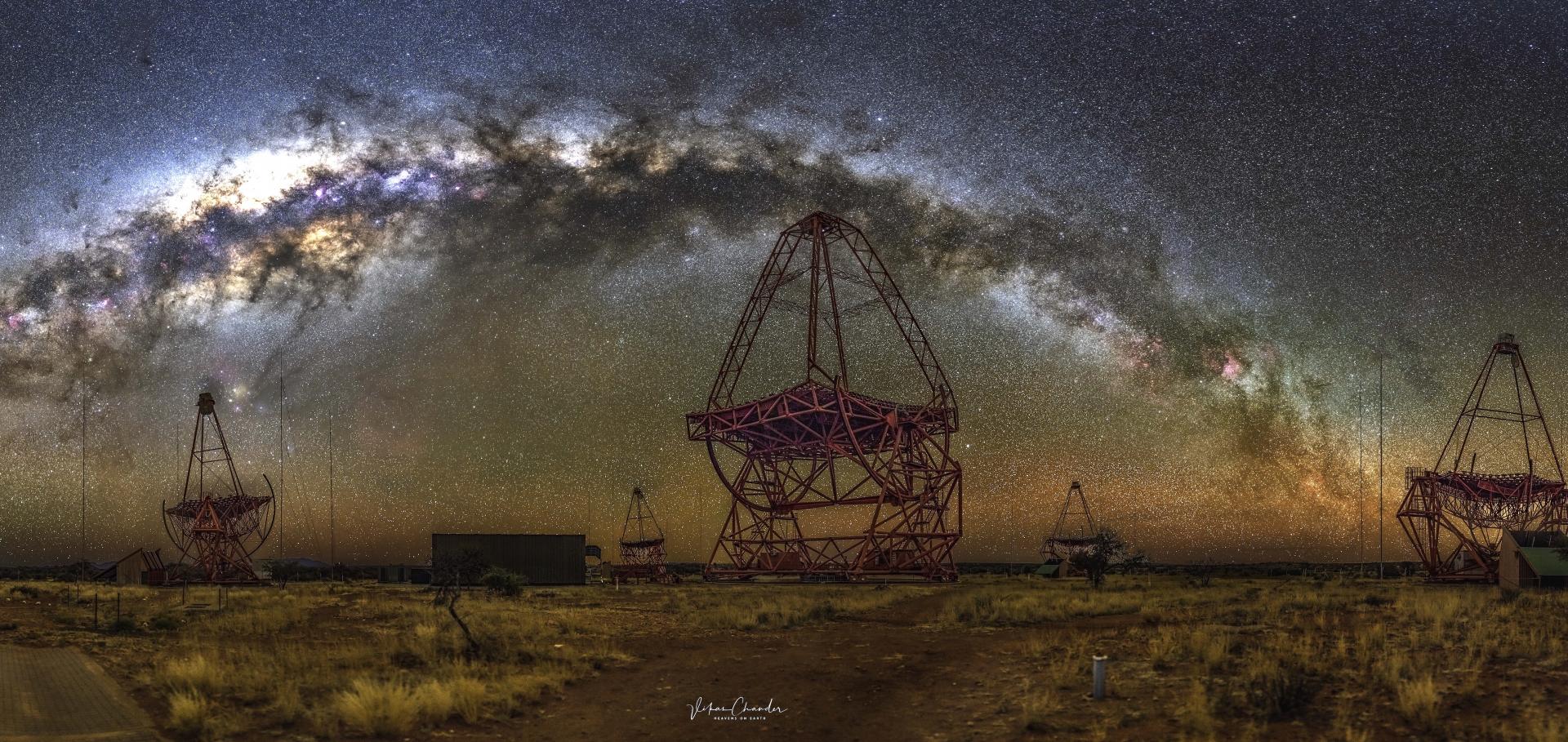
A MeerKAT, e-MERLIN, HESS, and Swift search for persistent and transient emission associated with three localized FRBs
MONTHLY NOTICES OF THE ROYAL ASTRONOMICAL SOCIETY 515:1 (2022) 1365-1379
Authors:
JO Chibueze, M Caleb, L Spitler, H Ashkar, F Schussler, BW Stappers, C Venter, I Heywood, AMS Richards, DRA Williams, M Kramer, R Beswick, MC Bezuidenhout, RP Breton, LN Driessen, F Jankowski, EF Keane, M Malenta, M Mickaliger, V Morello, H Qiu, K Rajwade, S Sanidas, M Surnis, TW Scragg, CRH Walker, N Wrigley, F Aharonian, F Ait Benkhali, EO Anguener, M Backes, V Baghmanyan, V Barbosa Martins, R Batzofin, Y Becherini, D Berge, M Bottcher, C Boisson, J Bolmont, M de Bony de Lavergne, M Breuhaus, R Brose, F Brun, T Bulik, F Cangemi, S Caroff, S Casanova, J Catalano, M Cerruti, T Chand, A Chen, OU Chibueze, G Cotter, P Cristofari, J Damascene Mbarubucyeye, J Devin, A Djannati-Atai, A Dmytriiev, K Egberts, J-P Ernenwein, A Fiasson, G Fichet de Clairfontaine, G Fontaine, S Funk, S Gabici, S Ghafourizadeh, G Giavitto, D Glawion, M-H Grondin, M Horbe, C Hoischen, TL Holch, Zhiqiu Huang, M Jamrozy, F Jankowsky, V Joshi, I Jung-Richardt, E Kasai, K Katarzynski, U Katz, B Khelifi, W Kluzniak, Nu Komin, K Kosack, D Kostunin, A Lemiere, J-P Lenain, F Leuschner, T Lohse, A Luashvili, I Lypova, J Mackey, D Malyshev, V Marandon, P Marchegiani, A Marcowith, G Marti-Devesa, R Marx, A Mitchell, R Moderski, L Mohrmann, E Moulin, J Muller, K Nakashima, M de Naurois, A Nayerhoda, J Niemiec, A Priyana Noel, P O'Brien, S Ohm, L Olivera-Nieto, E de Ona Wilhelmi, M Ostrowski, S Panny, RD Parsons, S Pita, V Poireau, DA Prokhorov, H Prokoph, G Puehlhofer, A Quirrenbach, P Reichherzer, A Reimer, O Reimer, G Rowell, B Rudak, E Ruiz-Velasco, V Sahakian, S Sailer, H Salzmann, DA Sanchez, A Santangelo, M Sasaki, HM Schutte, U Schwanke, JNS Shapopi, A Specovius, S Spencer, R Steenkamp, S Steinmassl, T Takahashi, T Tanaka, C Thorpe-Morgan, N Tsuji, C van Eldik, J Veh, J Vink, SJ Wagner, A Wierzcholska, Yu Wun Wong, A Yusafzai, M Zacharias, D Zargaryan, AA Zdziarski, A Zech, SJ Zhu, S Zouari, N Zywucka, HESS Collaboration