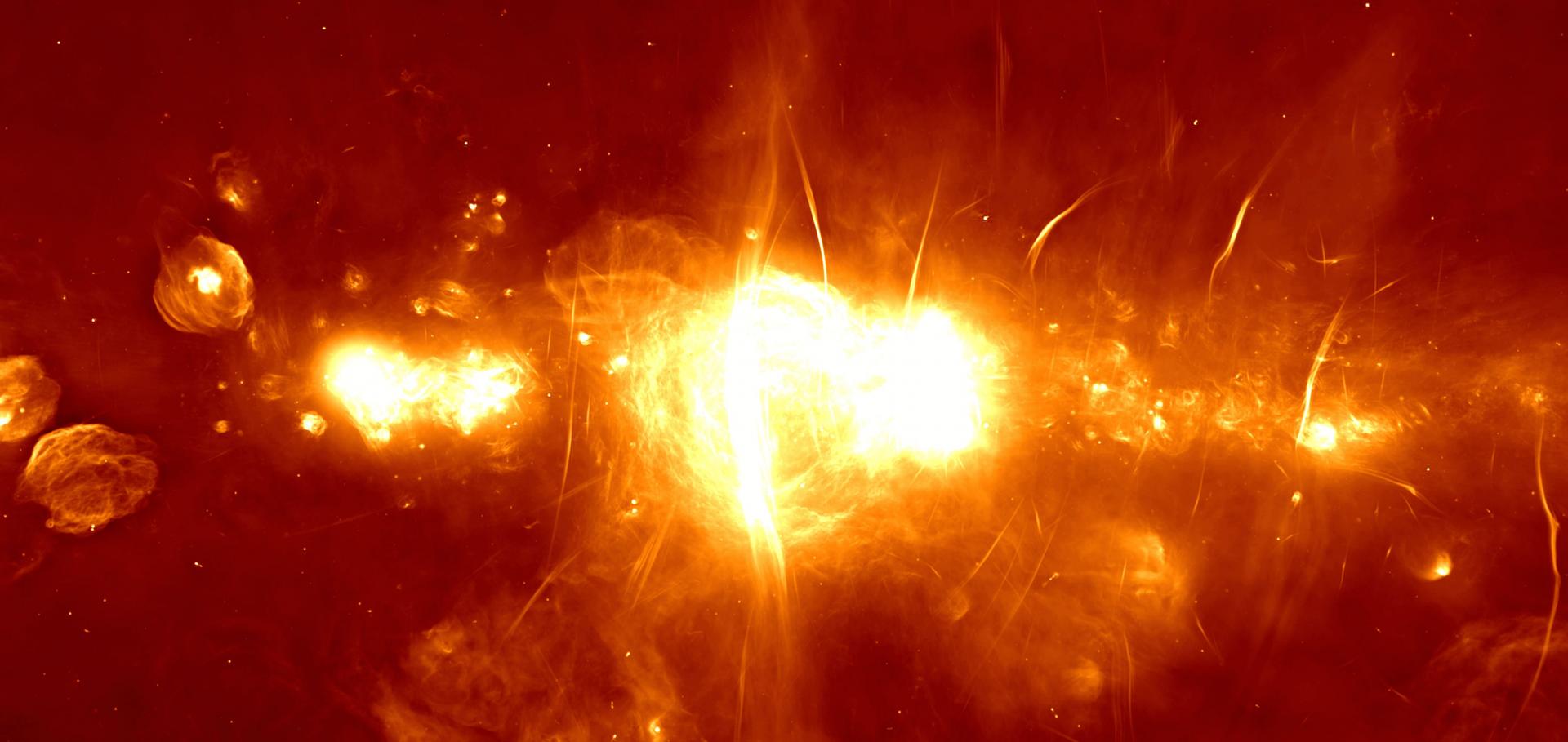
Massive black holes and their galaxies

Chapter in Encyclopedia of Astrophysics, (2025) V4-209

Authors:

RS Beckmann, RJ Smethurst

Abstract:

Almost every galaxy in the local Universe is observed to have a massive black hole in the center. The properties of these black holes are observed to tightly correlate with those of their host galaxy which has been interpreted as coevolution regulated by black hole feedback. This coevolution spans most of cosmic history, as the first active black holes, so-called active galactic nuclei, are already observed as early as z∼10. In this chapter, we lay out how we can find supermassive black holes, review what we know about the population of black holes and their host galaxies from observations, and summarize what we have learned about their coevolution across cosmic time from both observations and simulations.

SN2025ulz Pan-STARRS reference images

University of Oxford (2025)

Abstract:

This repository contains the Pan-STARRS grizy reference frame stacks that were utilised by Gillanders et al. (2025) for accurate template subtraction of the field of SN2025ulz.

If one makes use of these data, the work of Gillanders et al. (2025) must be credited.

NOTE. There is a known compatibility issue with Pan-STARRS image coordinates in DS9. To resolve this, one can switch to the FK4 coordinate system.

Link to article: Gillanders et al. (2025): https://iopscience.iop.org/article/10.3847/2041-8213/ae2125

Strong gravitational lensing: Structure and evolution of galaxies

Chapter in Reference Module in Materials Science and Materials Engineering, Elsevier (2025)

Authors:

Aprajita Verma, Chiara Spiniello

Abstract:

Strong gravitational lensing has emerged as one of the most versatile tools to explore a range of open questions in astrophysics and cosmology. In this chapter, we focus on the significant contribution of strong lensing in the fields of galaxy structure and evolution. This includes the distribution of luminous and dark matter in galaxies, dark matter substructure, the initial mass function in intermediate redshift massive galaxies and the nature of high redshift galaxies. The impact of this probe has been significant, despite the rarity of known gravitational lens systems. In the imminent era of wide-area sensitive sky surveys, that will reveal 105 strong lensing systems, the full potential of strongly lensed galaxies as an essential and versatile probe of the nature of galaxies will be realized.

The MAGPI Survey: The subtle role of environment and not-so-subtle impact of generations of stars on galaxy dynamics

Publications of the Astronomical Society of Australia Cambridge University Press (CUP) 42 (2025) e035

Authors:

Caroline Foster, Sabine Bellstedt, Francesco D’Eugenio, Adriano Poci, Ryan Bagge, Katherine Harborne, Thomas Venville, Jon Trevor Mendel, Claudia Lagos, Emily Wisnioski, Tania Barone, Andrew J Battisti, Stefania Barsanti, Sarah Brough, Scott Croom, Caro Derkenne, Lucas Kimmig, Anilkumar Mailvaganam, Rhea-Silvia Remus, Gauri Sharma, Sarah M Sweet, Sabine Thater, Lucas Valenzuela, Jesse van de Sande, Sam P Vaughan, Bodo Ziegler

HETDEX-LOFAR Spectroscopic Redshift Catalog ∗ ∗ Based on observations obtained with the Hobby–Eberly Telescope, which is a joint project of the University of Texas at Austin, the Pennsylvania State University, Ludwig-Maximilians-Universität München, and Georg-August-Universität Göttingen

The Astrophysical Journal American Astronomical Society 978:1 (2024) 101

Authors:

Maya H Debski, Gregory R Zeimann, Gary J Hill, Donald P Schneider, Leah Morabito, Gavin Dalton, Matt J Jarvis, Erin Mentuch Cooper, Robin Ciardullo, Eric Gawiser, Nika Jurlin

Abstract:

We combine the power of blind integral field spectroscopy from the Hobby–Eberly Telescope (HET) Dark Energy Experiment (HETDEX) with sources detected by the Low Frequency Array (LOFAR) to construct the HETDEX-LOFAR Spectroscopic Redshift Catalog. Starting from the first data release of the LOFAR Two-metre Sky Survey, including a value-added catalog with photometric redshifts, we extracted 28,705 HETDEX spectra. Using an automatic classifying algorithm, we assigned each object a star, galaxy, or quasar label along with a velocity/redshift, with supplemental classifications coming from the continuum and emission-line catalogs of the internal, fourth data release from HETDEX (HDR4). We measured 9087 new redshifts; in combination with the value-added catalog, our final spectroscopic redshift sample is 9710 sources. This new catalog contains the highest substantial fraction of LOFAR galaxies with spectroscopic redshift information; it improves archival spectroscopic redshifts and facilitates research to determine the [O ii] emission properties of radio galaxies from 0.0 < z < 0.5, and the Lyα emission characteristics of both radio galaxies and quasars from 1.9 < z < 3.5. Additionally, by combining the unique properties of LOFAR and HETDEX, we are able to measure star formation rates (SFRs) and stellar masses. Using the Visible Integral-field Replicable Unit Spectrograph, we measure the emission lines of [O iii], [Ne iii], and [O ii] and evaluate line-ratio diagnostics to determine whether the emission from these galaxies is dominated by active galactic nuclei or star formation and fit a new SFR–L 150MHz relationship.