

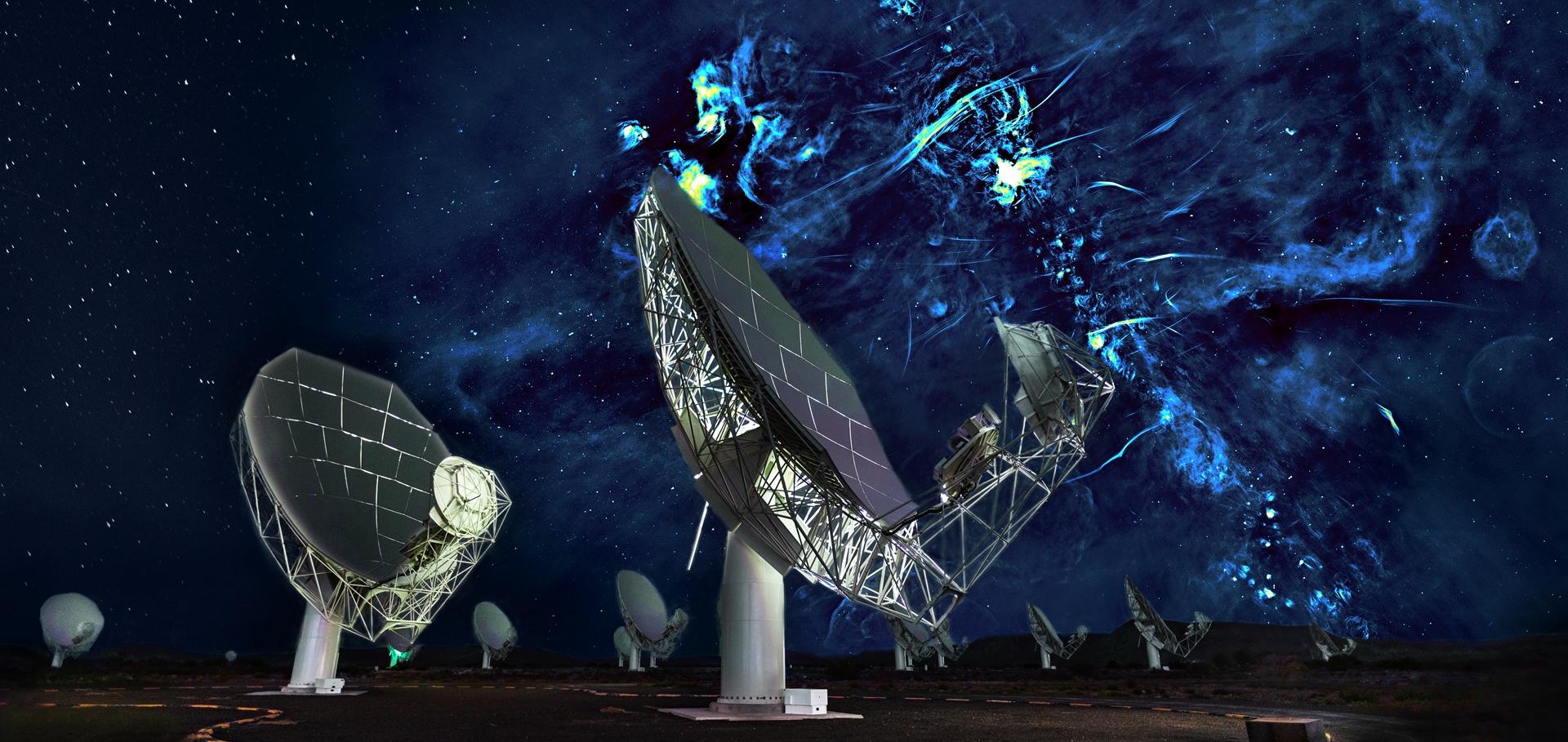
MeerKAT radio detection of the Galactic black hole candidate Swift J1842.5-1124 during its 2020 outburst
(2021)
New constraints on light axion-like particles using Chandra transmission grating spectroscopy of the powerful cluster-hosted quasar H1821+643
MONTHLY NOTICES OF THE ROYAL ASTRONOMICAL SOCIETY 510:1 (2021) 1264-1277
The Panchromatic Afterglow of GW170817: The Full Uniform Data Set, Modeling, Comparison with Previous Results, and Implications
The Astrophysical Journal American Astronomical Society 922:2 (2021) 154
The impact of glitches on young pulsar rotational evolution
MONTHLY NOTICES OF THE ROYAL ASTRONOMICAL SOCIETY 508:3 (2021) 3251-3274
Abstract:
We report on a timing programme of 74 young pulsars that have been observed by the Parkes 64-m radio telescope over the past decade. Using modern Bayesian timing techniques, we have measured the properties of 124 glitches in 52 of these pulsars, of which 74 are new. We demonstrate that the glitch sample is complete to fractional increases in spin frequency greater than Delta \nu 90{{\ \rm per\ cent}} \mathrm{ g}}/\nu \approx 8.1 \times 10 -9}$. We measure values of the braking index, n, in 33 pulsars. In most of these pulsars, their rotational evolution is dominated by episodes of spin-down with n > 10, punctuated by step changes in the spin-down rate at the time of a large glitch. The step changes are such that, averaged over the glitches, the long-term n is small. We find a near one-to-one relationship between the interglitch value of n and the change in spin-down of the previous glitch divided by the interglitch time interval. We discuss the results in the context of a range of physical models.Probing the Wind Component of Radio Emission in Luminous High-redshift Quasars
ASTRONOMICAL JOURNAL 162:6 (2021) ARTN 270