

Mesoporous TiO2 single crystals delivering enhanced mobility and optoelectronic device performance.
Nature 495:7440 (2013) 215-219
Abstract:
Mesoporous ceramics and semiconductors enable low-cost solar power, solar fuel, (photo)catalyst and electrical energy storage technologies. State-of-the-art, printable high-surface-area electrodes are fabricated from thermally sintered pre-formed nanocrystals. Mesoporosity provides the desired highly accessible surfaces but many applications also demand long-range electronic connectivity and structural coherence. A mesoporous single-crystal (MSC) semiconductor can meet both criteria. Here we demonstrate a general synthetic method of growing semiconductor MSCs of anatase TiO2 based on seeded nucleation and growth inside a mesoporous template immersed in a dilute reaction solution. We show that both isolated MSCs and ensembles incorporated into films have substantially higher conductivities and electron mobilities than does nanocrystalline TiO2. Conventional nanocrystals, unlike MSCs, require in-film thermal sintering to reinforce electronic contact between particles, thus increasing fabrication cost, limiting the use of flexible substrates and precluding, for instance, multijunction solar cell processing. Using MSC films processed entirely below 150 °C, we have fabricated all-solid-state, low-temperature sensitized solar cells that have 7.3 per cent efficiency, the highest efficiency yet reported. These high-surface-area anatase single crystals will find application in many different technologies, and this generic synthetic strategy extends the possibility of mesoporous single-crystal growth to a range of functional ceramics and semiconductors.A COMPARATIVE RHEOLOGICAL STUDY OF WATERLESS AND CONVENTIONAL OFFSET INKS
JOCCA-SURFACE COATINGS INTERNATIONAL 76:4 (1993) 164-&
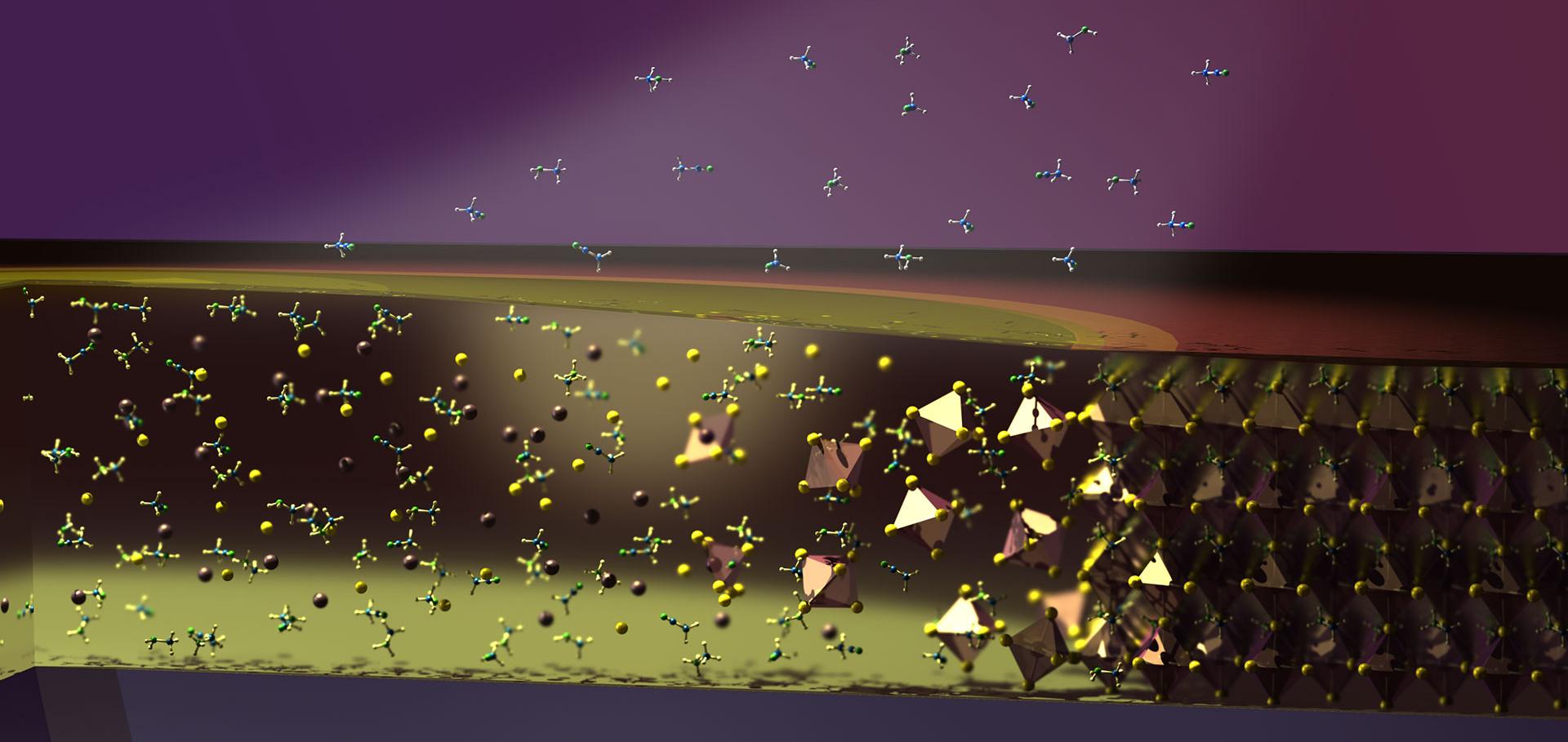
A green solvent system for templated sequential deposition of stable formamidinium lead triiodide for perovskite solar cells
Assessing the Opportunities of Spectral Shaping by Quantum Cutting for Perovskite/Silicon Tandem Solar Cells
ACS Energy Letters American Chemical Society
Automation of Simultaneous 4DSTEM-EDX Acquisition and Data Analysis for Beam-sensitive Materials
ScienceOpen