

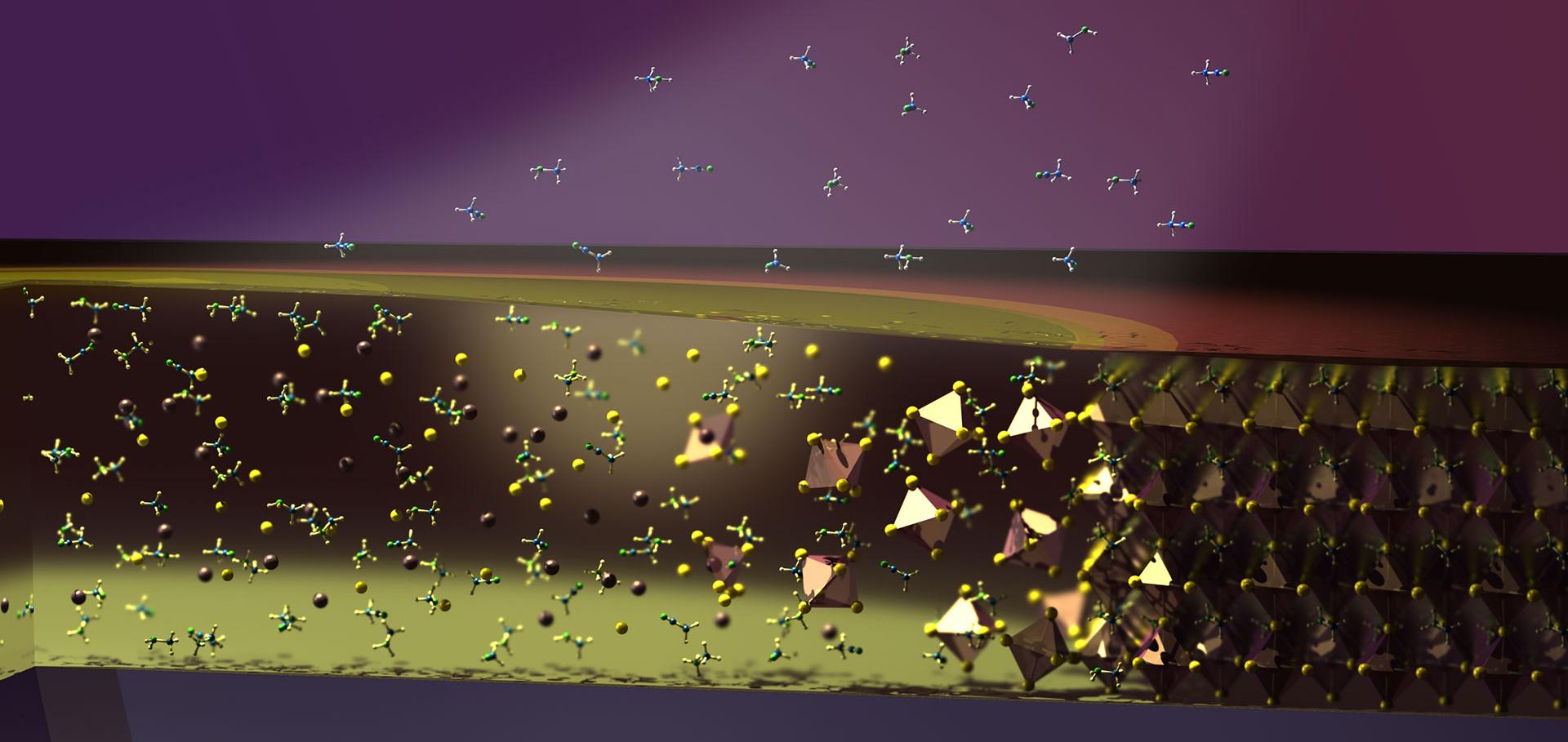
Lead-free organic–inorganic tin halide perovskites for photovoltaic applications
Energy and Environmental Science Royal Society of Chemistry 7:9 (2014) 3061-3068
Abstract:
Already exhibiting solar to electrical power conversion efficiencies of over 17%, organic-inorganic lead halide perovskite solar cells are one of the most promising emerging contenders in the drive to provide a cheap and clean source of energy. One concern however, is the potential toxicology issue of lead, a key component in the archetypical material. The most likely substitute is tin, which like lead, is also a group 14 metal. While organic-inorganic tin halide perovskites have shown good semiconducting behaviour, the instability of tin in its 2+ oxidation state has thus far proved to be an overwhelming challenge. Here, we report the first completely lead-free, CH3NH 3SnI3 perovskite solar cell processed on a mesoporous TiO2 scaffold, reaching efficiencies of over 6% under 1 sun illumination. Remarkably, we achieve open circuit voltages over 0.88 V from a material which has a 1.23 eV band gap.Anomalous hysteresis in perovskite solar cells
journal of physical chemistry letters American Chemical Society 5:9 (2014) 1511-1515
Abstract:
Perovskite solar cells have rapidly risen to the forefront of emerging photovoltaic technologies, exhibiting rapidly rising efficiencies. This is likely to continue to rise, but in the development of these solar cells there are unusual characteristics that have arisen, specifically an anomalous hysteresis in the current-voltage curves. We identify this phenomenon and show some examples of factors that make the hysteresis more or less extreme. We also demonstrate stabilized power output under working conditions and suggest that this is a useful parameter to present, alongside the current-voltage scan derived power conversion efficiency. We hypothesize three possible origins of the effect and discuss its implications on device efficiency and future research directions. Understanding and resolving the hysteresis is essential for further progress and is likely to lead to a further step improvement in performance.Observation of annealing-induced doping in tio2 mesoporous single crystals for use in solid state dye sensitized solar cells
Journal of Physical Chemistry C 118:4 (2014) 1821-1827
Abstract:
Mesoporous single crystals (MSCs) of TiO2 are promising materials for more efficient dye sensitized solar cells and other energy conversion or storage devices, since they combine high surface area with large crystalline domain size. In this work, we investigate the charge transport properties of TiO2 MSCs after annealing them within a confining template at temperatures from 500 to 850 C. We observe that higher anneal temperatures do not change the crystal phase, as in nanocrystalline TiO 2, but do influence the MSC absorption spectrum in a manner consistent with the signature of increased oxygen-vacancy defects. By comparing MSC film conductivity in vacuum and in air, we infer that these anneal-induced defects increase the background charge density in TiO2. Subsequently, we measure higher effective mobility in annealed MSCs using transient mobility spectroscopy (TMS), consistent with higher anneal temperatures filling sub-bandgap trap states by n-doping TiO2. Finally, we measure faster charge transport rates in solid-state dye sensitized solar cells as well as increased open-circuit voltages at low light intensity with increasing MSC anneal temperature. This study leverages the fixed geometry and crystal phase of MSCs under thermal treatment to identify and isolate the doping effect of annealing at high temperature, previously inaccessible for mesoporous anatase TiO2. The results offer insight into the influence of doping on charge transport in TiO2-based solar cells and the tunability of MSCs for use in enhancing device performance. © 2013 American Chemical Society.Performance and stability enhancement of dye-sensitized and perovskite solar cells by Al doping of TiO2
Advanced Functional Materials 24:38 (2014) 6046-6055
Abstract:
© 2014 WILEY-VCH Verlag GmbH & Co. KGaA. Reversible photo-induced performance deterioration is observed in mesoporous TiO2-containing devices in an inert environment. This phenomenon is correlated with the activation of deep trap sites due to astoichiometry of the metal oxide. Interestingly, in air, these defects can be passivated by oxygen adsorption. These results show that the doping of TiO2with aluminium has a striking impact upon the density of sub-gap states and enhances the conductivity by orders of magnitude. Dye-sensitized and perovskite solar cells employing Al-doped TiO2have increased device efficiencies and significantly enhanced operational device stability in inert atmospheres. This performance and stability enhancement is attributed to the substitutional incorporation of Al in the anatase lattice, "permanently" passivating electronic trap sites in the bulk and at the surface of the TiO2.Mesoporous TiO 2 single crystals delivering enhanced mobility and optoelectronic device performance
Nature 495:7440 (2013) 215-219