

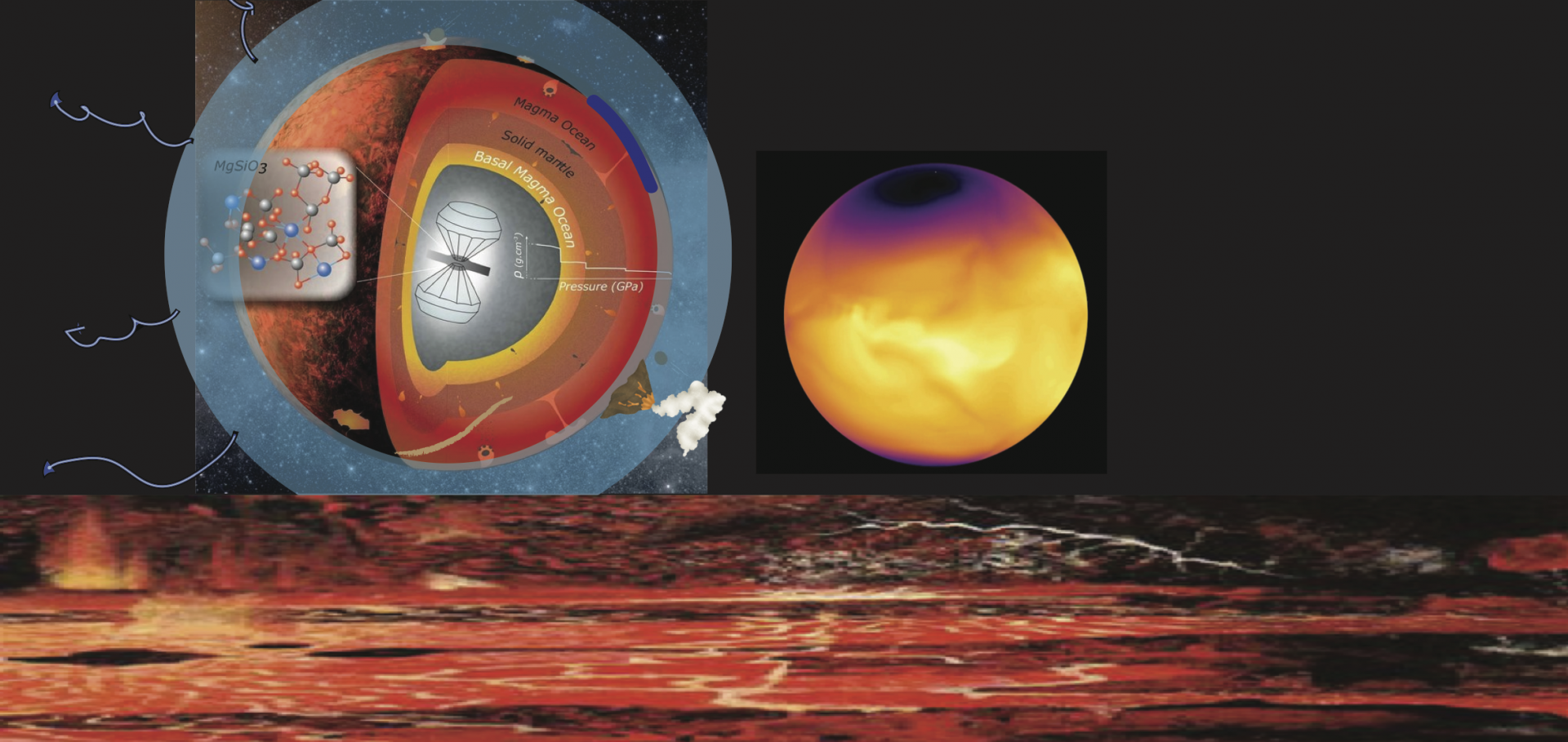
Modeling the day-night temperature variations of ultra-hot Jupiters: confronting non-grey general circulation models and observations
(2024)
Oscillations in terrestrial planetary atmospheres
Chapter in Atmospheric Oscillations: Sources of Subseasonal-to-Seasonal Variability and Predictability, (2024) 399-441
Abstract:
Earth is not the only terrestrial body in the solar system with subseasonal-to-seasonal climate oscillations. Though these worlds are not as well observed as Earth, Venus, Mars, and the Saturnian moon Titan each has multiple modes of variability. Mars climate analyses can be considered the most robust given the large quantity of data available, along with three reanalysis datasets. Venus also has had multiple orbiters monitor the climate, and the Cassini mission studied Titan for nearly a decade. Mars and Titan appear to have annular modes of variability in their zonal-mean zonal wind and in the zonal-mean eddy kinetic energy. Mars’s modes are most similar to Earth’s whereby the barotropic mode in the zonal wind captures latitudinal variation in the jet stream; Titan’s mode in the zonal wind describes vertical shifts in the jet. For both Mars and Titan, the baroclinic mode in the eddy kinetic energy quantifies storm track intensity, like Earth’s mode. Mars’s annular modes relate to the timing of large dust storms, and Titan’s annular modes appear related to methane convective events. Mars also has a Semi-Annual oscillation (SAO) in its mesosphere, with similarities to Earth’s stratospheric SAO. Mars’s zonal mean wind swaps between relative westward and eastward phases during solstices and equinoxes, respectively, due primarily to thermal tides. Separately, Venus has three seasonal modes: A 255-day oscillation in zonal wind which is similar to Earth’s Quasi-Biennial Oscillation (QBO) due to vacillations between when Kelvin or Rossby wave modes prevail; a 150-day oscillation in cloud optical depth which may be related to a cycle in eddy diffusion and radiative cooling in the upper-level sulfuric acid cloud deck; and a 50-day oscillation in cloud albedo which could be due to an as yet undetected oscillation in the source of Rossby waves below 35km altitude. Some of the Venusian modes may be related to a recharge-discharge oscillation of convection that has also been speculated to occur on Titan or exoplanets. Finally, we are beginning to glimpse the climate of exoplanets, and simulations in advance of new observations from space telescopes suggest that tidally locked (showing the same face to their star) planets may also have a QBO. Continued discovery and understanding of climate modes of variability remains predicated on continued atmospheric monitoring of these worlds, both from the ground on Earth, in situ on their surfaces, and particularly from orbit around them. The planetary science community must pay particular priority to maintaining monitoring efforts to ensure a robust understanding of these impactful atmospheric features. Future work should pursue a mechanistic understanding of the modes and seek to quantify how they interact.The dynamics of Jupiter’s and Saturn’s weather layers: a synthesis after Cassini and Juno
Annual Review of Fluid Mechanics Annual Reviews 56 (2024)
Abstract:
Until recently, observations of the giant planets of our Solar System were confined to sampling relatively shallow regions of their atmospheres, leaving many uncertainties as to the dynamics of deeper layers. The Cassini and Juno missions to Saturn and Jupiter, however, have begun to address these issues, for example, by measuring their gravity and magnetic fields. The results show that the zonally coherent jets and cloud bands extend to levels where the electrical conductivity of the fluid becomes significant, whereas large-scale vortices, such as the Great Red Spot, are relatively shallow but may have deep-seated roots. The polar regions also exhibit intense cyclonic vortices that, on Jupiter, arrange themselves into remarkably regular “vortex crystals.” Numerical models seem able to capture some of this complexity, but many issues remain unresolved, suggesting a need for models that can represent both deep and shallow processes sufficiently realistically to compare with observations.Atmospheric Dynamics of Terrestrial Planets
Chapter in Handbook of Exoplanets, Springer Nature (2024) 1-32
Jupiter’s Equatorial Quasi-quadrennial Oscillation Forced by Internal Thermal Forcing
The Astrophysical Journal American Astronomical Society 958:1 (2023) 50