Terahertz Characterization of Charge Carrier Dynamics in 3D Dirac Semi-metal Cd3As2 Nanowires

Institute of Electrical and Electronics Engineers (IEEE) 00 (2023) 1-2

Authors:

Y Saboon, D Damry, CQ Xia, P Schonherr, X Liu, T Hesjedal, LM Herz, MB Johnston, JL Boland

Topological materials for helicity-dependent THz emission

Institute of Electrical and Electronics Engineers (IEEE) 00 (2023) 1-2

Authors:

A Mannan, Y Saboon, CQ Xia, DA Damry, P Schoenherr, D Prabhakaran, LM Herz, T Hesjedal, MB Johnston, JL Boland

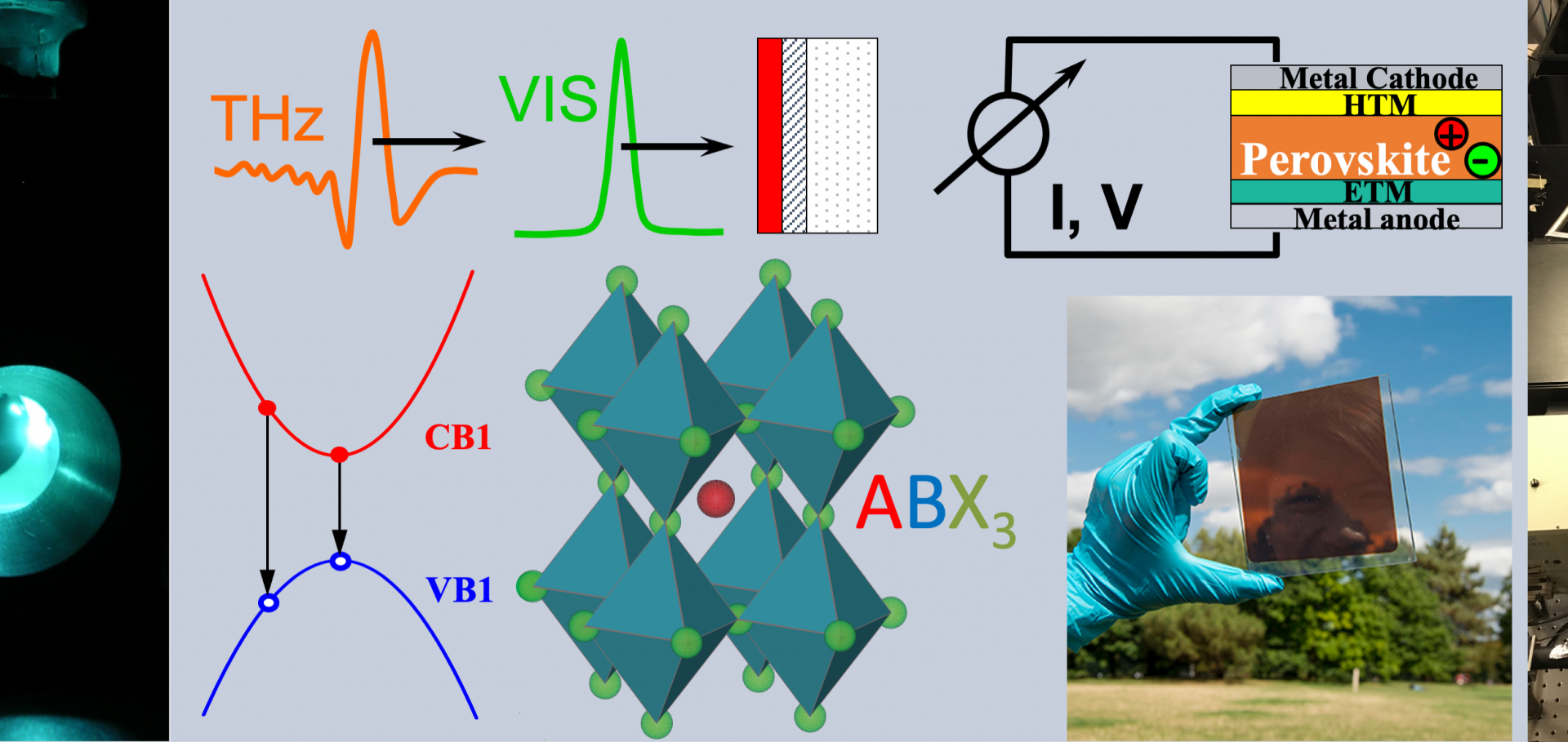
Thermally stable perovskite solar cells by all-vacuum deposition

ACS Applied Materials and Interfaces American Chemical Society 15:1 (2022) 772-781

Abstract:

Vacuum deposition is a solvent-free method suitable for growing thin films of metal halide perovskite (MHP) semiconductors. However, most reports of high-efficiency solar cells based on such vacuum-deposited MHP films incorporate solution-processed hole transport layers (HTLs), thereby complicating prospects of industrial upscaling and potentially affecting the overall device stability. In this work, we investigate organometallic copper phthalocyanine (CuPc) and zinc phthalocyanine (ZnPc) as alternative, low-cost, and durable HTLs in all-vacuum-deposited solvent-free formamidinium-cesium lead triodide [CH(NH2)2]0.83Cs0.17PbI3 (FACsPbI3) perovskite solar cells. We elucidate that the CuPc HTL, when employed in an “inverted” p–i–n solar cell configuration, attains a solar-to-electrical power conversion efficiency of up to 13.9%. Importantly, unencapsulated devices as large as 1 cm2 exhibited excellent long-term stability, demonstrating no observable degradation in efficiency after more than 5000 h in storage and 3700 h under 85 °C thermal stressing in N2 atmosphere.

Dual-Interface-Reinforced Flexible Perovskite Solar Cells for Enhanced Performance and Mechanical Reliability.

Advanced materials (Deerfield Beach, Fla.) 34:47 (2022) e2205301

Authors:

Zhenghong Dai, Shunran Li, Xing Liu, Min Chen, Christos E Athanasiou, Brian W Sheldon, Huajian Gao, Peijun Guo, Nitin P Padture

Abstract:

Two key interfaces in flexible perovskite solar cells (f-PSCs) are mechanically reinforced simultaneously: one between the electron-transport layer (ETL) and the 3D metal-halide perovskite (MHP) thin film using self-assembled monolayer (SAM), and the other between the 3D-MHP thin film and the hole-transport layer (HTL) using an in situ grown low-dimensional (LD) MHP capping layer. The interfacial mechanical properties are measured and modeled. This rational interface engineering results in the enhancement of not only the mechanical properties of both interfaces but also their optoelectronic properties holistically. As a result, the new class of dual-interface-reinforced f-PSCs has an unprecedented combination of the following three important performance parameters: high power-conversion efficiency (PCE) of 21.03% (with reduced hysteresis), improved operational stability of 1000 h T90 (duration at 90% initial PCE retained), and enhanced mechanical reliability of 10 000 cycles n88 (number of bending cycles at 88% initial PCE retained). The scientific underpinnings of these synergistic enhancements are elucidated.

Bending a photonic wire into a ring.

Nature chemistry Springer Science and Business Media LLC (2022)

Authors:

Henrik Gotfredsen, Jie-Ren Deng, Jeff M Van Raden, Marcello Righetto, Janko Hergenhahn, Michael Clarke, Abigail Bellamy-Carter, Jack Hart, James O'Shea, Timothy DW Claridge, Fernanda Duarte, Alex Saywell, Laura M Herz, Harry L Anderson

Abstract:

Natural light-harvesting systems absorb sunlight and transfer its energy to the reaction centre, where it is used for photosynthesis. Synthetic chromophore arrays provide useful models for understanding energy migration in these systems. Research has focused on mimicking rings of chlorophyll molecules found in purple bacteria, known as 'light-harvesting system 2'. Linear meso-meso linked porphyrin chains mediate rapid energy migration, but until now it has not been possible to bend them into rings. Here we show that oligo-pyridyl templates can be used to bend these rod-like photonic wires to create covalent nanorings that consist of 24 porphyrin units and a single butadiyne link. Their elliptical conformations have been probed by scanning tunnelling microscopy. This system exhibits two excited state energy transfer processes: one from a bound template to the peripheral porphyrins and one, in the template-free ring, from the exciton-coupled porphyrin array to the π-conjugated butadiyne-linked porphyrin dimer segment.