

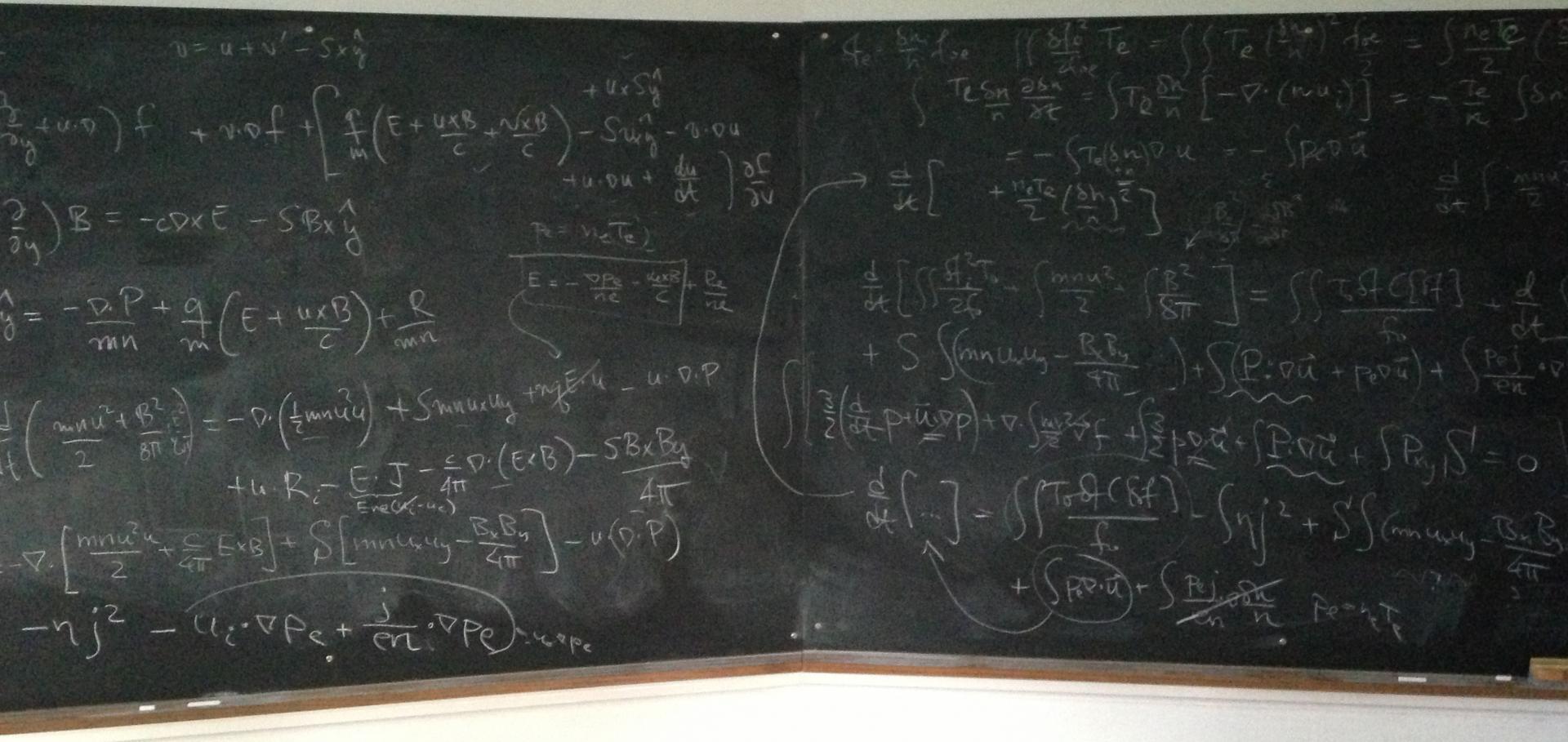
Astrophysics in the lab
Physics World IOP Publishing 17:12 (2004) 20-21
Evolution of self-gravitating magnetized disks. I. Axisymmetric simulations
Astrophysical Journal 616:1 I (2004) 357-363
Abstract:
In this paper and a companion work, we report on the first global numerical simulations of self-gravitating magnetized tori, subject in particular to the influence of the magnetorotational instability (MRI). In this work, Paper I, we restrict our calculations to the study of the axisymmetric evolution of such tori. Our goals are twofold: (1) to investigate how self-gravity influences the global structure and evolution of the disks and (2) to determine whether turbulent density inhomogeneities can be enhanced by self-gravity in this regime. As in non-self-gravitating models, the linear growth of the MRI is followed by a turbulent phase, during which angular momentum is transported outward. As a result, self-gravitating tori quickly develop a dual structure composed of an inner thin Keplerian disk fed by a thicker self-gravitating disk, whose rotation profile is close to a Mestel disk. Our results show that the effects of self-gravity enhance density fluctuations much less than they smooth the disk, giving it more coherence. We discuss the expected changes that will occur in three-dimensional simulations, the results of which are presented in a companion paper.Modelling the Galaxy for GAIA
ArXiv astro-ph/0411229 (2004)
Abstract:
Techniques for the construction of dynamical Galaxy models should be considered essential infrastructure that should be put in place before GAIA flies. Three possible modelling techniques are discussed. Although one of these seems to have significantly more potential than the other two, at this stage work should be done on all three. A major effort is needed to decide how to make a model consistent with a catalogue such as that which GAIA will produce. Given the complexity of the problem, it is argued that a hierarchy of models should be constructed, of ever increasing complexity and quality of fit to the data. The potential that resonances and tidal streams have to indicate how a model should be refined is briefly discussed.Low Surface Brighness galaxies: Vc-s0 relation and halo central density radial profile from stellar kinematics measurements
Sissa Medialab Srl (2004) 046
The Cosmological Context of Extraplanar Gas
ArXiv astro-ph/0409639 (2004)