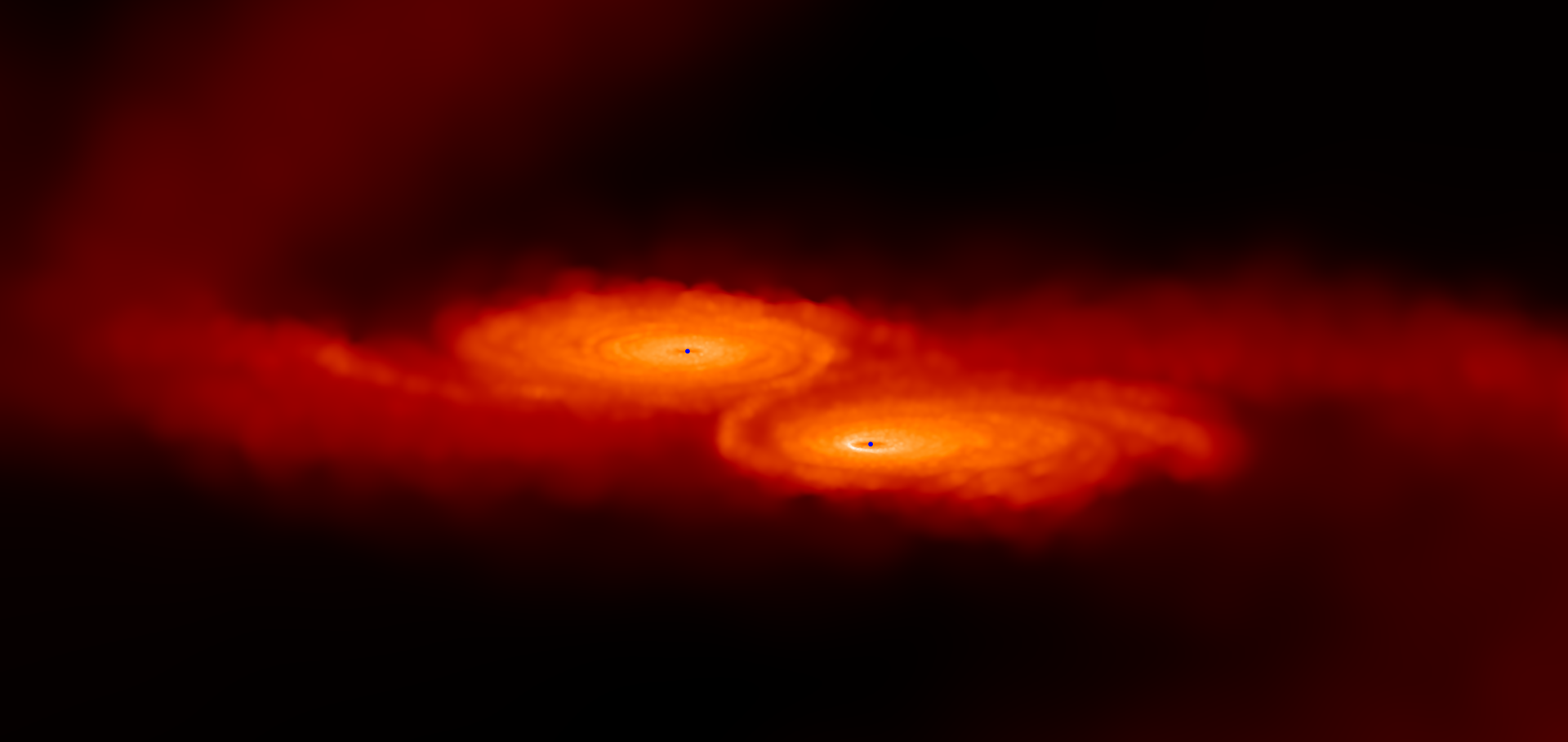
Hierarchical Black Hole Mergers in Active Galactic Nuclei.

Physical review letters American Physical Society (APS) 123:18 (2019) ARTN 181101

Authors:

Y Yang, I Bartos, V Gayathri, Kes Ford, Z Haiman, S Klimenko, B Kocsis, S Márka, Z Márka, B McKernan, R O'Shaughnessy

Abstract:

The origins of the stellar-mass black hole mergers discovered by LIGO/Virgo are still unknown. Here we show that if migration traps develop in the accretion disks of active galactic nuclei (AGNs) and promote the mergers of their captive black holes, the majority of black holes within disks will undergo hierarchical mergers-with one of the black holes being the remnant of a previous merger. 40% of AGN-assisted mergers detected by LIGO/Virgo will include a black hole with mass ≳50M_{⊙}, the mass limit from stellar core collapse. Hierarchical mergers at traps in AGNs will exhibit black hole spins (anti)aligned with the binary's orbital axis, a distinct property from other hierarchical channels. Our results suggest, although not definitively (with odds ratio of ∼1), that LIGO's heaviest merger so far, GW170729, could have originated from this channel.

Validation of gyrokinetic simulations of a National Spherical Torus eXperiment H-mode plasma and comparisons with a high-k scattering synthetic diagnostic

Plasma Physics and Controlled Fusion IOP Publishing 61:11 (2019) 115015-115015

Authors:

J Ruiz Ruiz, W Guttenfelder, AE White, NT Howard, J Candy, Y Ren, DR Smith, NF Loureiro, C Holland, CW Domier

Stellar mergers as the origin of magnetic massive stars

Nature Springer Nature 574 (2019) 211-214

Authors:

FRN Schneider, ST Ohlmann, Philipp Podsiadlowski, FK Röpke, Balbus, R Pakmor, V Springel

Abstract:

About ten per cent of 'massive' stars (those of more than 1.5 solar masses) have strong, large-scale surface magnetic fields1-3. It has been suggested that merging of main-sequence and pre-main-sequence stars could produce such strong fields4,5, and the predicted fraction of merged massive stars is also about ten per cent6,7. The merger hypothesis is further supported by a lack of magnetic stars in close binaries8,9, which is as expected if mergers produce magnetic stars. Here we report three-dimensional magnetohydrodynamical simulations of the coalescence of two massive stars and follow the evolution of the merged product. Strong magnetic fields are produced in the simulations, and the merged star rejuvenates such that it appears younger and bluer than other coeval stars. This can explain the properties of the magnetic 'blue straggler' star τ Sco in the Upper Scorpius association that has an observationally inferred, apparent age of less than five million years, which is less than half the age of its birth association10. Such massive blue straggler stars seem likely to be progenitors of magnetars, perhaps giving rise to some of the enigmatic fast radio bursts observed11, and their supernovae may be affected by their strong magnetic fields12.

Effective spin distribution of black hole mergers in triples

(2019)

Authors:

Giacomo Fragione, Bence Kocsis

Making a supermassive star by stellar bombardment

(2019)

Authors:

Hiromichi Tagawa, Zoltan Haiman, Bence Kocsis