

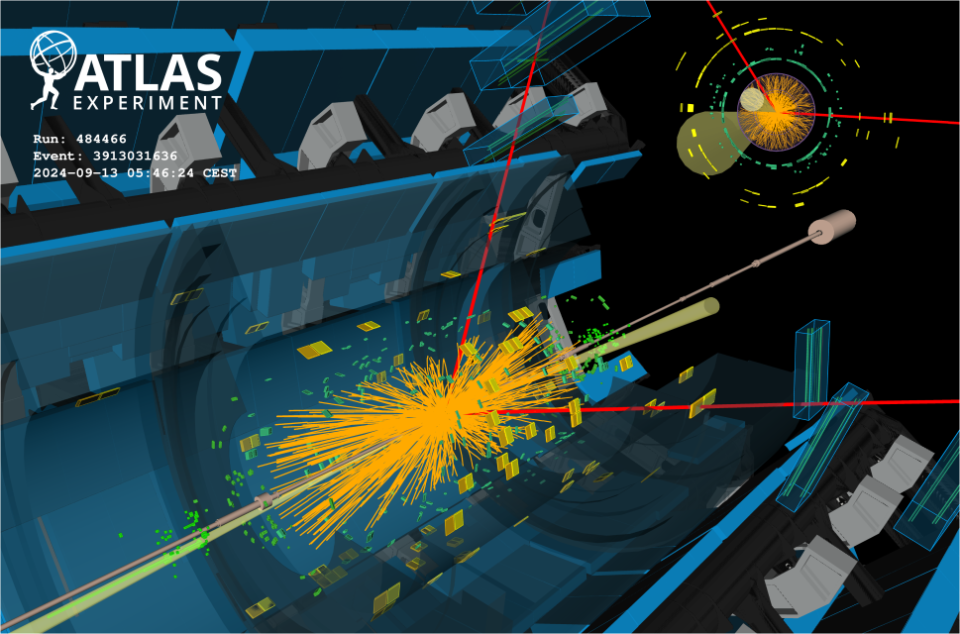
Event display of a candidate Higgs boson decaying to two muons (H→μμ), shown as red tracks in the detector. (Image: ATLAS/CERN)
Researchers from the University of Oxford have played a major role in one of the most precise studies yet of the Higgs boson – the mysterious particle that helps explain why everything in the universe has mass.
Working as part of the ATLAS Collaboration at CERN’s Large Hadron Collider (LHC), Oxford physicists have contributed to a landmark result showing the first evidence that the Higgs boson can decay into two muons (H→μ⁺μ⁻) – an incredibly rare process that happens in only about one in every 5,000 Higgs decays.
This discovery provides the first direct insight into how the Higgs field interacts with second-generation particles, helping scientists test whether the Higgs mechanism works the same way for all types of matter – not just the heaviest ones.
‘Uncovering a one-in-5,000 decay is a true testament to precision and dedication,' comments Professor Daniela Bortoletto. 'We are continuing on our path to revealing the Higgs' deepest secrets.’
A tiny signal in a sea of noise
To uncover this faint signature, researchers analysed data from both Run 2 and Run 3 of the LHC, representing more than 300 fb⁻¹ of proton–proton collisions at energies of 13 and 13.6 TeV. By combining these datasets, the team achieved an observed significance of 3.4 sigma (compared to 2.5 sigma expected) – strong evidence that the Higgs boson really does couple to muons as predicted by the Standard Model of particle physics.
Detecting this signal required extraordinary precision. The Oxford group has led global efforts to perfect muon identification, alignment, calibration, and momentum-scale corrections – all crucial to isolating this elusive decay. Their contributions underpin the analysis itself, which used advanced statistical methods to tease out the Higgs signal from the overwhelming background of ordinary muon-pair events.
Oxford at the heart of the effort
Current Oxford members Professor Daniela Bortoletto, Dr Eleonora Rossi, Weitao Wang, Chunhao Tian, and Yangfan Zhang (the latter two also affiliated with the University of Science and Technology of China) are key figures in this work. They are continuing a line of research shaped by former Oxford collaborators Giacomo Artoni, Siyuan Yan, Miha Zgubic, Luigi Marchese, Ricardo Woelker, and Yingjie Wei, who contributed to earlier stages of the analysis and to refining the ATLAS detector’s muon performance.
This milestone also reflects the long-term vision of Professor Ian Shipsey, whose leadership helped define Oxford’s central role in Higgs physics. Recognising early on the importance of the H→μ⁺μ⁻ decay as a precision probe of the Higgs sector, Professor Shipsey championed the development of the technologies and expertise that made this result possible.
‘The era of precision Higgs measurements is now in full swing,' comments Dr Rossi. ‘For us at Oxford and within the ATLAS Collaboration, this is an incredibly exciting time; each new result pushes the boundaries of our understanding and brings us closer to uncovering the full nature of the Higgs boson.'
The full results are available in the ATLAS physics briefing and the accompanying scientific paper.
Evidence for the dimuon decay of the Higgs boson in pp collisions with the ATLAS Detector, G Aad et al, Physical Review Letters, 135, 231802, 3 December 2025