

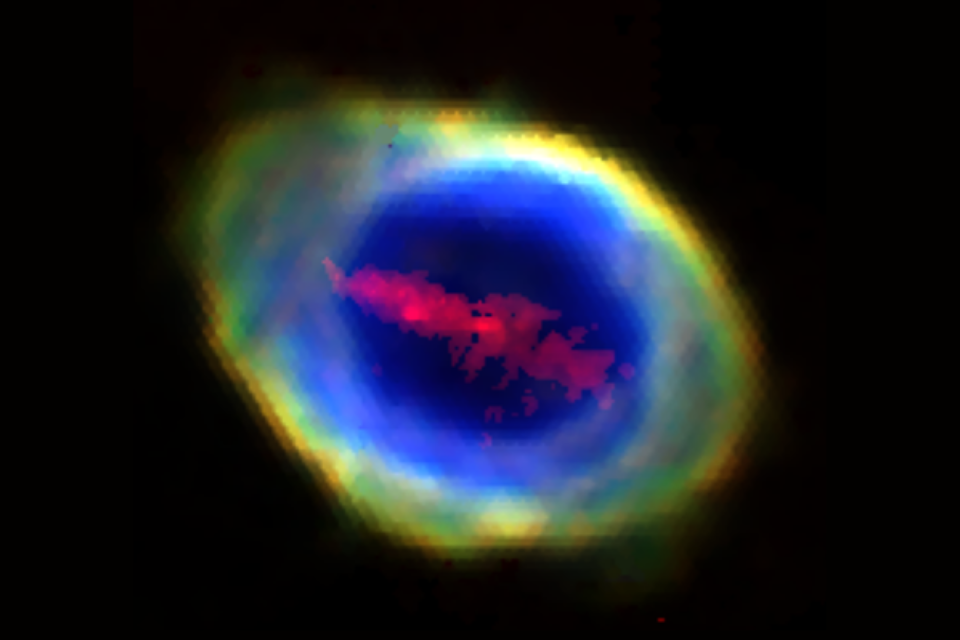
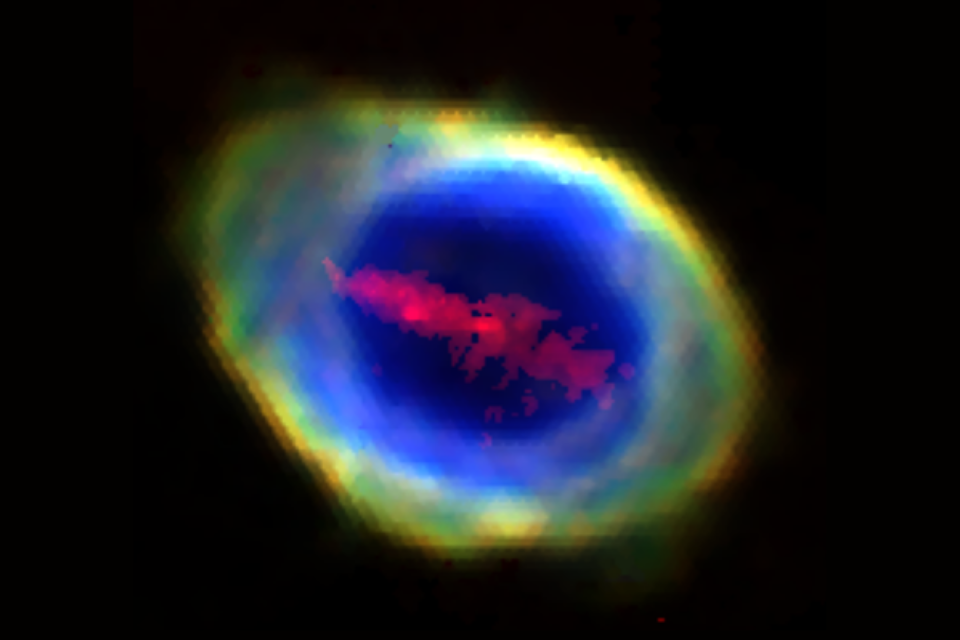
A composite RGB image of the Ring Nebula (also known as Messier 57 and NGC 6720) constructed from four WEAVE/LIFU emission-line images. The bright outer ring is made up of light emitted by three different ions of oxygen, while the ‘bar’ across the middle is due to light emitted by a plasma of four-times-ionised iron atoms. North is up and East is to the left in the image.
A striking and previously unknown bar-shaped cloud of ionised iron has been discovered at the heart of the iconic Ring Nebula. This is one of the first discoveries from WEAVE (William Herschel Telescope Enhanced Area Velocity Explorer), a pioneering astronomical instrument conceived, designed, and led by physicists at the University of Oxford.
The Ring Nebula, located roughly 2,600 light-years away in the constellation Lyra, is the glowing remnant of a sun-like star that exhausted its nuclear fuel and cast off its outer layers. Over centuries it has been imaged by successive generations of telescopes, including the James Webb Space Telescope, yet this narrow strip of iron atoms had eluded detection until now.
WEAVE’s Large Integral Field Unit allowed astronomers to obtain spectra continuously across the entire nebula, revealing its chemical composition in unprecedented detail. By effectively creating an image at every optical wavelength, the team uncovered a narrow bar of highly ionised iron running across the nebula’s interior—a feature never before detected. The iron bar spans roughly 500 times the distance of Pluto’s orbit around the Sun and contains an amount of iron comparable to the mass of Mars — a surprising find in what had been thought to be a well-understood object.
This discovery, published in Monthly Notices of the Royal Astronomical Society and led by researchers at University College London and Cardiff University, represent one of the first major discoveries from WEAVE’s five-year international survey programme.
The WEAVE project was led by Professor Gavin Dalton of Oxford’s Department of Physics, in partnership with an international consortium. Professor Dalton first presented the concept for WEAVE to the astronomical community at a Royal Astronomical Society meeting in 2010 and has guided the project from its earliest design stages through to full installation at the telescope.
WEAVE operates on the 4.2-metre William Herschel Telescope at the Roque de los Muchachos Observatory, La Palma. The William Herschel Telescope is the leading telescope of the Isaac Newton Group (ING), which in turn is part of the Roque de los Muchachos Observatory on La Palma, in the Canary Islands. The ING is jointly operated by the United Kingdom (STFC-UKRI), the Netherlands (NWO) and Spain (IAC, funded by the Spanish Ministry of Science, Innovation and Universities).
'The discovery of something new in such a well-known and well-studied object is an excellent illustration of the new capabilities provided by the WEAVE facility,' commented Professor Dalton. 'We are looking forward to many more discoveries as the survey programmes now commence in earnest.'
WEAVE imaging spectroscopy of NGC 6720: an iron bar in the Ring, R Wesson et al, Monthly Notices of the Royal Astronomical Society, Volume 546, Issue 1, February 2026