

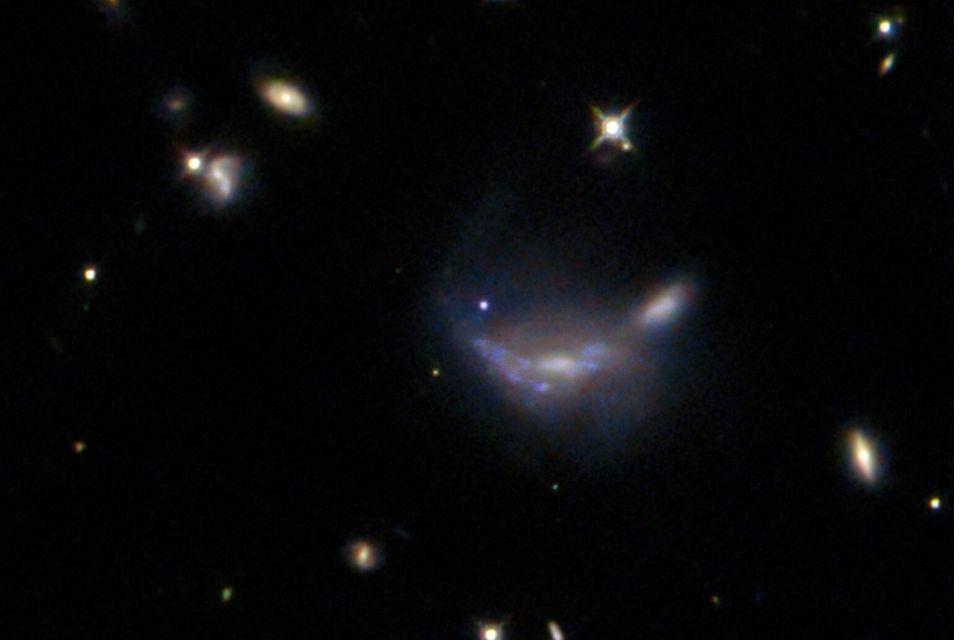
Type Ia supernova visible as a blue dot at the centre of this NASA/ESA Hubble Space Telescope image
A new international study has strengthened evidence that the expansion of the universe is still accelerating, addressing recent claims that had called one of modern cosmology's most important discoveries into question. The research, published in Monthly Notices of the Royal Astronomical Society, re-examines suggestions that subtle changes in the properties of Type Ia supernovae – exploding stars used to measure cosmic distances – could explain away the evidence for dark energy, the mysterious component thought to drive the accelerating expansion of the universe. Instead, the team finds that these effects are already understood and accounted for in modern cosmological analyses. The results show that the evidence for cosmic acceleration remains remarkably strong.
Lead author Dr Phil Wiseman from the University of Southampton said: ‘The previous and well-accepted measurements were, in fact, fine and our current understanding of the fate of the Universe remains robust. Thankfully we have averted this crisis, but the mystery about why the Universe is still accelerating remains. By proving our measurements are correct, we can get back to trying to understand what dark energy actually is, rather than wondering if it exists at all.’
The accelerating expansion of the universe was first discovered in 1998 using observations of Type Ia supernovae, a breakthrough that led to the 2011 Nobel Prize in Physics. Recent work had suggested that changes in the ages of the stars producing these explosions might bias cosmological measurements, potentially reducing or even removing the evidence for dark energy.
However, the new study demonstrates that the proposed effect is largely already captured through the standard corrections used in modern supernova cosmology. Associate Professor Maria Vincenzi from the Department of Physics at the University of Oxford and co-author of the study, has been working on Type Ia supernova cosmology for almost a decade. She said: ‘We have long known that the brightness of Type Ia supernovae depends on the age of the stars that produce them, but measuring those ages directly is incredibly challenging. Instead, we use indirect clues, such as the mass of the galaxies that host these explosions and already take into account for these effects.’
Co-author Professor Adam Riess, Nobel Laureate and one of the original discoverers of cosmic acceleration, comments: ‘Extraordinary claims require especially careful testing. What we find is that when we calibrate these supernovae, accounting for different host environments and stellar populations, the evidence for cosmic acceleration remains remarkably consistent.’
Dr Vincenzi concludes: 'Understanding how the environments of Type Ia supernovae affect cosmological measurements and galaxy evolution is a rich field of study and one that we hope will enable us to deepen our greater understanding of the universe. Our recent findings provide further confidence in the cosmological framework that has emerged over the past three decades and allow the research community to focus on one of the biggest unanswered questions in physics: the nature of dark energy itself.'
In the same journal issue, a paper led by the Tata institute of Fundamental Research, Mumbai with Professor Subir Sarkar from the University of Oxford questions the evidence for cosmic acceleration.
Still accelerating: type Ia supernova cosmology is robust to host galaxy age evolution, P Wiseman et al, Monthly Notices of the Royal Astronomical Society, 11 June 2026