

Researchers at the University of Oxford have demonstrated a new family of quantum superpositions in which each component is itself a highly exotic quantum state — an advance that extends the toolkit available for quantum computing, sensing, and error correction. The findings have been published in Physical Review X.
Quantum mechanics, unlike classical physics, allows objects to exist in more than one state at the same time. This idea is most famously illustrated by Schrödinger's cat: a thought experiment in which a cat is imagined to be both alive and dead until it is observed. While no real cat behaves this way, physicists can create genuine laboratory equivalents of this effect by placing atoms, light, or the motion of trapped particles into two distinct quantum states at once.
The most familiar version of such a ‘cat state’ uses components known as coherent states – quantum wave packets that behave as classically as quantum mechanics allows. The cat-like quality comes from placing two such components, displaced in opposite directions, into a superposition. In that standard picture, the two components are essentially copies of the same classical-like wave packet, separated in phase space.
In the new study, the researchers demonstrate a method for creating superpositions from a broad range of components that are themselves highly non-classical, thereby creating a new family of Schrödinger-cat-like states. These components need not be simple displaced copies of one another: they can differ in their intrinsic quantum structure, such as how their uncertainty is distributed or how they are oriented in phase space. The individual components brought into superposition, including squeezed, trisqueezed or quadsqueezed states, had previously been synthesised in the same trapped-ion platform. The new advance is to combine them coherently into programmable Schrödinger-cat-like superpositions, with control over the size, orientation, and separation of each part.
The experiment used a single ion of strontium-88 confined in an ion trap. Trapped ions are well-suited to this kind of work because they combine two different quantum systems in one: the internal electronic state of the ion acts like a quantum bit, or qubit, while the ion's physical motion along the trap behaves like a quantum harmonic oscillator – a system capable of occupying many different quantum states. By coupling these two degrees of freedom, the researchers could use the qubit as a control lever to shape the motional state.
To build the superpositions, the team first applied engineered interactions that entangled the ion's internal state with different possible states of motion. A mid-circuit quantum measurement of the internal state then projected the ion's motion into the desired superposition, disentangling the two systems without disturbing the motional state.
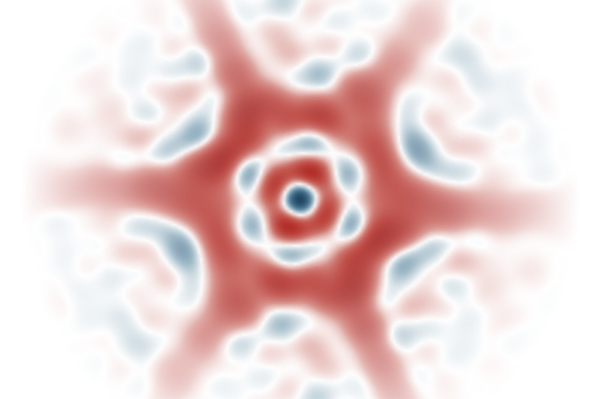
‘This approach gave us a tool to sculpt quantum superpositions into almost any shape,’ explains lead author Dr Sebastian Saner. ‘The states we produced exhibit rotational symmetries and form striking geometric interference patterns.’
Crucially, the technique gave the researchers programmable control. By adjusting the experimental settings, they could tune the relative size, phase, and separation of the components, or switch between entirely different types of non-classical state – for instance, combining a squeezed state and a trisqueezed state in a single superposition. The method works because the underlying interactions are unitary: they can be applied repeatedly within a single experimental sequence without destroying the intermediate state.
The team confirmed the nature of the states they created through a process called state tomography, which reconstructs the full quantum state from a series of measurements. The reconstructed states displayed interference patterns and regions of negative values in a mathematical representation called the Wigner function – signatures that the states are genuinely quantum and cannot be described as ordinary classical mixtures. For a given average energy, the new superpositions were found to exhibit greater quantum resourcefulness than standard cat states or Fock states, a property relevant to their usefulness for quantum computation.
'We were really encouraged by our colleagues' reaction when we showed them what we had made,' says study co-author Dr Raghavendra Srinivas, also from the Department of Physics at the University of Oxford, who supervised the work. 'We believe we're still scratching the surface of what's possible, both for practical applications and for understanding these states at a more fundamental level.'
This work opens a route towards richer continuous-variable quantum technologies, where information is encoded in oscillator-like degrees of freedom rather than only in two-level quantum bits. Such states could become useful resources for bosonic quantum error correction, while also providing a new platform for exploring how far quantum behaviour can be pushed beyond familiar classical intuition.
Generating arbitrary superpositions of nonclassical quantum harmonic oscillator states, S Saner et al, Physical Review X, 3 June 2026.