

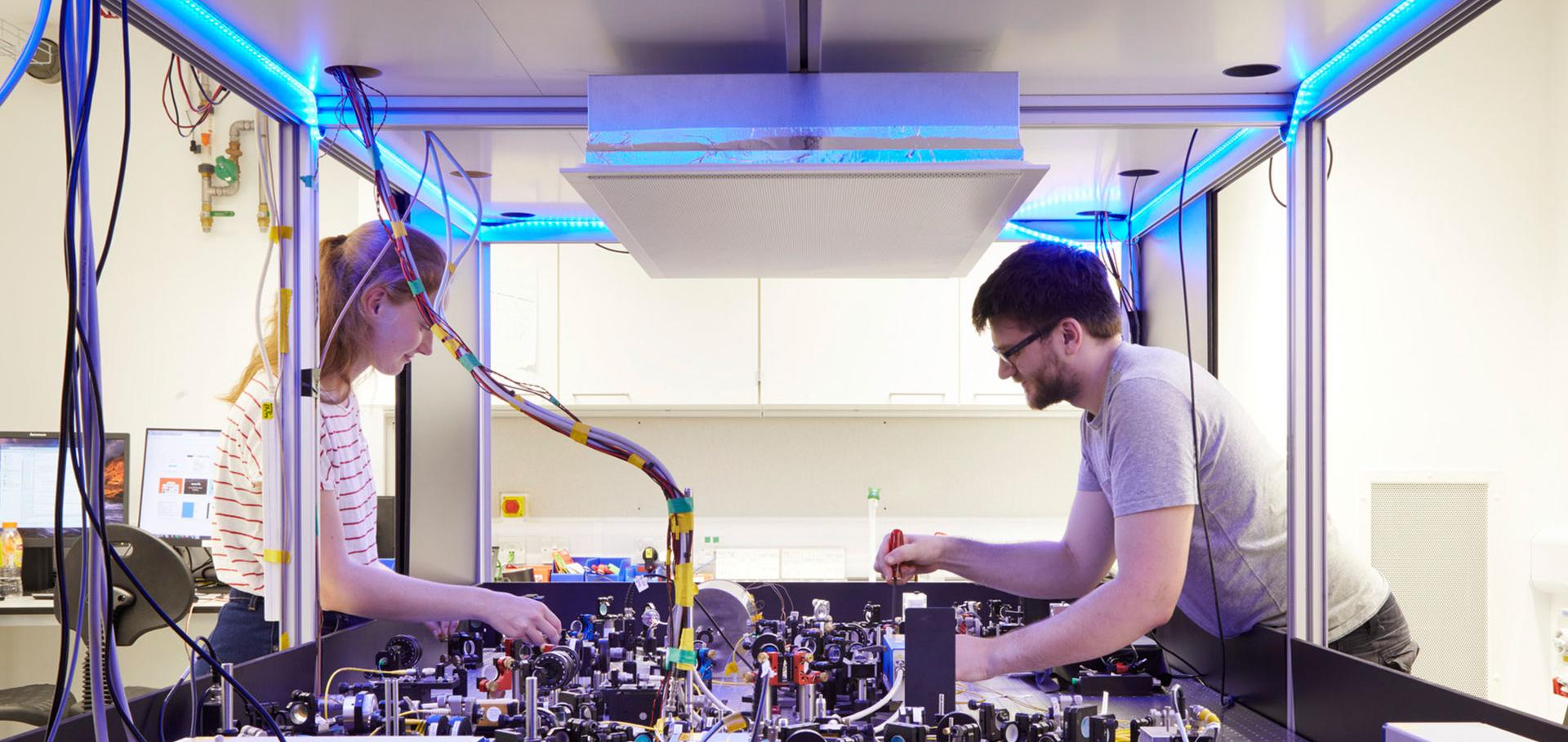

I have worked with trapped ions for more than a decade and have come to appreciate them as a uniquely powerful platform for experimentally exploring quantum physics. While my PhD work initially focused on quantum computing, my research interests have since expanded significantly to include quantum-enhanced metrology and fundamental quantum optics.
I began my PhD in 2013 at the University of Colorado, Boulder, joining Dave Wineland’s group. My research focused on developing new techniques for entangling ions without lasers, leading to one of the highest-fidelity entanglement demonstrations across any physical platform. In 2020, I joined David Lucas’ quantum networking experiment at Oxford, where we demonstrated the first network of entangled optical atomic clocks. I was subsequently awarded an EPSRC Quantum Technologies Career Development Fellowship to advance these proof-of-principle experiments towards practical quantum enhancement. I was also an Early Career Fellow at Balliol College from 2022–2025.
In parallel, I have continued to expand my research in quantum computing. At the University of Oxford, we explore laser-based quantum information processing, including new benchmarking protocols and novel types of entangling gates. Alongside this, I continued my PhD work part-time at Oxford Ionics, contributing to the development of large-scale quantum processors through new techniques for individual ion addressing and benchmarking, and achieving record-breaking fidelities.
Alongside this applied work, I have pursued more fundamental research in quantum optics. Building on my exposure to squeezing during my PhD, we have explored generalised squeezing interactions, including the first realisation of a fourth-order quadsqueezing interaction on any platform. We subsequently extended this technique to generate arbitrary superpositions of nonclassical states, opening up new opportunities to explore quantum optics in previously inaccessible regimes. In recognition of this work, I was awarded the Optica Hänsch Prize in Quantum Optics in 2024.
In 2026, I was appointed as an Associate Professor at the department alongside a Tutorial Fellowship at Balliol college.
Finally, I view outreach as an integral part of my scientific leadership and career. In 2022, I helped to found an annual week-long summer school with the National Quantum Computing Centre to widen participation in quantum technologies for underrepresented students. Ultimately, I want others to have access to the same opportunities that I have been privileged to enjoy. I am always keen to explore new outreach opportunities and welcome ideas or collaborations.
You can also read more about me here - https://physicsworld.com/a/ask-me-anything-raghavendra-srinivas-experimental-physics-is-never-boring/
And my full publication record is available on Google scholar - https://scholar.google.com/citations?user=JsZAdv8AAAAJ&hl=en